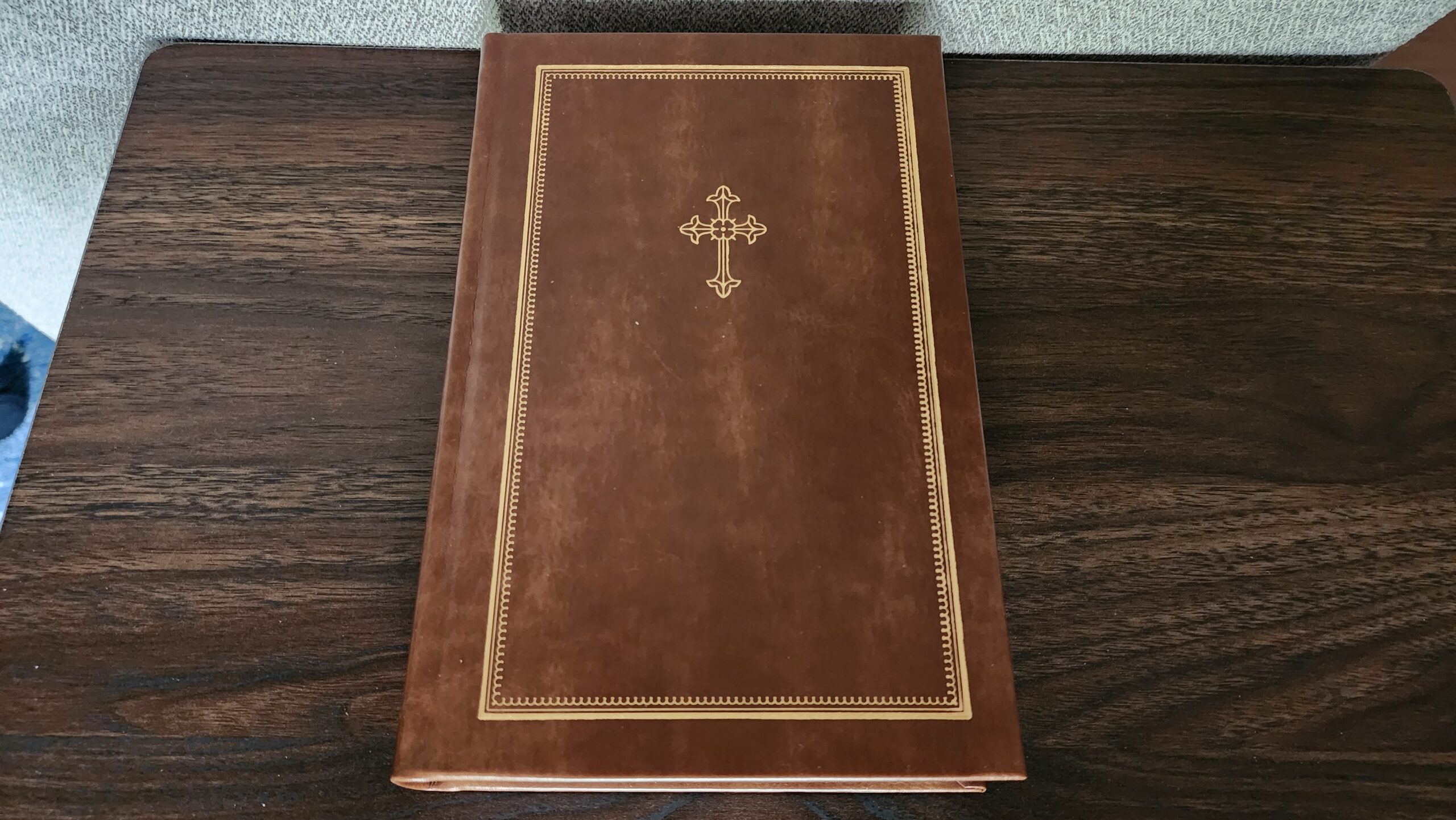
Tyndale just published a new NLT-CE Gift Edition Bible, and I received my pre-ordered copy from Amazon. My first impression is that it is essentially a smaller carbon copy of the original hardcover NLT-CE with a nicer imitation leather-wrapped cover. In fact, the pages are completely identical. I checked various parts of the Bible, and when I turned to the same book and chapter in each edition of the NLT-CE, the page layout was exactly the same. Disappointingly, the new Gift Edition also has a glued (not sewn) binding, just like the old hardcover edition.
Physical Construction
The Gift Edition is noticeably smaller than the original Tyndale NLT-CE (quite similar in size to my hardcover Cambridge REB with Apocrypha). Here is a photo of it on top of a stack of other Bibles for comparison:
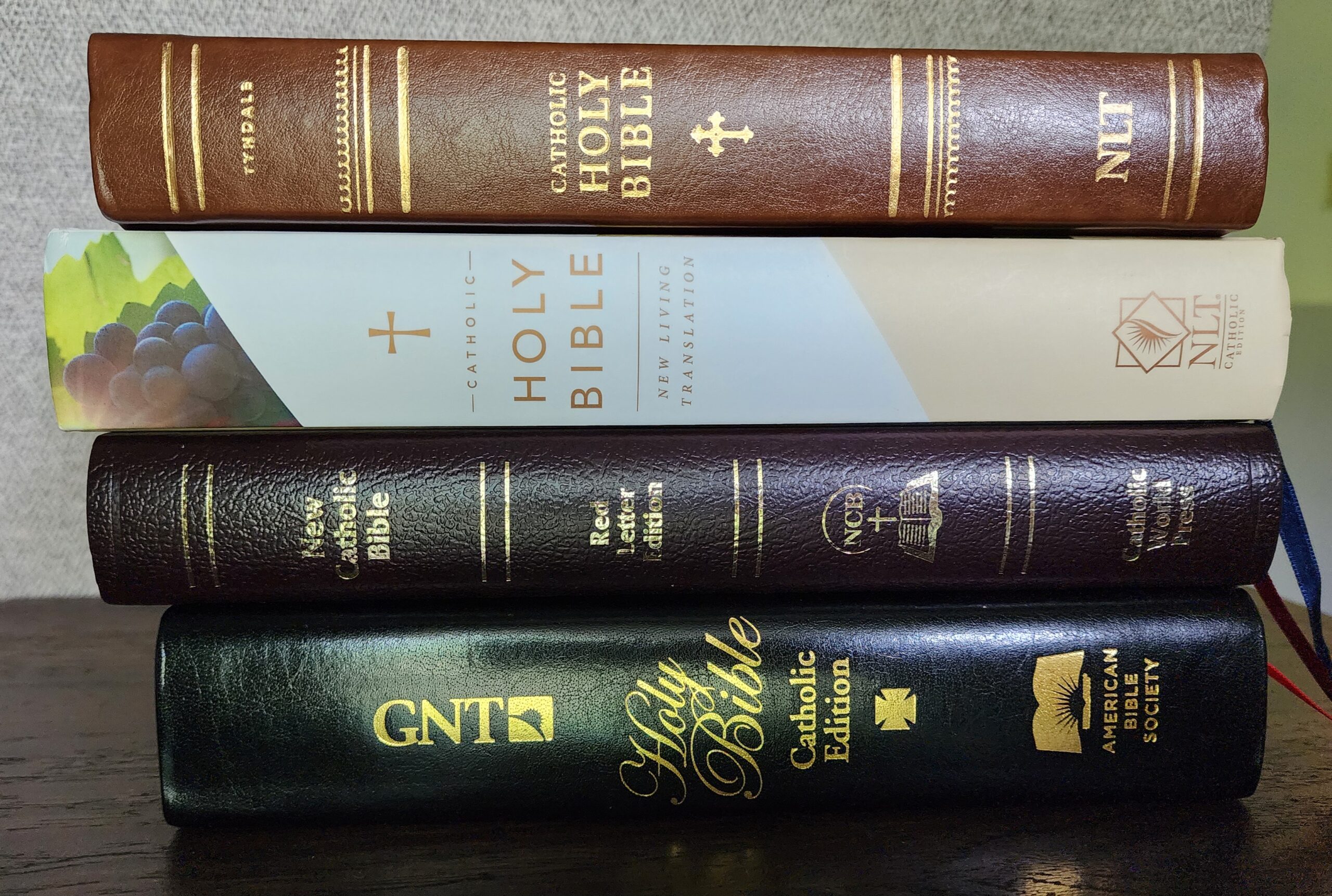
The exterior dimensions are approximately 5 5/8 X 8 5/8 X 1 3/8 inches. It has plain white paper with no gilding or colored edges. The binding is glued, and there are no ribbon markers (unlike the hardcover edition, which has a single ribbon).
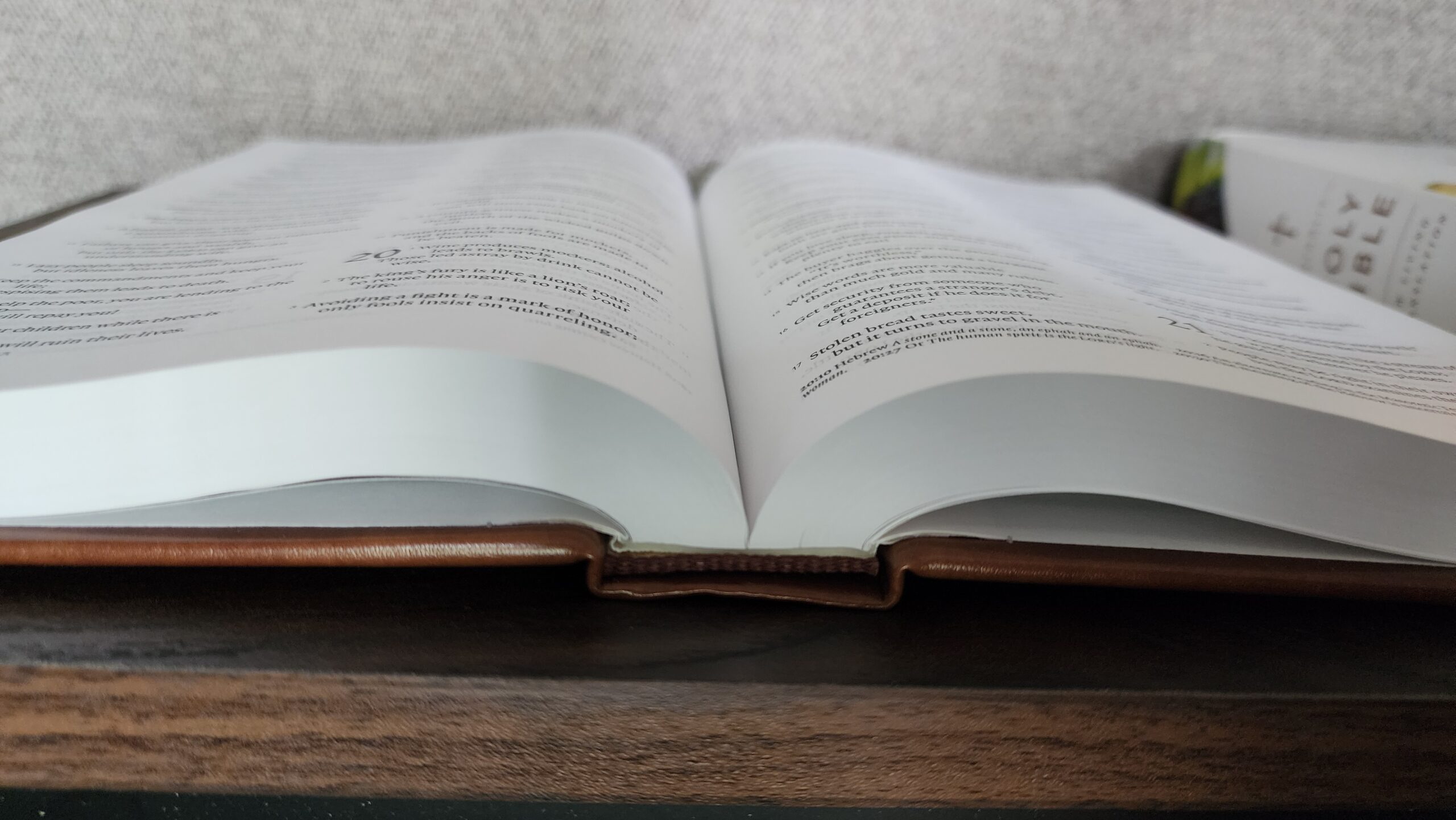
The paper is brighter white in the gift edition compared to the old hardcover, and ghosting is minimal and unobtrusive, even though the text is not line-matched. I don’t think ghosting will cause any difficulty with reading this Bible.
Page Layout, Font, and Typesetting
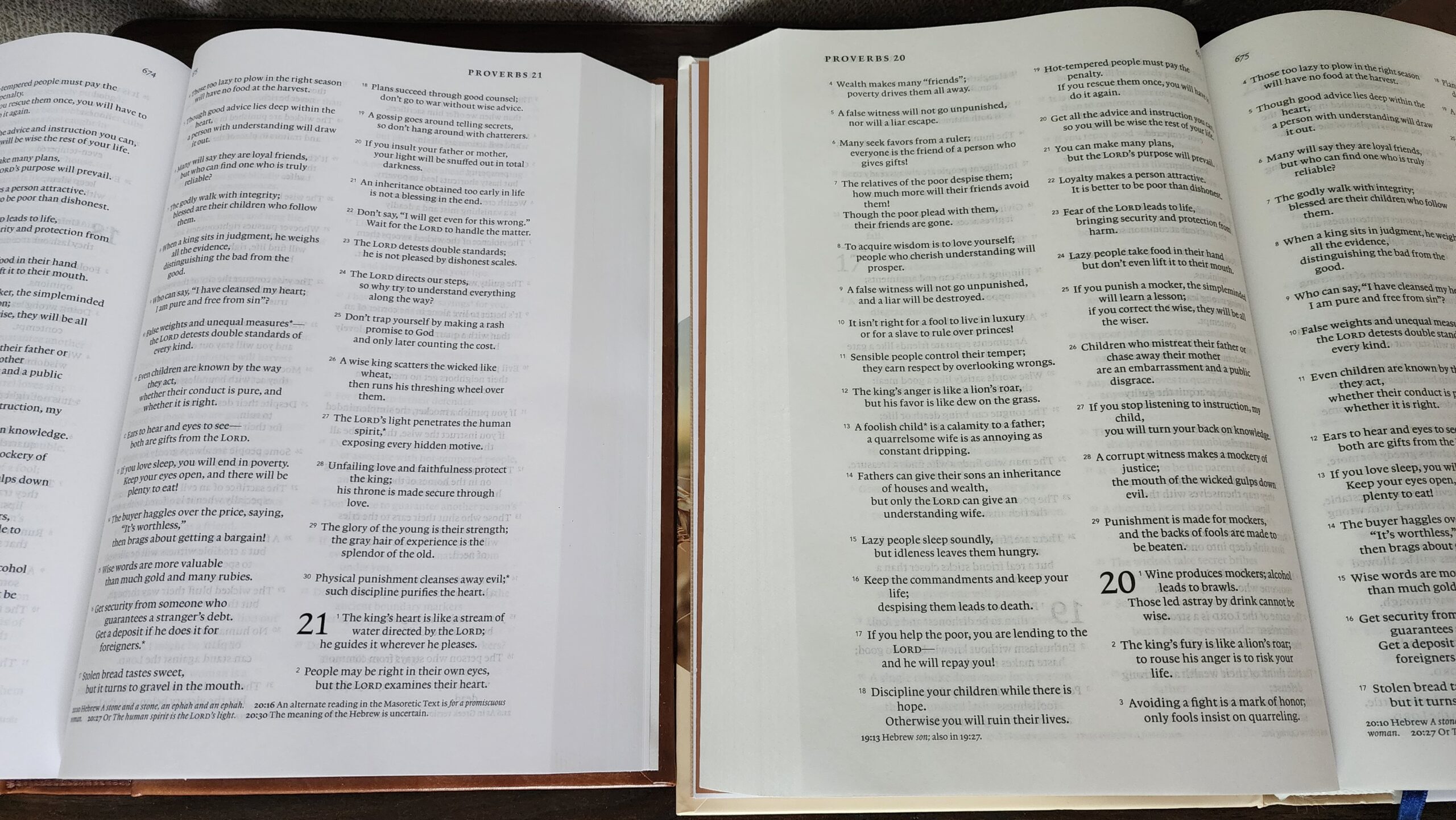
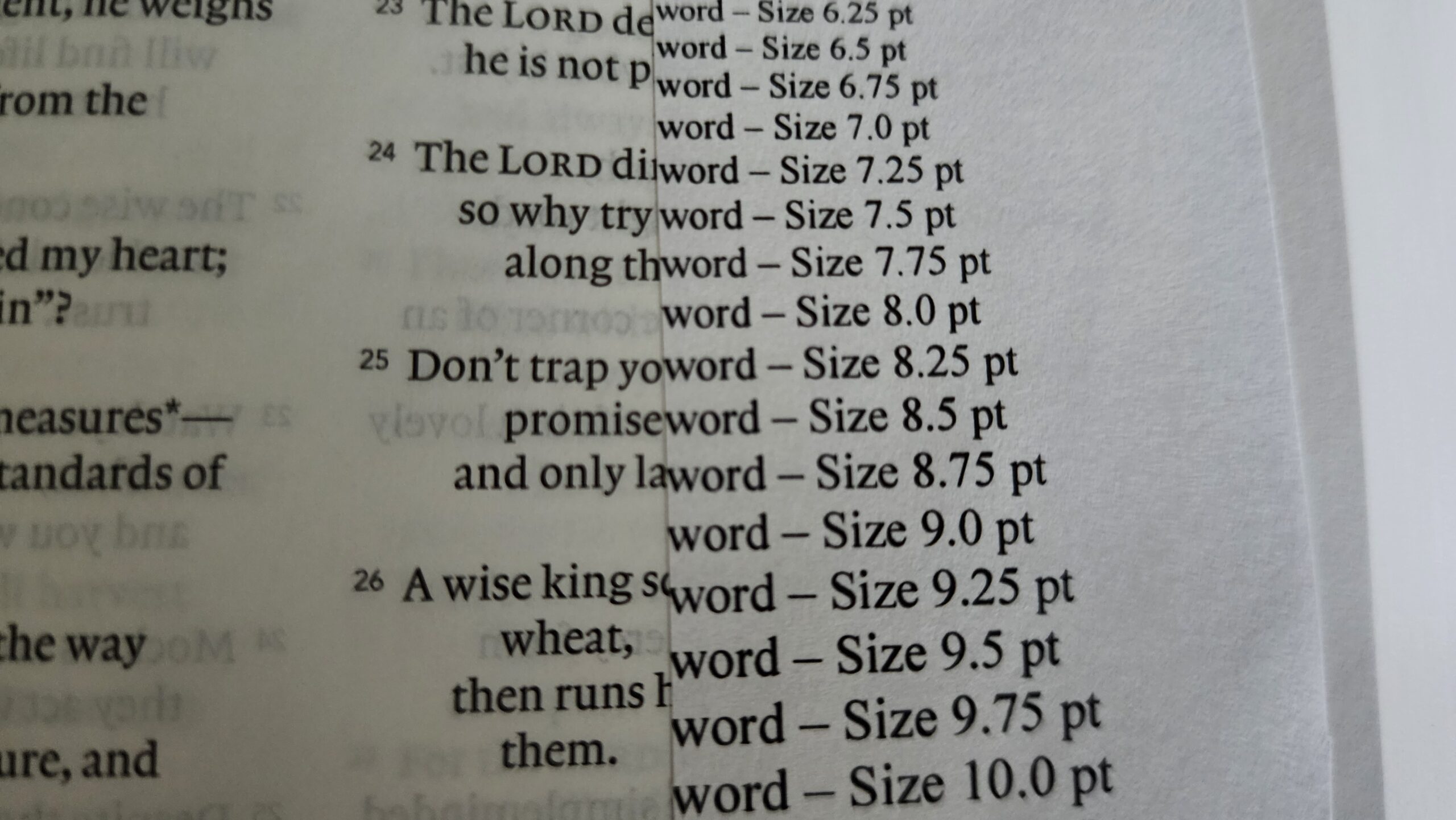
I was surprised (and somewhat disappointed) to find that the page layout is a scaled-down carbon copy of the layout in the old hardcover edition. There is nothing new about the style. Both Bibles are printed in double-column format with brief introductions to each biblical book. The font size is listed as 8 pt. According to my homemade font size comparison sheet, it is equivalent to approximately 8.25-8.5 pt. Times New Roman:
Conclusion
To my mind, the main benefit of this edition (compared to the hardcover) is the smaller, more portable size. I like the form-factor. It’s easily portable. And I consider the lack of gilding to be a positive. For a portable edition, gilding makes me think twice about putting a Bible in a backpack or taking it out of the house for fear that the gilding will get scraped and dinged. I also like the feel of the imitation leather. It definitely looks and feels nicer than the original hardcover. But if you already own the original hardcover, it’s hard to justify getting the Gift Edition. The page layout is identical, and the font is smaller in the Gift Edition. I’m disappointed that the binding is glued, and I was hoping for a different page design or layout which would offer more variety for people to choose from.
The NLT-CE is a Bible I always forget exists. I seldom hear about it in Catholic circles, and even the original NLT seems like the Protestant Bible that slips through the cracks (compared to the ESV, NKJV, CSB, NASB, NIV, etc.).
Thank you for this review. I have grown to really appreciate the NLT CE over time, and it has become my main translation for devotional reading. The Kindle Catholic addition is great and very easy to navigate compared with my other Kindle Bibles (NRSVUE and RNJB). I wanted a nice physical edition of the NLT to read from so ended up purchasing the schuyler quentel which I love (but it’s sadly lacking deuterocanonical books). I’m in my early 50’s now so an 8 point font just wouldn’t work for me – the Quentel is a more comfortable 10 point font.
Glad you’re liking the NLT Quentel! A year or two ago, I emailed Schuyler to ask if they would consider printing an NLT with Apocrypha. They said they don’t have plans for it, but they will keep the suggestion in mind. Most likely, there isn’t a lot of interest, but for anyone who would be willing to purchase a Schuyler NLT with Apocrypha, it’s worth emailing Schuyler to register your support.
Thanks Marc, I will email them too. By the way Tyndale have published the updates to the text of the 2015 version: https://sites.tyndale.com/nlt/2015-new-living-translation-updates/
Which would I think include the contributions from the Bishops of India.
I still have my doubts that the “New Living Translation” is even a translation at all; many observers have suggested it is really nothing more than a modest revision of the 1971 paraphrase text.
BC, I trust your take on this kind of thing and know you don’t pull punches. Your post reminded me of something similar I have been wondering about. How much actual translation do you think went into the making of the RSV2CE and the ESV? I have spent months trying to find the video again, but I saw someone show how one reading in the ESV was based on a misunderstanding of an RSV textual note–suggesting they had just flown in a footnoted passage and were not careful about it. (I think it was from an R Grant Jones video.)
Regarding the NLT and Living Bible I think a better comparison could be made to the relationship that the New Jerusalem Bible has to the Jerusalem Bible. I think overall the NLT is a fine translation and I enjoy spending time with it. I’m not sure about how much translation work went into the RSV2CE, I like it very much but it’s surely a very light touch revision of the RSV? I don’t know very much about the ESV, although being based in the UK I hear it in Mass every week. I’m a bit less keen in the ESV compared to the NRSVUE and RSV2CE – it just doesn’t read as well to my ears.
Minimal, very minimal. There have been changes in a few hundred places since the first publication in 2001, but the 2001 ESV is estimated to be around 98% identical to the 1971 RSV. Moreover, it was completed in an astonishing amount of time, first commissioned in September 1998 and published in October, 2001; it seems that an actual translation ought to take a little longer than 3 years.
I sometimes wonder if I’m missing something by confining myself to two main traditions in engaging with scripture (RSV/NRSV/ESV and JB/NJB/RNJB) and sometimes engaging with the DR, NABRE, NCB and even Nicholas King’s quirky translation. Perhaps life is too short! I made a personal rule some time ago not to buy Bibles that only have the Protestant canon but I have wondered about the NLT given that there’s a CE option. With this publication I wonder who the marketing people at Tyndale are seeking to appeal to, especially as they don’t seem to have made much effort with the quality of the offer. No one has really heard of the NLT on this side of the Atlantic.
I must respectfully disagree with NLT CE naysayers. First, there is absolutely no comparison between the Living Bible Paraphrase and the NLT -CE. A verse to verse comparison easily shows the vast differences. Are there translation issues? Of course there are. As there are with every single Bible translation. There’s no such thing as a “perfect” translation. That’s just a simple fact. Second, The Living Bible Paraphrase was the work of one man – Ken Taylor. The NLT-CE had dozens of translators and experts involved. The process was rigorous. I personally know several of the translators. They are men of high intellect and integrity. Third, could it be better? Yes. The marketing has been less than exciting. It’s almost as if the evangelical Tyndale House is afraid of the conservative blowback from having a Catholic Bible in their stable. But more sales might mean they could improve the presentation: leather cover, sewn binding, even gold page gilding. I am personally quite happy with this Bible. Should they or someone else publish a more premium edition, I might buy it. But until then, I will gladly use this one.
Right now, Tyndale’s most “premium” NLT-CE Bible is in their Inspire line (“The Bible for Coloring & Creative Journaling”). If you want a smyth-sewn NLT-CE from Tyndale, this is where you’ll find it. If you want a large-print NLT-CE, you’ll also have to go to the Inspire line. I don’t think Tyndale is worried about blowback from Evangelicals for printing a Catholic Bible (unlike Crossway and the ESV), I think they’re just worried about the size of the market, so they’re (very) slowly expanding into it. After all, the Reader’s Edition used to be their only NLT-CE offering. I don’t think there will be Catholic editions of the full-range of Tyndale’s devotional Bibles, but there will ultimately be more, probably in the areas of Premium and Large Print. Tyndale will be releasing a One Year Bible of the NLT-CE in October.
Where is this printed? The hardcover was from LEGO in Italy if I recall.
The cooyright page of the Gift Edition says “printed in the United States of America.” My copy of the hardcover says “printed in Italy,” but it doesn’t specify LEGO as the printer.
The 2CE primarily updates archaisms (thee/thou) and some older vocabulary (babe/baby, travail / giving birth, and some things like that); it switched out a handful of Masoretic readings to the footnotes in favor of LXX readings (Isaiah 7:14, Psalm 2:12, Psalm 110:3, etc); and, it made some amendments for liturgical suitability (cup/chalice, moving “and fasting” into the main text of Mark 9:29, and moving a handful of other received readings back into the main text from the footnotes). It’s definitely not a new “translation,” but a light revision of the RSV-CE. In my mind, it’s the “definitive” and far-and-away best edition of tbe RSV over all.
(source: reading through the RSV1971 and 2CE cover-to-cover many times).
Yes, the RSV2CE is the best RSV available, although I still go back time and again to the New Oxford Annotated Bible published in 1977, which accompanied me through university although the NRSV was making headway at that time. I sometimes wonder how the RSV2CE might have differed if it had utilised NOAB as its base text. We’ve now adopted the ESV-CE for the lectionary in Britain but I still go back to the RSV2CE for devotion and study. There’s life in her yet!