The most common complaint about the New American Bible family has been its notes. If you have spent any time on the Catholic corner of the internet in the last 30 years, you probably do not need me to summarize the gripes. The notes are damaging to faith. The notes do not apply themselves to the life of the believer. The notes are poorly formatted. If you believe Trent Horn, some of them are even “cringe”.
Back in 2011, Mary Sperry confirmed on Catholic Bibles Blog that all editions of the NABRE needed to include the notes, with very limited exceptions like parallel Bibles. Early in this century, Oxford figured out one way around this problem by exiling the notes and cross references to the end of each book of the Bible, making the references useless but the notes harmless. Until the advent of the black spined, white covered Harper One NABRE in late 2012 (now printed by the Catholic Bible Press), those Oxford editions of various sizes had the best page layout the NAB and NABRE.
As I was comparing the Confraternity and NABRE translations of Genesis for the most recent entry of the NABRE Farewell Tour, I noted that the Confraternity’s annotations were written from a place of faith seeking understanding, rather than from a historical-critical stance. I thought to myself that if the entire Bible been annotated in this way, the NAB’s stock would be way higher among the opinion-havers of the Catholic internet, and probably with the regular folks too.
I bring up regular folks, because this stain on the NAB’s reputation is not just on the internet. I remember getting sneered at when I took a NABRE out of my bag at a parish event around 2017. “Oh, you brought a Jesuit Bible,” the man next to me said with a sneer to which italics do not do full justice. “If you really want to study the Bible,” more than one person has told me in an attempt to be helpful, “you will use the RSV.” Not everyone would agree, but I am of the opinion that since the release of NABRE there is no appreciable difference between the RSV and the NAB as a text for study. To go even further, since I have been writing weird little articles for this blog, I also know that in some places, the NABRE is more literal than the RSV. (Mary Healy agrees with me on this one.)
So why aren’t more people using the NABRE for study? The problem simply must be the notes. Or perhaps the issue is only a few notes which are egregiously bad and spoil the whole bunch. If only there was an edition of the NABRE with more faithful notes.
What if I told you the NABRE we were looking for was released in 2015, but nobody cared?
The Didache Bible
At the start of that year the Midwest Theological Forum had a hand in two editions of The Didache Bible. The project was subtitled “With Commentaries Based on the Catechism of the Catholic Church”, and as they say, it does what it says on the tin. In the foreword, the late Cardinal Francis George writes, “it is ideal for students and those participating in Scripture studies as well as those who seek to contemplate the Word of God in prayer.” One edition, released in collaboration with Ignatius Press, had this commentary keyed to the text of the RSV-2CE. The other, which I will be examining today, was published by the MTF themselves and had the NABRE text.
First off: How many of you were aware at the time that the Didache Bible even had a NABRE edition? Eleven years ago, I was in my late 20s and often went to young adult events put on at the Dominican order’s parish in Providence. I recall seeing the green hardcover around in 2015 and 2016, usually held in the arms of an earnest and bespectacled young man. I recall people saying the “Didache Bible”, sometimes even pronouncing it correctly, and always meaning the RSV-2CE edition.
I used to own a copy of that exact edition. I even reviewed it in an oblique manner more than four years ago on this very blog in a post where I used a number of different resources popular among the self-consciously orthodox crowd to examine the parable of the pounds in Luke’s Gospel, known in the NABRE as the parable of the ten gold coins. I left the experience of writing that article with a deep respect for the Didache Bible. I kept it for a while, but donated it to a religious education classroom a year or two ago.
I wish I still had it for the purposes of this article, though, because I would love to juxtapose that lithe forest green book with the chocolate brown monster on my desk. Note in the photo below that the ribbon markers are aftermarket. This book did not come with any ribbons, and I have recently discovered how cheap it is to get adequate ribbons that fit into most books for which I would want ribbon markers.
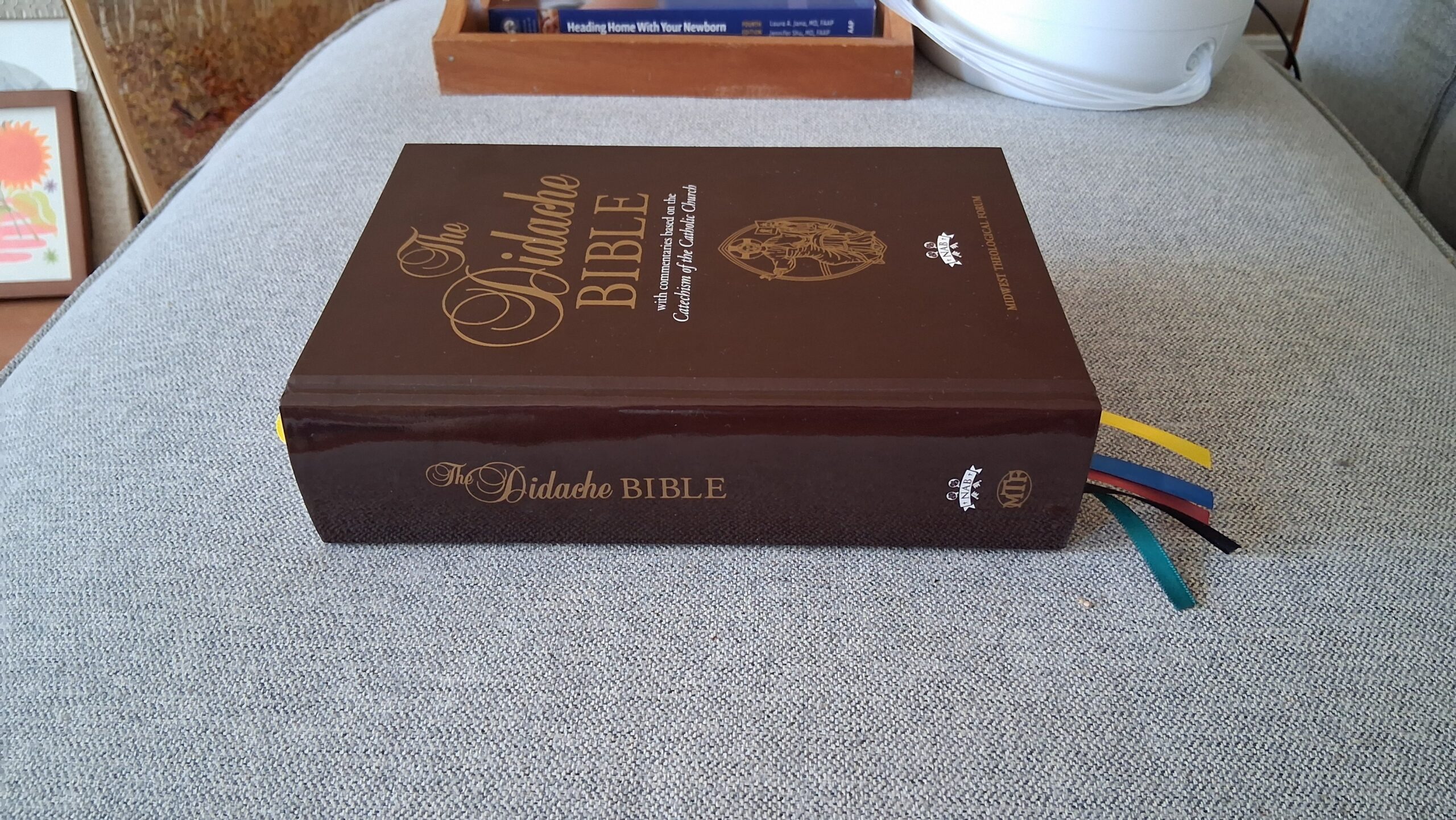
For us to compare the Ignatius and NABRE editions, data will have to do. Their covers have the same dimensions: 9.25 inches tall and 6.25 inches wide. But while the Ignatius edition is 1.75 inches thick according to the internet, I measure the NABRE edition at 2.5 inches; more than 40% thicker. According to Amazon, the RSV-2CE edition is 3.2 pounds, while the NABRE edition is 4.43 pounds. When I worked construction for a summer after college, one fact I learned that has stuck with me is that ordinary bricks weigh 4 to 5 pounds each. This thing is a brick in at least two ways of speaking!
As you probably have already deduced, the notes and introductions to the NABRE weigh just short of one and a quarter pounds. They are all here. Every last one of them. Even the one that makes you mad is here.
Here is what I found when looking at the Ignatius edition four years ago in my study of that parable from Luke 19:
The Parable of the Pounds emphasizes that the Kingdom of God, being spiritual, dwells in the human heart. Its foundation and expansion rests on generosity and the faith-filled response to his gratuitous infusion of grace received at Baptism. This grace is intended to grow through deeds of charity, and, as it grows, the love of Christ flows into the hearts of others. Although God-given gifts and opportunities are not distributed equally among all people, each of us is required to use and develop our talents and opportunities well in the service of God and neighbor. Ultimately, the Lord will ask us for an accounting of our deeds and our growth in holiness initiated by our baptismal grace. (CCC 1879-1880, 1936-1938, 2402)
In the NABRE edition, this note is exactly the same. In its substance it obviously would be, but its choice to retain the name of the parable as the Parable of the Pounds is one I find interesting. This is not the Parable of the Prodigal Son we are talking about here—this is a parable without a fixed name in the public consciousness. Having done an internet search with the terms parable Luke 19, I saw names like The Parable of the Ten Minas or the Parable of the Ten Coins or the Parable of the Ten Gold Coins (as the NABRE renders it). The King James lineage from the Authorized Version all the way down to the NRSVue has it as the Parable of the Pounds, but the name has not stuck in the culture. (I do recall four years ago that the use of “pounds” was one of the renderings that made me feel the RSV seemed a bit old-fashioned compared to its cousin the ESV.)
From having spent a week or so with this Didache Bible in its NABRE edition, I can report that I found nothing different whatsoever in the Didache introductions, nor did I find any difference in the 106 full page apologetical explanations that are peppered throughout the text. The only differences in the notes are small ones: thankfully, direct references to the text were keyed to the NABRE in this edition. In the parable discussed above, there is a note that the Greek behind the term “gold coins” was a particular coin called the minas. In the RSV-2CE edition, they mentioned that “ten pounds” was literally “ten minas”. (I cannot help but feel that the RSV using “pounds” here is yet another example of translations getting a free pass to be as loose as they want, as long as they are loose in the way the KJV was. Just imagine how we would howl if an American translation used “dollars” for minas. Perhaps Eugene Peterson already has done this.)
That being said, within the note itself, the parable is referred to as The Parable of the Pounds. This reinforces my suspicion that the Ignatius edition of the Didache Bible was considered the normative version and the NABRE edition was an afterthought. Whether or not this is true, I wonder why the Midwest Theological Forum thought they needed two editions of this. What other Catholic study resource is available in two translations? Not the Great Adventure Bible, not the Catholic Study Bible, or the Ignatius Catholic Study Bible, or the Navarre Bible; not Paulist Press’ Catholic Prayer Bible, nor The Word on Fire Bible. It is a mystery to me why this was necessary, unless the MTF wanted to give NABRE readers some notes more applicable to the life of the believer. If this is so, I thank them for this service.
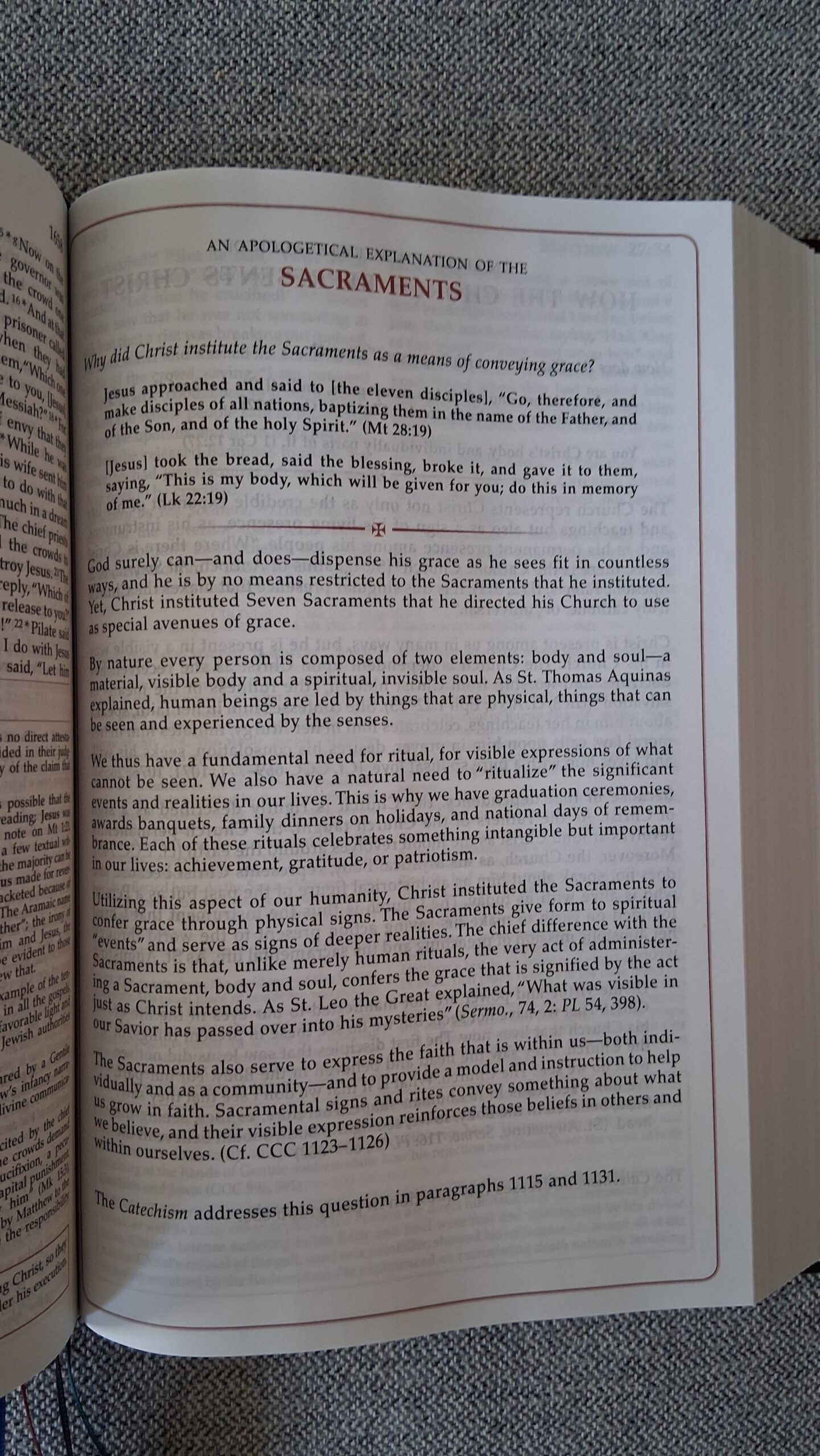
If you are unfamiliar with the either edition of the Didache Bible, here are some photos of some distinctive features. Here, take in the tone of an apologetical explanation:
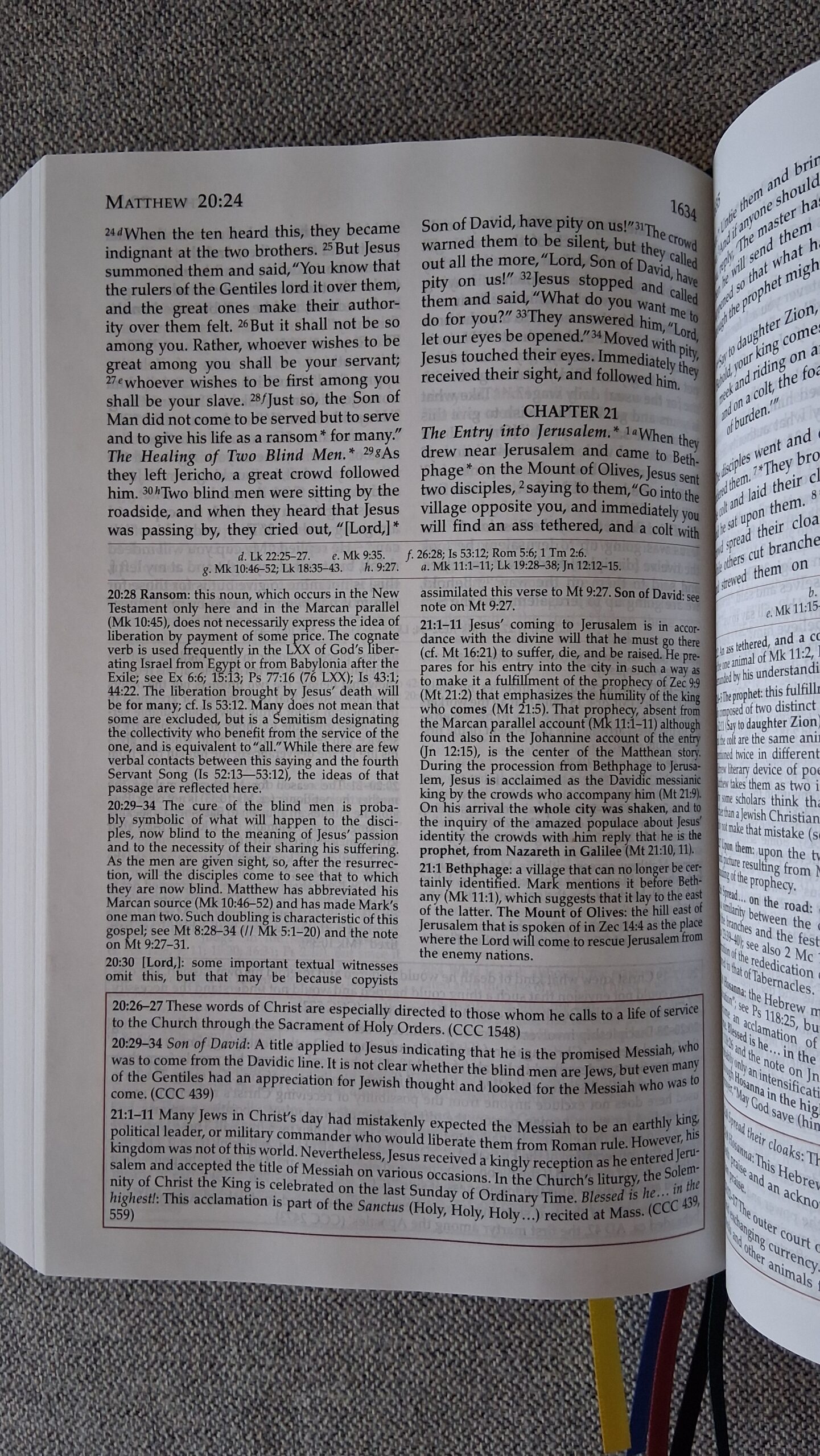
…and now a page with some notes. Notice how the NABRE notes and cross references are present alongside the Didache notes…
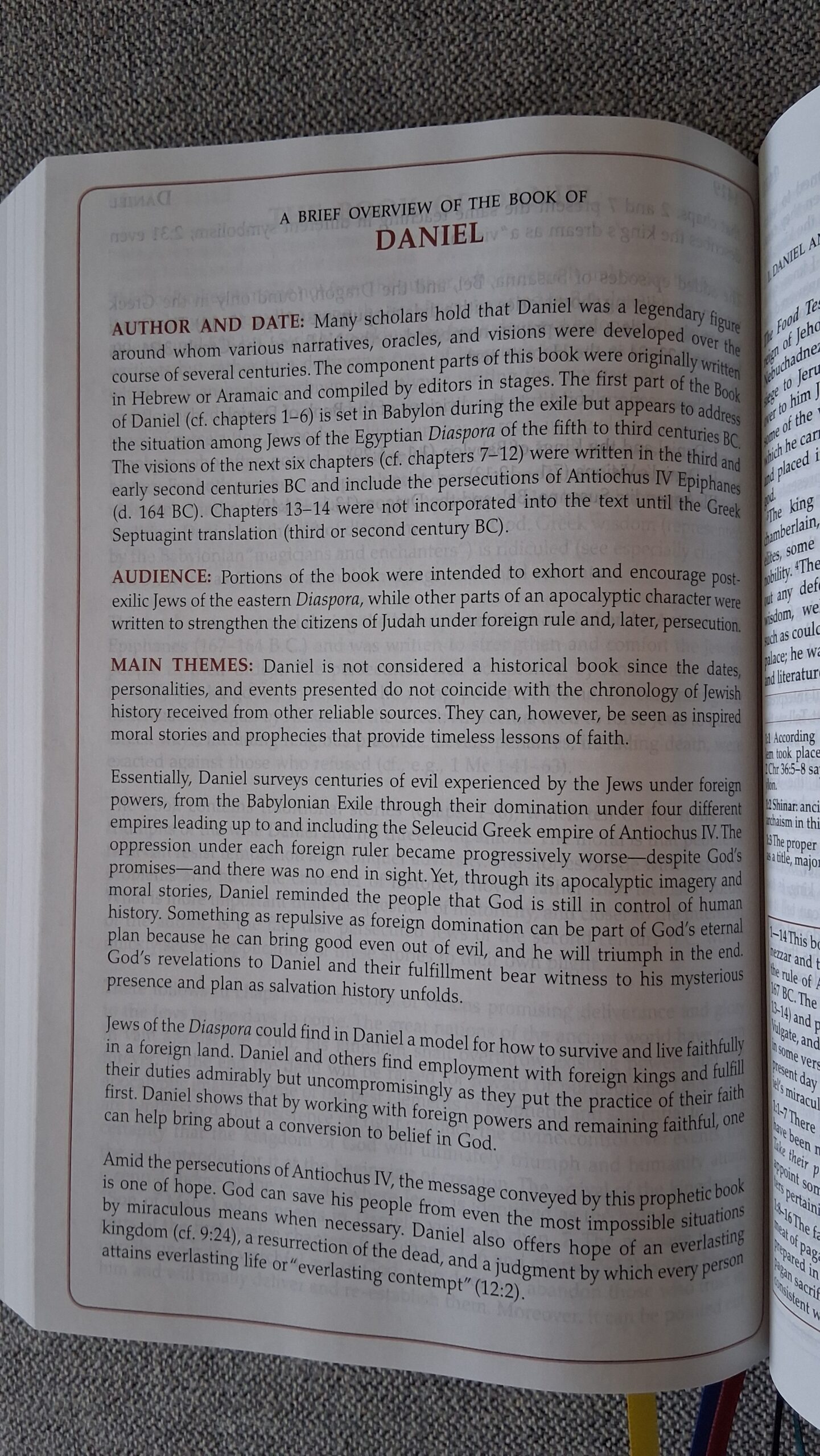
…and a book introduction:
Appraisal of the Didache Bible’s Study Materials
I chose the Book of Daniel’s introduction not only because I am reading that book currently, but because it had been a long while since I had given my full attention to a Didache Bible introduction and I wanted to see if there would a marked difference in the dating of the book between this introduction and the NABRE one. I found a difference, though not a large one. The Didache introduction notes that the background of the book’s first six chapters is the circumstances of Jews in the Egyptian diaspora from the 5th to 3rd century BC while the apocalyptic visions which begin in chapter 7 were addressed to the Jews of the homeland in the 3rd and early 2nd century BC. The NABRE introduction does not make a distinction between the backgrounds of the two major units within the book and limit their theorized context to the persecution of Antiochus IV Epiphanes in the 160s BC.
The traditional view that Daniel himself wrote the book bearing his name in the 6th century BC has not held up to a linguistic study of the Hebrew and Aramaic text, and is almost extinct among scholars. Still, I had reason to wonder if the Didache Bible might give some credence to the older view: In the ample introductory matter to this Bible, which boasts of a short guide on reading the Bible and a list of scriptural passages for meditation, there is an Old Testament chronology which places the events of Genesis in the 18th-17th Century BC. That isn’t so controversial, except that the chronology lists a number of events as happening in that span of time, beginning with the creation of Adam and Eve. This puts their creation sometime just over 3,800 years ago. Even Ussher put their creation in the 40th century BC! And two centuries is far too short a time to cover the primeval history to the death of Joseph. Even if you just count Jacob’s meager 147 years on this earth, it would only leave 53 years—not enough for Isaac, never mind Methuselah! It would have been far better for the Didache Bible to begin the general dating of events as many other Bibles do, when history as such begins with the calling of Abraham.
I do not want to dwell on this misstep. I think that the historical information I see in the book introductions is generally centrist when it comes to good Catholic scholarship and intellectually honest.
It gives a one sentence summary of why scholars doubt direct Pauline authorship of the Pastoral Epistles with little in the way of counterargument and sides with the later date (around 95 AD) for the Book of Revelation, which bucks a trend among more theologically orthodox study materials, which betray a strong desire to assign the earliest possible date to the New Testament books. I can understand this desire, and have long felt that the synoptics could very well be pre-70 documents. (With the destruction of Solomon’s Temple looming so large in the tragic imagination of the Jews of that period, I see nothing too on-the-nose specific to make me think of the prophecies of the Olivet discourses to be literary creations.) Still, this does not preclude them from being post-70 documents that accurately report Jesus’ words. Speaking only for myself, I feel quite comfortable that the mainstream scholarly consensus even among secular scholars is that when we open the New Testament, we are seeing all first century documents.
If you follow the traditional understanding that Matthew the Apostle, John Mark, Luke, the companion of Paul, and John the son of Zebedee physically wrote out their works by hand in the exact chronological order that they appear in the New Testament, there will be nothing in the Didache introductions to jostle you out of your convictions. You may, however, be confused by the differences between this material and the NABRE introductions! It would be understatement to describe the NAB introductions to the synoptic gospels as presuming the Two Source hypothesis.
Thinking ahead to the Catholic American Bible’s revised New Testament and notes, I wonder what direction the introductions will go when it comes to date and authorship. Sometimes it seems to me that the trend in faithful and orthodox Biblical scholarship in the English speaking world has been to let apologetics be the horse and scholarship be the cart. I am as tired as anyone over a historical-critical monomania, but I cannot help but think that we have thrown away the insights of scholars like Donald Senior, Daniel Harrington, Joseph Fitzmyer, Lawrence Boadt, Richard Clifford, Robert Karris, and, yes, even Raymond Brown like they were so many felt banners. I see a lot of popular biblical scholarship using the tools and techniques of higher and lower criticism when it suits their argument, but leaning on tradition when the scholarship contradicts a sort of conservative view of Church history. Now, I am not against examining modern biblical scholarship with a critical eye. David Laird Dungan’s A History of the Synoptic Problem was a watershed book in my intellectual development and I suggest anyone with an interest in how scholarship and faith interact pick up a copy of that wonderful book. I await the CAB with eagerness.
Thank you for letting me think through all of this in public, but back to the task at hand. I like the Didache Bible a lot, though you might not know it from my essay so far. I certainly did not get this for the historical interpretation in the book introductions. I got it for the notes. And they are excellent for what they are.
Here are some of the Didache notes from the Sermon on the Mount:
5:3 The kingdom belongs to the poor in spirit, who receive the Word of God with humility—the poor and lowly—with whom Christ identifies. St. Gregory of Nyssa (d. 394) equated poverty in spirit with humility. This phrase was applied to those Israelites, who, living righteously, sought the Kingdom of God amid their many trials and tribulations. Though the Beatitudes point to eternal happiness, those who live them will find happiness amid suffering on earth as well because they know they are on the path to eternity and, comforted by that knowledge, can offer up their suffering to God. (CCC 544, 1716, 2546)
5:4 They who mourn include those who suffer out of love for others afflicted by the reality of sin and its consequent alienation from God. (CCC 1716)
5:5 The meek are those who seek to imitate Christ (cf. Matthew 11:29; 21:5) by showing kindness and gentleness toward their neighbors. (CCC 716, 1716)
Now, if I was a not particularly savvy reader with a particularly literal mind, I might read the last note and think, “ok, the meek are those who seek to imitate Christ” as if the two were synonymous. A verse of scripture’s meaning cannot be exhausted of meaning so simply, but neither can a study Bible preface every single note with the words “one way of thinking of this verse is…”
For those of you who have been following the series, don’t those seem like notes from the Confraternity New Testament, albeit longer and more frequent? And they are frequent! The heaping double-serving of notes can often create a comical ratio of Biblical text to notes. As I compose this post I have the volume open to Matthew 16 and 17 and on the facing pages the ratios are 10:49 and 15:43. If you open to page 540, though, which has the end of chapter 11 and the start of chapter 12 of 1 Chronicles, you will find no notes of either sort. These pages with fewer than five lines of annotation are incredibly rare, though, even in Chronicles. (Why check Chronicles? I have taken to checking those books in every study Bible I put my hands on. I feel like many deserve a sticker that reads “we haven’t read Chronicles either!” This is not one of those Bibles.)
Physical Construction, Paper, and Binding
I am not savvy enough about book construction to tell you much about the binding. Some glue is visible when I look at the head and tail band, but I know that this does not automatically mean it is a “glued binding”. It feels very solid, actually, much more solid than the similarly huge Little Rock Study Bible. There are ample color maps in the back, but rather simple ones of the sort in Ignatius Bibles. It feels quite like the Ignatius edition of the Didache Bible, even with its extra weight and girth. The pages, though, do have a sort of splotchy sheen to it when opened in indirect light.
Conclusion
This is a Bible I will definitely keep on the shelf and reference on occasion. I like what its notes offer. I don’t quite have anything like it. I will have it on my shelf next to the Ignatius Catholic Study Bible, a resource I think that this complements well. Would this be my only study Bible? No, I do not think so. I think the Ignatius Catholic Study Bible has to take that crown now.
If you are familiar with the Didache Bible, I am curious what you think of the apologetical explanations. For me, they are a bit of an intrusion. I feel like they could have been an appendix if they simply had to be there. I do not mind the annotations at the bottom of the page, even here in the Didache Bible where they are as common as sand on the beach, but I dislike when a page of supplementary matter interrupts a Biblical book. Also, while I understand that the folks at MTF want to answer the most common dismissals of Catholicism, some apologetical pages seem to be on secondary topics rather than central ones. I am thinking especially of the page explaining the scriptural basis of the Rosary which appears in Revelation. Even if they had not included this apologetic for this most Latin of devotions, this is a study Bible which is Roman Catholic through and through.
If someone wanted a Catholic Bible and didn’t know much about the faith, I might hand them a Didache Bible—but probably the Ignatius edition. With its parallel sets of study helps, the NABRE edition might be too accurate an image of the divisions in the Church. It doesn’t bother me, though. I still hope to bridge this gap in my own piety and Bible study, to look at all four senses of the Scriptures, and live out the Catholic both/and in a way that will serve my prayer life.
I wanted a Didache for awhile, and didn’t on a NABRE, happens to be on sale from MTF quite a bit as the phase out happens with the translation I think. That being said I love it. I had heard the original NAB had some issues, I have no idea I was a KJV onlyist most of my life to a full on heathen so bible study wasn’t a think after awhile. Though I’ve not found any real issues with it thus far. Do love the Catechism’s commentary on there though. Makes a terrific reference book, to the point anyone getting interested in Catholicism, I recommend the Didache for that reason.
Well – it’s not JUST the notes, it’s the literary quality. Which to this day I find horrible in the NT of the NABRE. The differences in “literalness” between the RSVCE2 (or just the RSVCE – which is still my preferred) – all small and unimportant and able to easily be covered in a footnote – do not override the bad literary quality.
I understand your take, but I have never agreed. Perhaps this is just the subjective nature of literary qualities. For the record if literary qualities were the only concern, I would say the REB takes the top spot and in terms of translations in the King James lineage, I prefer both the ESV and the NRSV to the RSV.
Where do you think the NAB falls on its face particularly hard?
People who make that complaint always rely upon the same verses, many of which were changed in 2011.
Iss 9:6, Gen 1:1, etc. While it is often inexplicably counted as a “dynamic” translation, most of the problematic verses are the result of excessive literalism.
Although I will say, the problem with the Old Testament is methodological, and not at all limited to the NAB. The problem is the assumption that the Old Testament is a Jewish text, and therefore it should be translated in such a way as to reflect a Jewish interpretation of the text. This, in practice, means downplaying the messianic passages, such as Isa 7:14. This is why the NAB translation of OT verses often mirrors the translation in the New Jewish Publication Society translation.
However, since the OT was last revised in 2011, this methodology has begun to change. The new methodology is to bring back the interpretations of the Fathers of the Church, which means there is a respect for typology. So I have hope that the “Judazing” of the OT will be significantly toned down in the new version to be released next year.
Yeah, when I first converted to Catholicism I was told by well meaning, but misinformed, Catholics to stay away from the NABRE. So, for the longest time I did and I stuck with the RSV-CE. A few years I decided to try to read the NABRE and was shocked at how much I enjoyed the translation, but most especially the introductions and footnotes. I wasn’t expecting that! I hope the footnotes in the forthcoming CAB are of a similar scholarly quality. Not to sound judgmental, but in the introduction to the 1986 New Testament it says:
“It is a further aim of the revised edition to supply explanatory materials more abundantly than in the first edition. In most cases the introductions and notes have been entirely rewritten and expanded, and the cross-references checked and revised. It is intended that these materials should reflect the present state of sound biblical scholarship and should be presented in such a form that they can be assimilated by the ***ordinary intelligent reader*** without specialized biblical training. ***While they have been written with the ordinary educated Christian in mind, not all technical vocabulary can be entirely dispensed with in approaching the Bible***, any more than in any other field” (emphasis mine).
And it’s to the uneducated that the scholarship, as presented in the NABRE, is a hindrance. Let us remember the warning from the book of Proverbs that says “zeal without knowledge is not good.”
Off topic, but I now have three years of saving up for my annual “big purchases”
This year I’m going to have one of my favorite Catholic books rebound by Leonards. Next year I’m going to buy the best quality CAB I can find. In 2028 (the Lord willing!) I shall buy the diurnal Midwest Theological Forum is planning on selling and which will be replacing Christian Prayer.
I think it’s just one of those things where the popular dogma that “everybody knows that the NAB is awful” doesn’t actually speak for everybody, or even for most people. You’ll still find articles listing the NABRE as a dynamic translation. By and large, I think the Revised Edition is pretty great (especially the OT), and I’m excited for the fully revised NT. Every translation has some infelicitous renderings, and I totally understand why some folks don’t care for the prose of the NABRE… There are certainly places where it could have been smoothed out a bit. Though honestly, on most days, I find the language of the RSV more stilted and anachronistic than the NABRE’s.
I must admit the older I get the more annoyed I become with the antiquated “thee” and “thou” and whatnot.
I noticed I am no longer called on to recite a decade of the Rosary, and I am 90% sure it is due to my refusal to use antiquated language in the Hail Mary which everyone else seems to love. “Blessed art thou” is not holier or more reverent than “Blessed are you”, but so many just refuse to make that minor update in language.
I wouldn’t say it’s just “faithful and orthodox Biblical scholarship” or a matter of “letting apologetics be the horse and scholarship be the cart.” The new-ish SBL Study Bible, no bastion of theological conservatism, noticeably toned down the assumptions of not only the Q source but even Markan priority. It still generally affirms both as the favored views, but it now doesn’t look down on Q deniers or Matthean priorists as totally fringe ignoramuses; rather, it sees them as people with a different but valid opinion. If anything, I’m expecting the CAB to follow a similar path to some degree, where the mainstream of Biblical scholarship at least appears to be trying to moderate to a more centrist position, shedding the excesses and too-dogmatic approaches to certain theories and aspects of historical-critical study that the late 20th and early 21st century indulged in. Even the standard Documentary Hypothesis has lost much popularity among especially non-American Biblical scholars.
Very interesting about the SBL. The price and reviews have prevented me from looking into that volume. I wonder if the newest New Jerome and the Paulist commentary do any of this moving to the center.
You are absolutely right that tempering a sort of historical-critical maximalism need not come from apologetics peddlers. I just want to see more Catholic versions of William Farmer rather than another study of sacraments in scripture, as if 7 verses to use as proof texts will prevent me from backsliding and convert the Protestants. Do you have any suggestions for resources?
Regarding the SBL Study Bible, this is the money quote I’ve seen passed around:
“Because of the close similarity of this added material, some scholars suggest that Matthew and Luke used another common source, labeled Q from the German Quelle (“source”), in addition to Mark. Yet this assumed document remains hypothetical. No evidence for Q exists outside of Matthew and Luke. [. . .] Other scholars offer an alternative theory and posit that Matthew came first. Mark then substantially abridged Matthew, and Luke created a new edition from Matthew, deleting and adding various segments as well as amending common material. In the end, we cannot know the precise literary relationship between the Synoptic Gospels with certainty.”
Compared to most works from the last several decades, this is quite a moderate position. The SBL Study Bible has a lot of material that I would consider odious, which makes this material on Q and the Synoptic Problem all the more striking.
I know the late Dom Bernard Orchard published “The Order of the Synoptics” in the late 80s and was an advocate for the Matthew-Luke-Mark order against the prevailing Two-Source Hypothesis.
For years I was confounded by the challenge of reconciling the traditional Catholic belief that Matthew wrote the first Gospel (in Aramaic) and the overwhelming proofs and scholarly consensus that Mark was the first Gospel written. It wasn’t until I read the ‘Introduction to the Synoptic Gospels” in my 1966 Jerusalem Bible that I found a satisfactory solution. Perhaps many of you are already familiar with this hypothesis, but in short, they posit that both are true. In the essay, which I am linking below, they provide a comprehensive and compelling argument for how it is plausible that Matthew did write his Gospel first in Aramaic (which they term ‘Matthew Aramaic’) for the Palestinian Christian converts from Judaism, and then Mark penned the first canonical Gospel in Greek using Matthew Aramaic and testimony from Peter as some of his sources. The canonical Greek Gospels of Matthew and Luke then used Matthew Aramaic, Mark, and other sources for their Gospels. That short summary doesn’t do justice to the essay, so if you are interested in a very thorough analysis of how the ‘Synoptic Problem’ can be reconciled in a way that lends credibility to both traditional Catholic belief and modern scholarly positions, here it is:
https://docs.google.com/document/d/e/2PACX-1vS7iNwmNALF4iNWgtxioe6xX3zPQ3zEF170_7C9_lv8zFtknAeAevYx07CS3pdP8JVr7LU9oGtJbqr9/pub
I’m certainly interested – it’s what I wrote my masters thesis on! Yay for niche areas of interest!
I should clarify that according to this theory, Matthew Aramaic was a much shorter and more primitive work than the canonical Gospel of Matthew. The latter adopted the name “Matthew” in order to credit the apostle, since Matthew Aramaic was used in its composition.
Bob,
The NAB’S notes are what did it in, culturally amongst Catholics and this carried over to later editions. I know in my own parish in 1979, when my older sister was to be confirmed, our parish priest, Henry Romanowski required all confirmandi candidates to buy a Catholic bible. My father bought my sister one and presented it to her. She came downstairs and told my Dad that John did not write his gospel. Dad asked her where she read that, and she said, “In the Bible you gave me.” So, Dad looked at it, and then pulled out his 1960 Confraternity Bible and an old Haydock Bible that was passed down in the family. After Sunday mass the next day, my father showed the Bible to Father Henry. He borrowed it from my father. The following Sunday, his sermon was on the NAB, that the notes were heretical and people should buy/read old Confraternity, Knox, and Douai-Rheims. By the time I went to college in 1986, it was commonplace to find practicing Catholics being suspicious of the NAB. But the issue then, and now, was almost always the notes, except during the inclusive language wars, when that issue was also paramount.
Amazing that that was already the attitude back then. Nowadays, especially in the recent internet age of Catholicism, Catholics seem hyper-aware of what the notes and introductions in their Bibles say and will either avoid Bibles with overly skeptical notes or segregate such Bibles from the rest of their Bibles and mentally prepare themselves to do battle with the notes every time they read them, rather than feel a sense of comfort or safety in their Bible. I’m thinking of the NOAB NRSV, Oxford Study Bible REB, and so forth.
At the end of the day, the NAB also suffered from wanting to be too much: it wanted to be *the* Catholic liturgical Bible but also something biblical scholars of all stripes would respect and use, only for laity to revolt on the former and the latter biblical scholars to largely ignore it and stick with the RSV and later the NRSV. It also wanted to be more ecumenical in an attempt to gain some Protestant adoption like the Jerusalem Bible did, only for Protestants by and large to just ignore it entirely, hence why I’m not surprised by the CAB rebranding that eschews any such ecumenical aims, at least in the title. I’m pretty sure I’ve read non-Catholic Bible commentaries, and recent ones at that, that were more likely to cite a reading from the NJB than the NAB to serve as their obligatory “Catholic representative.”
If the NAB was trying to wear all of those hats as you say, it doesn’t appear the CAB is following suit. Its aims seem to be rather focused:
-conformity with Liturgiam Authenticam
-ease of proclamation and understanding
-suitability for prayer, study, catechesis, and liturgy
What that means practically is it will lean towards formal equivalence, simplicity of phrasing, preservation of the dignity, beauty, and doctrinal precision of the original text, an eye towards the Nova Vulgata regarding textual variants, and a consistent translation across published CAB Bibles, the Liturgy of the Hours, and the Lectionary. I think that calls for a toast!
I recall a partial analysis of the forthcoming Catholic Standard Version, and other translations, regarding closeness to the Nova Vulgata, showing the CSV achieving the top score of 94% and the NABRE, NRSV, and NCB in a three-way tie for second at 84% in the examined parts. It will be interesting if the CAB decides to bump up the NAB’s score to rival the CSV, since that same analysis had the NRSVue backsliding to 79% agreement.
In all honesty I have optimistic but un-naive hopes for the CAB, especially in regards to the notes. What surprised me when I was reading a book by Luke Timothy Johnson (by no means at all a conservative scholar) was his citation of the NABRE. I had always assumed that even in the halls of Catholic academia, the NRSV and its many revisions would be the default. It will be interesting to see if the CAB can curry at least some favor with academics in Catholic circles or even whether it will end up being used outside of liturgy. Time will tell
As a semi-tangent. I think the CAB moving away from the NAB acronym will be good in the long run for the new translation’s reputation, if only to bypass the hypothetical trigger response by changing one letter. New American Bible is a pretty generic title, but seeing as CBPC and CTS both have their very different New Catholic Bibles, so is “Catholic American Bible” probably rehashing everything everyone else has already said
Adam,
Since Ascension plans to publish a Great Adventure Bible with the CAB, presumably without it ballooning much thicker than the RSV-2CE one, I wonder whether the USCCB’s “all the NAB notes must be included” publishing requirement will be dropped with the CAB. Also, I wonder if Ascension will have Fr. Mike Schmitz record another full reading of the Bible, this time with the CAB, to serve as the audio in the Ascension app alongside the RSV-2CE. I doubt they’d rerecord an entire second version of the podcast just to give the CAB translation, though you never know, since Ascension appears ready to go all-in on the CAB.
Due to a conversion, I went directly from studying the King James Bible to studying the New American Bible with the1986 New Testament. It was a matter of literary shock and I thought to myself, “I don’t think I can do this.” The NAB seemed utterly artless and banal, like a campaign speech by Madeleine Albright, and the admittedly moderate inclusive language stung my love of nineteenth-century English poetry. Such literature is not my biblical standard, but only my formation. The result was a quest for a replacement Catholic Bible. For a while I liked the New Jerusalem Bible, but that wore off. Next, I tried the Revised Standard Version Catholic Edition. I’ve used that quite a bit for teaching and writing, but I’ve never taken to it. After trying the whole circuit of old and new, I’ve found the Confraternity New Testament to be most to my liking – text and footnotes together. But of course, that’s an incomplete Bible. So now for work I use the New Catholic Bible and am fairly content with that.
Unavoidably, I’ve used the revised Old Testament of the NAB. For a Catholic in America, there’s no escaping it. Eh….I find it to be bland and the inclusive language emasculating. It’s not as if male references and pronouns need to be everywhere; that’s not at all how I feel. But the constant effort to avoid them, as one finds for example in Psalm 95, is so obsessive and awkward that the verses shout – “no male pronouns at any cost!” I try to chant that Psalm with the Divine Office, but it sounds and feels so artificial, like a mere political exercise:
“For the Lord is the great God,
the great king over all the gods,
WHOSE hand holds the depths of the earth,
WHO owns the tops of the mountains.
The sea and dry land belong to God.
WHO made them, formed them by hand.”
All those clumsy “whos,” and just to avoid vertical inclusive language, (which is supposed to be a no-no). It sounds like a small flock of owls in my study! I’m thankful the Revised Grail Psalter will replace this version.
Now what will come of Is. 7:14 in the new, revised, updated, improved, finalized, state-of-the-art CAB? Will “young woman” be restored to “virgin” again, as is the case even in the Revised New Jerusalem Bible? If not, the faithful are in for a shock during Advent of 2027.
I was under the assumption (perhaps mistaken) that the CAB translation is supposed to match the lectionary text, and that that was one of the main reasons for its very existence. And since the current NAB-based lectionary readings for the Solemnity of the Annunciation of the Lord read “the virgin shall be with child” for Isaiah 7:14 and “Hail, full of grace! The Lord is with you” for Luke 1:28, a CAB-based lectionary would retain those and, thus, the CAB translation itself, in order to match the lectionary text, would restore those readings. However, I’ve always prepared myself to be disappointed by new Bible translations, so that if the CAB does restore those texts, it will be more of a pleasant surprise.
As I read about the CAB online, I keep coming across the statement that the Old Testament will contain changes from the present version in the NABRE. But this is always stated after saying the Psalter will be changed to the revised Grail. So, I don’t know if this means there will be additional changes elsewhere to the Old Testament text, including the passages you’ve mentioned. That’s certainly my hope.
I had both Didache Bibles for a while but found the NABRE version redundant. Obviously, if one has the RSVSCE Didache version as well as a Saint Joseph NABRE by Catholic Book Publishing Corporation, one has everything. So, I sold it.
The idea of a catechetical Bible is fabulous, but I’ve found the notes in the Didache Bible to be too basic, even obvious. But at least they are faithful to Catholic teaching, which is a tremendous improvement over modern footnotes in general.
Speaking of which…I will take the footnotes in the 1970 NAB New Testament any day over the footnotes in the 1986 version. The old version had problems – that is for certain. But the footnotes most often offered a decent summary of textual paragraphs that were helpful and orthodox. By contrast, the newer footnotes tended to get specific to individual verses and to suggest unsound notions that belong in a scholarly debate, not a Bible that will be read by all ranks of the faithful. In reading those footnotes I’ve often said to myself, “if I believed what these scholars believe, I wouldn’t have reason enough to be a Catholic.”
But it all begins to make sense when you see some of these scholars listed in the back of the NABRE: Theodore McCarick, Blase Cupich, etc.. Oh God, save us all!
Going from raised Baptist, to Eastern Orthodox for 7 years, and now Melkite, I have little experience with the NABRE, but I must admit I have a hard time enjoying it when I do hear it. It feels awkward and dull to me.
I’m eager to see what changes the CAB brings though.
I must admit I still hold a special place in my heart for the ESV/RSV/NRSV family
We already have two-thirds of the CAB Bible in the NABRE. That’s surely enough to get a good sense of the forthcoming New Testament.
I see lots of interesting observations and points in this comment section.
My biggest question about the CAB is changes to the OT. Simply changing the first two verses in Genesis and changing one word in Isaiah would go a long way. That being said, I have also suspected they would put the Abbey Psalms in and call it a day, and maybe the best we could hope for was an appendix in some liturgical edition with the Abbey canticles. I hope I am wrong. I know they want a text that is fitting (or did they say ideal?) for liturgy, prayer, study, and catechesis, but it is hard to do all of those things. The Abbey Psalms I find to be superior for prayer, but not as good for study as the NABRE psalter.
Bc, your comment on Judaizing the OT puts to voice something I have been thinking of. These books are not just the collected literary output of a people. They are revelation from God which was once veiled but was opened to us by the Spirit. How does this affect translation? Well at the very least Isaiah 7:14 should have “virgin”. Should the animal God will provide on Mount Moriah in Genesis be “lamb”? The Hebrew word is non specific, but what was it in the Vulgate and what is it in the Neo-vulgate.
I have heard people cpmplain about the Neo Vulgate as an inferior Latin text to Jerome’s original, but what is its intended purpose? To provide normative readings for future translations? If so, I do not hear very much about it. Early on, thr press for the RSV 2CE trumpeted its fidelity to Liturgiam Authenticum, but not the Neo Vulgate. Did any of the ESV deuterocanonicals get translated from the Neo Vulgate?
I find myself persuaded by the work of Farmer, Orchard, and others that Matthew could very well have been written first, but I wonder about us calling Matthean priority a tradition of the Church. It was certainly Augustine’s opinion. That in itself outranks quite a bit of Patristic speculation and consensus. Did the Pontifical Biblical Commission come down on the order of the synoptics? Are all assertions about biblical history and authorship made in the heat of the modernist crisis Catholic traditions? Surely not. Matthean priority has a better pedigree than that the prophet Samuel wrote Judges.
For what it’s worth, Eusebius, in his “Ecclesiastical History (Book 3, chapter 24),” holds to the traditional ordering of the four Gospels, with Matthew being first composed “in his native language.”.
There are at least 20 different Fathers who speak of an Aramaic original, yet they all seem to have based this idea on a quote from Papias, which probably doesn’t mean what they thought it did. Eusebius quotes Papias on an Aramaic original. Papias wrote 5 volumes, but all we have is a handful of out-of-context quotes that we do not understand. Basing elaborate theories based on that handful of quotes is a bad idea.
In that case we should also do away with the association of Mark’s Gospel with Peter. Not to mention Peter being crucified upside down and Mary’s parents being named Joachim and Anne. In fact, we might as well throw out everything in Eusebius’ history that has no prior mention elsewhere and that the rest of Christianity just blindly went along believing for almost 2 millenia.
Let us not discredit *Saint* Papias so easily. He was an Apostolic Father and Bishop at the turn of the first century. According to St. Irenaeus he was a hearer of St. John the Apostle and Evangelist and was a companion of Polycarp. Per Mike Aquilina, an expert on the Fathers of the Church, St. Papias “made it his business to seek out several of the original generation of disciples.” It sounds to me like someone we should take seriously on this matter.
St. Irenaeus, not on the authority of St. Papias, also said that Matthew issued a written gospel among the Hebrews in their own dialect. This is echoed by St. Jerome, St. Isidore of Seville, and St. Bede. Even St. Thomas Aquinas restates these positions in his Catena Aurea.
This, to me, is more than enough support for the position that Matthew wrote his Gospel first in Aramaic. The elaborate theories natually follow, and I think the Dominican Fathers and Friars responsible for creating the Jerusalem Bible have the best one yet.
Yup^^
Papias, Origen, and Irenaeus are the earliest witnesses for Matthew writing first and “in the language of the Hebrews” (Hebrew or Aramaic), and this is echoed by Augustine, Jerome, and Eusebius a couple centuries later, and affirmed by (as far as I can tell) everyone until the 19th century. External evidence has to count for something.
An apostolic father about whom he knows absolutely nothing. Unless and until a complete or nearly complete copy of his work is discovered, we have absolutely no idea what he said. All we have is conjecture, based on a fraction of a fraction of a third fraction of a fourth fraction of a fifth fraction of the evidence we would need to draw any conclusions.
I have no idea how probable that is; I know that we have, or at least tens of thousands, if not hundreds of thousands, of ancient papyri that have never been examined or catalogued; this is why the number of New Testament manuscripts keeps increasing, because as scholars go through that vast collection of ancient papyri, at a snail’s pace, some of which has been uncatalogued for over 150 years, they keep finding more and more New Testament manuscripts among them.
I wonder if modern AI technology would help get through the backlog, if they could scan a bunch of manuscripts into a computer and ask AI to identify them. Then instead of identifying one manuscript every 10 years or so, they could identify thousands of them in a matter of hours.
If one wants to say the Greek canonical Gospel of Matthew came first and was written by the Apostle Matthew, how do you account for the fact that 98% of Mark’s Gospel is present in the Gosepl of Matthew? On a purely logical basis, is it more likely that Mark, who travelled with Peter and associated with other disciples and Apostles, took Matthew’s Greek canonical Gospel and simply cut out large portions of it to make his own Gospel, or that the Greek canonical Gosepel of Matthew used the more limited account of Mark and added details from other sources (like a possible Aramaic account written by the Apostle Matthew himself), in order to appeal more to a Jewish-Christian community?
We have no recorded case of any early Christian scholar, theologian, clergy, historian, commentator, or Saint that says Mark wrote his Gospel first. Try to find anything in the first 1500 of Christianity that supports Markan priority. You won’t be able to. So how could it be that it seems so obvious that the canonical Gospel of Mark came before the canonical (Greek) Gospel of Matthew? In the absence of contradictory beliefs from the early Church, or any authority in Christianity for the first 1500 years after the Gospels were written, I think the testimonies of Saints Papias and Irenaeus win out. They would have known the gospel origins much better than any modern person.
No, it doesn’t make sense that Mark is an abridgement of Matthew, because both gospels are one scroll in length. There is no point in reducing a book which is already short enough to be contained in one scroll. If Matthew was 5 scrolls long and Mark reduced it to one scroll, that would make sense, but there is no need to shorten an account that already fits onto one scroll. Do you condense a 200-page book into an 180-page book?
In addition, if Matthew wrote first and Mark abridged Matthew, why did Mark, if he is trying to make Mark shorter, add details that are not in Matthew? Do abridgements generally make scenes longer?
Among the details mentioned in Mark that are not in any other gospel are:
The grass at the Multiplication of the Loaves was green; this is not a given in Israel, where, due to the heat, grass is almost always brown.
When Jesus calmed the storm, only Mark notes that Jesus was in the stern of the ship, asleep on a cushion.
In the story where Jesus says, “Whoever does not receive me as this child…etc”. Only Mark mentions that Jesus picked up the child in the crook of his arm when saying this.
Only the Gospel of John has as many of these kinds of intimate, eyewitness details.
Now, here is what makes more sense. Peter was the leader of the Apostles and the Early Church. Therefore, out of deference, everyone waited for Peter to write his account; Mark was a companion of Peter, and Mark’s gospel has the authority of Peter behind it. So, Matthew and Luke based their account on Mark out of deference to the authority of Peter.
The Apostle John didn’t want to write anything at all; he no doubt believed the three gospels that already existed were sufficient, but as he got older and the other apostles started dying off, everyone around him encouraged him to write an account, which he did. He decided to supplement the Synoptic gospels by focusing on things that they didn’t mention; he seems to be familiar with all three Synoptics, but draws the most from Luke. There is, in fact, a shocking number of details that only Luke and John mention, such as John and Peter racing to the tomb on Easter Sunday,
Now that is a composition theory that makes sense.
It would make perfect sense if Mark removed many of the teachings/sayings of Christ (which is a huge amount of material in Matthew’s Gospel), emphasized the actions of Christ, including the finer details of setting, and combined this reduced material with the preaching he had heard from Saint Peter. This would result in a distinct work from that of Saint Matthew and make a real contribution to the record of the Gospel.
I wouldn’t discount tradition. For example, in the NRSVue they had to translate some stuff in line with church tradition because it was correct. Now, I was talking to somebody getting their PhD, and they took my idea of translating the Aramaic or Hebrew text of Matthew in light of the Gospel by giving them the vowel pointers required to make it line with the canonical one. Unlike the terrible translation that we currently have, which is done by a family that has no formal training in the proper language. Should note these manuscripts are written in a Galilean dialect and date from the first century. Interesting, perhaps? 😉
When their PhD dissertation is finished would make a good read regardless of what it finds.
It wasn’t St. Augustine that came up with the four Gospels about an order of composition but if memory serves me; it was St. Ignatius of Antioch in second century (making it a apostolic father who did) or St. Irenaeus of Lyon. One of the two? And St. Irenaeus of Lyon assertion in Against Heresies (Book III, Chapter 11) about the four Gospels.
BC, maybe I wasn’t clear enough. I was suggesting it is *not* more logical that Mark came after canonical Matthew and abridged it. But I am unwilling to discount the unanimous voice of the Fathers of the Church saying Matthew wrote his gospel first, and the earliest witnesses saying it was in Aramaic. If they were right AND if it is true that Mark’s gospel came before the Greek canonical Gospel of Matthew, then it is highly likely that Matthew’s Aramaic original was shorter and less developed than its final Greek form. Hence the case that I have been making across all of my posts on this subject, which is presented in full in the ‘Introduction to the Synoptic Gospels’ in the original Jerusalem Bible linked here.
https://docs.google.com/document/d/e/2PACX-1vS7iNwmNALF4iNWgtxioe6xX3zPQ3zEF170_7C9_lv8zFtknAeAevYx07CS3pdP8JVr7LU9oGtJbqr9/pub
There is no “unanimous voice”; there is St Augustine, specifically, but he wrote close to 400 years later.
The earlier Fathers tell us the background behind the Four Gospels, but they never say who wrote first, second, etc. Augustine was the first to theorize about an order of composition. But he was very influential, and over the centuries, his view eventually became THE VIEW.
In fact, while the common order that appears in the New Testament, “Matthew/Mark/Luke/John,” is due to the common belief, due to the influence of Augustine, that this was the order of composition, even that order took a fairly long time to develop. Different NT manuscripts have a different order, apparently because there were many competing theories of the order they were written,
If you can show me even one Father of the Church who says Mark was first, I will back off my “unanimous voice” statement. It would also be nice see to proof of one or more credible ancient NT manuscripts that place Mark first. Of all the ancient NT manuscripts dated before 600, what percent would you guess place Mark first? Fr Jedidiah wrote his masters thesis on the synoptic problem, so I am sure he can supply you with all the quotes you need to show that Augustine wasn’t alone.
Here’s the link. You’d probably be most interested in the bibliography and sanctoral quotes. I’m certainly not a qualified academic on the subject!
https://etd.ohiolink.edu/acprod/odb_etd/etd/r/1501/10?clear=10&p10_accession_num=athe155022231240027
Lots of ink being spilt here over Matthean or Markan priority. Markan priority, which as I understand it was first proposed in the 18th century, is a credible hypothesis but it is just that, an hypothesis. Yes, there must have been other sources utilised by the evangelists, such as oral tradition or possibly collections of sayings and stories, but after all Matthean priority was the settled view of the Church for 1400 or 1500 years. It isn’t incredible to assert Matthean priority, although there are, of course, several hypotheses that have been used to argue the case for the traditional view (viz. Augustine or Eusebius). The debate will likely continue until the eschaton.
“If you are familiar with the Didache Bible, I am curious what you think of the apologetical explanations. For me, they are a bit of an intrusion. I feel like they could have been an appendix if they simply had to be there. I do not mind the annotations at the bottom of the page, even here in the Didache Bible where they are as common as sand on the beach, but I dislike when a page of supplementary matter interrupts a Biblical book. Also, while I understand that the folks at MTF want to answer the most common dismissals of Catholicism, some apologetical pages seem to be on secondary topics rather than central ones. I am thinking especially of the page explaining the scriptural basis of the Rosary which appears in Revelation. Even if they had not included this apologetic for this most Latin of devotions, this is a study Bible which is Roman Catholic through and through.”
I use the Ignatius RSV version of the Didache Bible as my primary teaching Bible and have recommended to others, especially to those new to the Faith or beginning Bible readers. I recommended it to our religious education staff and they all ran out to get one (including our pastor). To my chagrin, they decided to get the NABRE version, probably because of it’s association with the lectionary or other catechetical materials they were using). I wonder how many of them are still carrying that big ol’ brick around.
Anyway, I share your views with the positioning and bible-topical selection of the apologetics essays. I find a lot of them useful and recommend them to my Bible study participants as appropriate, but, no, not all of them are not directly related to understanding the Bible text itself. I console myself with the recognition that, as reflected in the footnotes overall, this Bible is in the main meant to be a catechetical resource rather than a true study Bible. The positioning of the essays does bug me in several ways, mostly because, as you noted, the interruption of the flow of the text (they could have placed them at the end of a book), and they are put in spots where they have no relation to the text they are implanted in (for example, they could place the essay on Purgatory near 1 Corinthians 3). It just seems to me so random and not well thought out. Even what you suggest, an appendix for them in the back, would have been better.
I agree with your comments on the Didache Bible. I was excited when it was first announced as a forthcoming apologetical Bible. But I was disappointed with the results in several ways. First – as you’ve said – the articles are for the most part arbitrarily placed throughout the book and have nothing to do with the particular book they’re placed within. Nor do they offer any depth on each subject; they’re merely introductory. I would have preferred the whole collection be placed at the end of the Bible and with a table of contents. But now, I would actually prefer that they be removed.
As for the rest of the book, I find its footnotes to be equally strange. They’re not as apologetical as I had expected but are more catechetical. Personally, I don’t care for the combining of several books into one, which is why I didn’t care for the Didache NABRE. It merely combined two Bibles into one gigantic Bible. I think it would have been much more useful if the Didache RSV2CE had been exclusively one thing or another. The footnotes should have been consistently of an apologetical nature, with all the articles collected at the end of the book.
Besides, the Catechism of the Catholic Church is so superbly indexed that it’s easy to consult it for comments on a particular biblical passage. The CCC could have been greatly served by a complimentary Bible that excelled at defending the faith that the catechism proclaimed. Instead, the Didache Bible is a bit of this and a bit of that, and not especially well organized.
For years, I used the Ignatius RSV2CE for teaching catechesis and apologetics. Then I switched to the Didache Bible. Now I’ve moved on to the New Catholic Bible. It’s primarily literal, although not strictly so, with a touch of dynamic equivalence here and there. But it uses inclusive language modestly and responsibly and succeeds at making Holy Writ understandable. Many of the familiar sayings of Scripture that were lost on the NAB are translated more traditionally, literally, and/or memorably. I find this to be helpful in the classroom.
For personal reading and devotion, though, I always prefer the Confraternity New Testament.
Do you primarily read just the New Testament devotionally, or do you read through the Old from time to time? Just curious – there’s no “question behind the question” haha
Ha ha, regarding the Confraternity version, I’m obviously stuck with only the New Testament, much to my frustration. I have no favorite translation of the Old Testament. I study it daily and I’ve read it entirely in multiple versions. I would say the New Catholic Bible is the one I now read the most.
Will this NABRE farewell series include a post about the Psalms at some point? The psalter tends to be a forgotten part of many Bible translations since the Psalms are often recited as part of the Divine Office and the the Mass, which usually use their own translations.
For that matter, perhaps readers could contribute guest reviews of their favorite Psalm versions that are not used in the Divine Office or Mass, or are otherwise not well known. I would be willing to contribute one for the RSV-2CE, which I have been using for my recitation of the Byzantine Divine Office for the last 14 years. I know that some other readers have recently commented about the Bea Psalter translations found in Confraternity Bibles in the 40s and 50s. I would be interested in hearing more about those.
I certainly plan to look at the three psalters of the NAB. They are an interesting trio: one followed the textual choices of the Bea Psalter and remains in the American Lectionary to this day. The next was widely despised, but could be quite poetic when it wasn’t carrying inclusive language too far. Also, that 1991 psalter was the base for the much appreciated NABRE psalter which was under consideration to be our next lectionary psalter until the USCCB selected the Revised Grail.
Thanks for responding to my input! I look forward to reading the post on the three different NAB Psalters.
I agree. The Psalter topic would be very interesting.
Off topic, but TAN released an update page for the CAB, as well as when preordering will begin
https://tanacademics.com/shop-by-grade-range/cab-info/
The link didn’t work for me, but I did find another: https://tanparish.com/cab-info/ . They confirm that the CAB “features an updated Old Testament with revised introductions and study notes”. They also show pictures of the various editions they are making. For you “premium” Bible lovers, it looks like you won’t find that with Tan. I personally don’t mind well made synthetic covers. I am much more concerned about readability features like paper quality, ghosting, line matching, sewn binding, and crisp black ink. All of that remains to be seen, but unless Tan departs from its historical approach to publishing Bibles, I don’t anticipate many of those features to be present.
“Features include an updated Old Testament with revised introductions and study notes.”
I’ve read this statement on a dozen websites by now, but I find it tantalizingly vague. Is the Old Testament “updated” only in the sense that the introductions and footnotes have been revised, or in the sense that the Psalter will be the revised Grail version? Or will the actual text of the Old Testament have changes (for example, Is. 7:14)? If the text has not been somewhat revised, then, by modern standards, that 2011 Old Testament is an outdated work and needs to be updated. Jeepers, it’s already time for a Revised Catholic American Bible!
As someone who has limited insight into the Catholic world, I want to say thanks to everyone for the insights into the NJB, NAB, CAB, etc., as provided through your dialog. I’ve encountered these translations from time to time without knowing their history and distinctives.
However, it was the Matthean priority discussion that led me here, courtesy of Google. Here’s my contribution. With regard to Matthew’s original language, given that there is little extant evidence of a Hebrew/Aramaic Matthew, perhaps it is time to take a fresh look at how the early church fathers are translated when making their assertions. Irenaeus asserts that “Matthew also issued a written Gospel among the Hebrews in their own dialect” (Irenaeus, Haer. 3.1.1). If Irenaeus is here explaining the origins of a Hebrew/Aramaic version of Matthew, which is on a par with the Greek versions of the other Gospels given the context, then nowhere does he explain where, when, and from whom the Greek version of Matthew was produced that he actually has in his possession. Very strange.
I suggest that the Greek datives used in “in their own dialect” would be better translated as datives of reference/respect, drawing a contrast with “among the Hebrews,” to the effect that the phrase should be translated as ““not in their own language.” Some biblical examples of this dative of reference/respect are offered in https://atrustworthygospel.com/response-to-nobts-review-the-language-of-matthew-and-the-use-of-the-dative-of-respect-for-contrast/. (Sorry, but I use the ESV!)
On this subject, I’m personally of the opinion that Papias and Irenaeus passed on an accurate statement that Matthew wrote his Gospel in a Hebraic “style/manner” of Greek, and that the subsequent Church Fathers just misinterpreted the word “dialekto” in their texts as meaning it was written in the Hebrew “language” itself, due to the varied meanings of the Greek term, and the fact that they all just started to repeat each other on this point. The fact that there were “Hebrew gospels” circulating even in Jerome’s day just became further justification for this mistaken understanding that the earlier Fathers were referring to a lost Hebrew Matthew rather than the literary style of the canonical Greek Matthew. I still believe in Matthean priority, though: Matthew, Luke, Mark, and then John, all before AD 70.
Yes, the “Hebraic ‘style/manner’ of Greek” approach remains a satisfying interpretation of Papias and Irenaeus as well.