One thing I would love to ask a historian of 20th century Catholicism is to what degree the encyclical Divino Afflante Spiritu came as a surprise to the churchmen of the day. The 1943 encyclical blessed the pursuit of textual criticism by Catholic scholars, gave cautious approval to the use of historical critical study, and for the first time made a top-down call for biblical translations from the original languages, rather than ones mediated by Jerome’s Vulgate.
I can only imagine the look on Ronald Knox’s face when he read the encyclical as his rendering of the New Testament of the Clementine Vulgate was being prepared for release. His complete translation, a towering literary accomplishment much loved in the pages of this blog, was obsolete before it was ever published.
Across the pond, the Catholic Biblical Association, which had been formed to revise Challoner’s revision of the Douay Rheims Bible for American Catholics, had just released their New Testament in 1941. A rapid change of direction was necessary.
The Confraternity Bible project, like the Jerusalem Bible, was not published all at once, but in dribs and drabs as the translations were completed. Rather than appearing in booklets, however, the new renderings were swapped into printed editions of the Bible as they were completed. At first there were editions in which the Old Testament was in the Douay Rheims while the New Testament was the 1941 revision. Editions from 1948 featured a new translation of Genesis from the Hebrew. By 1955 a new Psalter, newly rendered wisdom books, and the books up to and including Ruth were in the new translation. The prophetic books followed in 1961. This is the edition I own. It is an odd volume. Except for the historical books from 1 Samuel to 2 Maccabees the Old Testament is in modern English translated from the Hebrew, Greek, and Aramaic. Those historical books are straight from the Douay Rheims, and the New Testament is the 1941 Confraternity revision of the englished Vulgate.
In 1969 those last books present in the Douay Rheims translation were replaced by the new renderings. I suppose these must be rare editions, because the very next year they were replaced by the first printings of the New American Bible. The NAB simply kept the Confraternity Old Testament translations and replaced the 1941 New Testament with the new 1970 New Testament.
There was one exception, though. Genesis, the first Old Testament translation completed by the CBA in 1948 was entirely re-translated.
I have long owned a copy of the Confraternity Bible. They printed lots of these and decent copies are available on the secondary market for ten to fifteen dollars. The volume is something I keep more as a curio on the shelf than as something I read, though I have read through one of those little pocket Confraternity New Testaments several times. I have sometimes idly wondered what the 1948 Confraternity Genesis was like and how it compared with the 1970 NAB Genesis, but it was never until this NABRE farewell tour that I decided I had to dig deep and see what was going on. Was the change mostly in the text, or the notes, or both? Was it a light revision being called a “new translation” or had they started from scratch? Which flows better with the rest of the rest of the Confraternity Pentateuch, which was released in 1952 and remained substantially unchanged until the revised Old Testament of 2011. So, for this stage of the NABRE farewell tour, let’s start at the very start of the NAB project, fittingly in the very first book of the Bible.
This is not very important, of course, nor is it particularly timely. But you come to this blog to find information and commentary that you won’t find anywhere else don’t you? My peculiar interest in the Confraternity and NAB 1970 Old Testament is mainly liturgical. For anyone belonging to a parish that uses the American lectionary, these translations, some of which are nearing 75 years old, are still what we hear at Mass. (Well, at least a very light revision of it.) Let’s dig in.
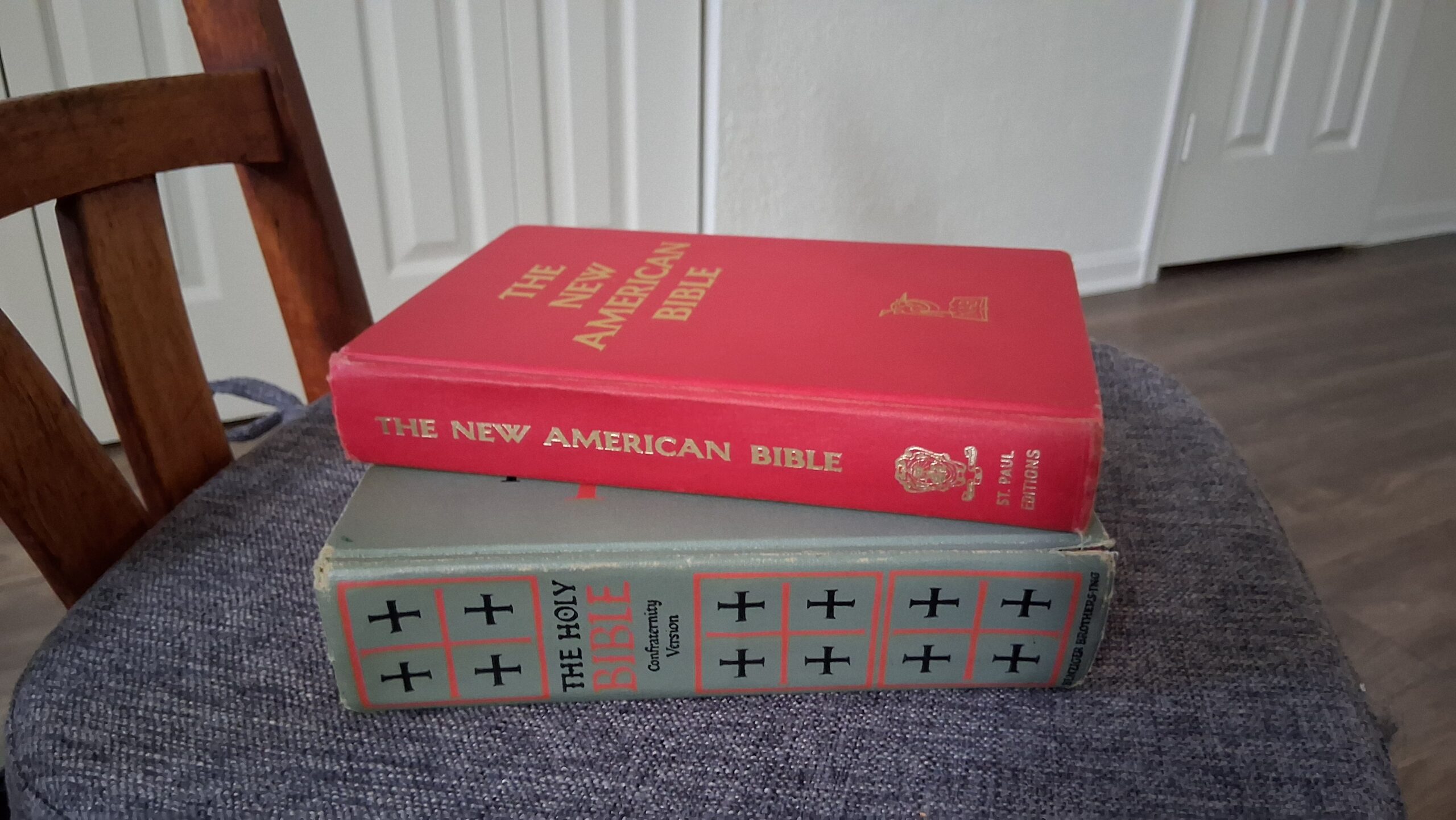
For purpose of comparison, I had my 1961 Confraternity Bible and a nice red Daughters of St. Paul edition of the New American Bible from 1976. The first thing I notice is that everything about the Confraternity Bible seems old in comparison—the typeface and the darkness of the text especially, which somehow feels more heavy than bold. There is something appealing about the sans-serif letters from the book titles that nostalgically scream out “mid-20th Century” to me.
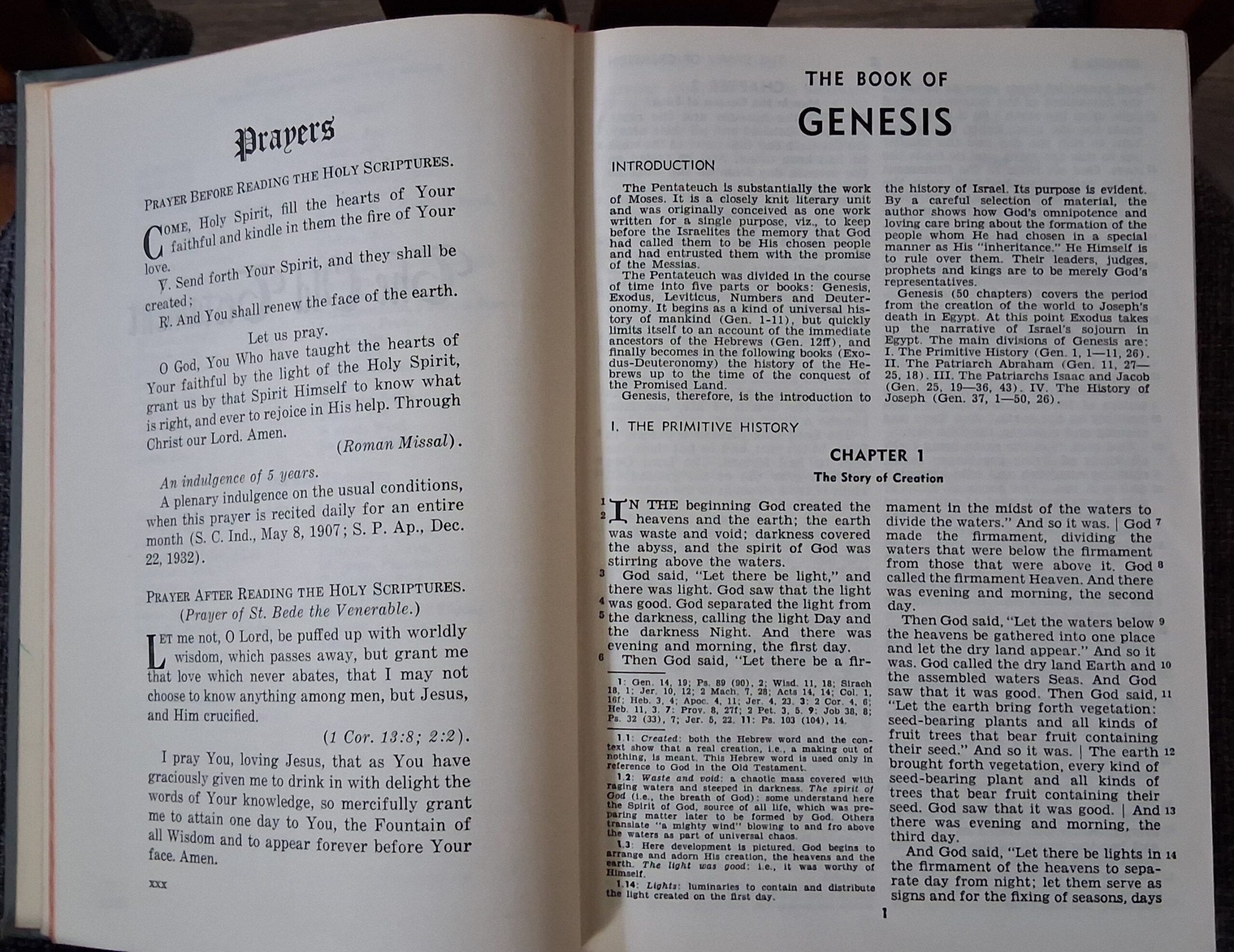
Introduction and Footnotes to Genesis
But we are not here to discuss design. Right in the introduction, we see major differences. The NAB notes, familiar to many of us, begin with an introduction to the Pentateuch that runs nearly two pages before an introduction to Genesis which is a page and a half long. The Confraternity Genesis introduction is very brief, about equal in length to the book introductions contained in the 1941 New Testament. There is no general introduction to the Pentateuch. My main observation is that the introduction and notes of the Confraternity Bible seem very close to the ethos of the team’s earlier work on the New Testament. I think many readers of this blog would be happy if the entirety of the NAB project retained this style of annotations. There are generally fewer notes, and what notes there are seem meant to clarify our interpretation of the text. (My sense is that when the Church required that Bibles be printed with notes, the notes they had in mind were more like this; not like the notes which turn every edition of the NAB into a scholarly study bible, not the elegant textual information featured in the NRSV or ESV, nor the inconsistent and sparse explanatory notes from the original RSV-CE.)
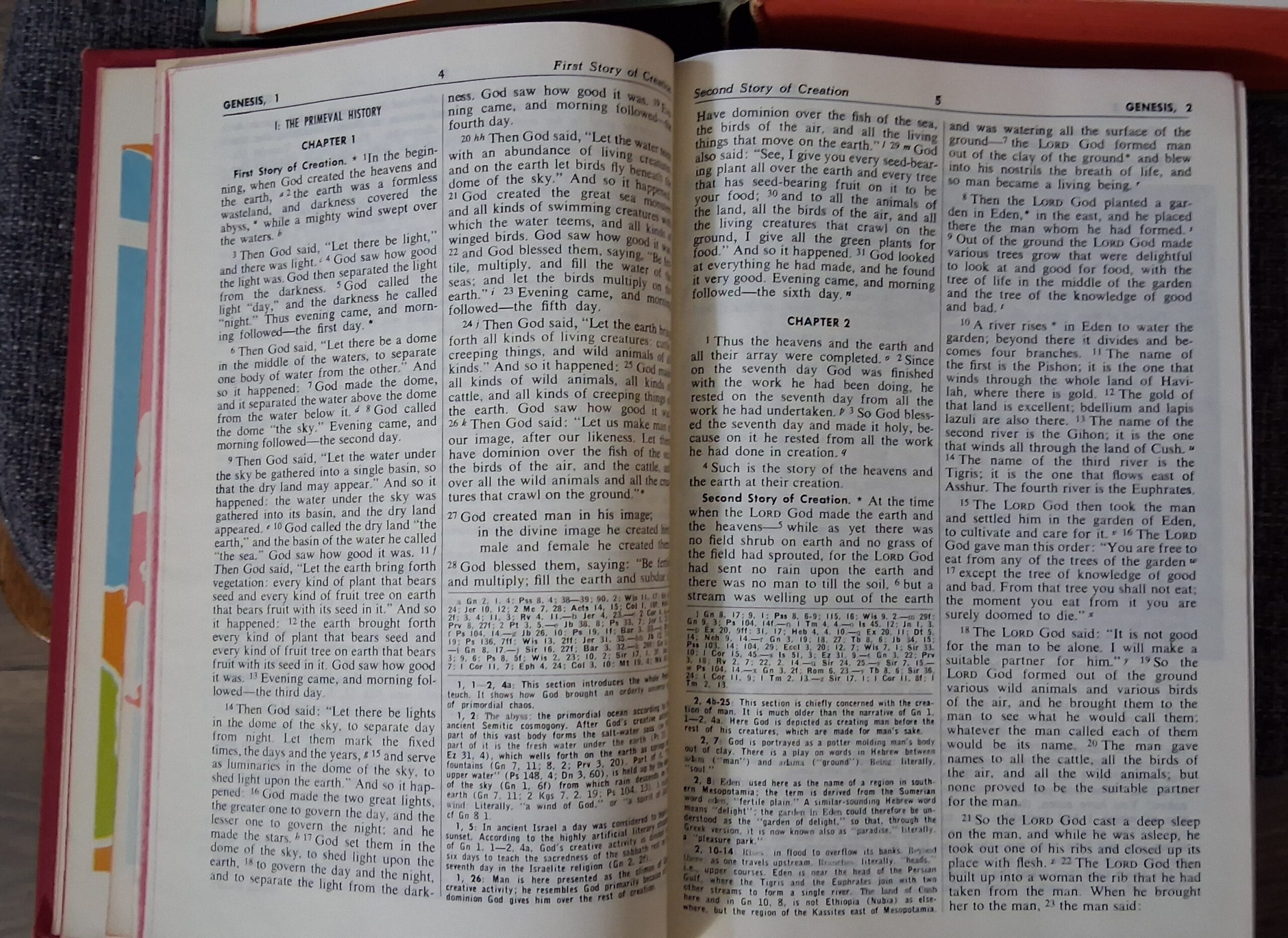
The first words of the introduction to Confraternity Genesis are “the Pentateuch is substantially the work of Moses.” On first glance, this is quite traditional, but they chose quite the curious adverb here. The word “substantially” is used in many different ways, from a stubborn fidelity to its root meaning to a debasement into a meaningless intensifier, a trend shared with words like “basically”, “truly”, and “literally”. I wonder if perhaps they are using “substantially” to mean what the NAB introduction goes at length to say: “It is true that we do not conceive of him as the author of the books in the modern sense. But there is no reason to doubt that, in the events described in these traditions, he had a uniquely important role, especially as lawgiver. Even the later laws which have been added in P and D are presented as a Mosaic heritage. Moses is the lawgiver par excellence, and all later legislation is conceived in his spirit, and therefore attributed to him. Hence, the reader is not held to undeviating literalness in interpreting the words, ‘the Lord said to Moses.’ One must keep in mind that the Pentateuch is the crystallization of Israel’s age-old relationship with God.”
Genesis 1:1
The Biblical text itself begins: “In the beginning God created the heavens and the earth; the earth was waste and void; darkness covered the abyss, and the spirit of God was stirring above the waters.”
Compare the NAB: “In the beginning, when God created the heavens and the earth, the earth was a formless wasteland, and darkness covered the abyss, while a mighty wind swept over the waters.”
And the NABRE: “In the beginning, when God created the heavens and the earth—and the earth was without form and shape, with darkness over the abyss and a mighty wind sweeping over the waters—“
The first thing I notice is the contentious move from “spirit of God” to “a mighty wind”. If you are unfamiliar with the issues involved, in ancient Hebrew an expression of divinity could be used in certain cases as an expression of superlative. In this verse, this linguistic riddle is combined with one of the more famous of nuances in Biblical literature: the identity between “breath”, “wind”, and “spirit” that existed in Hebrew, Greek, and Latin, among other languages. (The NRSV split the difference here and rendered it “a wind from God”, a choice which an NAB footnote claims to be not a compromise but quite literal. The RSV-CE chose “Spirit”—note the capitalization—but footnoted the reading “wind” as an alternative. The ESV, which has a reputation for not papering over obscurities in the text, papers over the nuance completely with an unfootnoted “Spirit”. )
I have sympathy for those who say that the Church’s liturgical tradition canonized the interpretation of this verse as being about the Holy Spirit on the waters. Especially at the Easter Vigil, this interpretation connects the recounting of salvation history with the baptismal rite. I will say, however, that being aware of the nuance between Spirit and wind has brought new life for me into the crossing of the Red Sea, the storm in Jonah, and other significant meteorological events from the Scriptures.
Confraternity Footnote to Genesis 1:1: Creation Ex Nihilo
The very first note in Confraternity Genesis illustrates what seems to me to be an even deeper split that has emerged in Biblical interpretation: it reads “1:1: Created: both the Hebrew word and the context show that a real creation, i.e., a making out of nothing, is meant. This Hebrew word is used only in reference to God in the Old Testament.”
While we can all agree that creation ex nihilo is what the Bible teaches as a whole, modern scholars are in agreement that the image Genesis 1 painted for its original hearers is the ancient idea of the watery primeval chaos, echoes of which may be found elsewhere in the Bible, such as Psalm 74. What does it do to us when Bibles annotations follow the historical critical method of viewing each book, or even smaller units, as individual units with particular audiences? In my introduction to this farewell tour, I gave some upsides to this approach. There are certainly downsides, chiefly how this can lead eventually to a certain mania that has us cleaving a book like Isaiah into parts and then ends with us pitting Mark’s Jesus against John’s Jesus against Paul’s Jesus.
I think that what is sometimes called “canonical exegesis” provides a way forward, which neither ignores historical-critical exegesis, nor considers it the only method of interpretation for the intelligent Christian. But what would a Bible with annotations along canonical lines look like? Perhaps it could look like the Ignatius Catholic Study Bible, but I think it could also look like a Bible with numerous and well chosen cross references. Does a Bible besides the NAB exist which cross references Genesis 1:1-2 with 2 Maccabees 7:28? This is, as I understand it, the first Biblical reference to creation ex nihilo, but I have never seen it in the cross references of any other translation or edition, even the study edition of the New Jerusalem Bible, which has the best cross references of any Bible I know of. The NABRE contains this cross reference as well.
I am beginning to think that more and better cross-references could, for the person well versed in Scripture, be far better than any notes.
NAB and NABRE Footnotes to Genesis 1:1:
Back to the task at hand. The NAB note here reads: “This section introduces the whole Pentateuch. It shows how God brought an orderly universe out of primordial chaos.” Another note: “The abyss: the primordial ocean according to the ancient Semitic cosmogony. After God’s creative activity, part of this vast body forms the salt-water seas (vv 9f); part of it is the fresh water under the earth (Ps 33:7; Ez 31:4), which wells forth on the earth as springs and fountains (Gn 7:11; 8:2; Prv 3:20). Part of it, “the upper water” (Psalm 148:4, Dn 3:60), is held up by the dome of the sky (Gn 1:6f) from which rain descends on the earth (Genesis 7:11; 2 Kgs 7:2, 19; Ps 104:13). A mighty wind: Literally “a wind of God” or “a spirit of God”, cf Gn 8:1.”
The NABRE expands this: “This section, from the Priestly source, functions as an introduction, as ancient stories of the origin of the world (cosmogonies) often did. It introduces the primordial story (2:4–11:26), the stories of the ancestors (11:27–50:26), and indeed the whole Pentateuch. The chapter highlights the goodness of creation and the divine desire that human beings share in that goodness. God brings an orderly universe out of primordial chaos merely by uttering a word. In the literary structure of six days, the creation events in the first three days are related to those in the second three.
| 1. | light (day)/darkness (night) | = | 4. | sun/moon |
| 2. | arrangement of water | = | 5. | fish + birds from waters |
| 3. | a) dry land | = | 6. | a) animals |
| b) vegetation | b) human beings: male/female |
The seventh day, on which God rests, the climax of the account, falls outside the six-day structure.
Until modern times the first line was always translated, “In the beginning God created the heavens and the earth.” Several comparable ancient cosmogonies, discovered in recent times, have a “when…then” construction, confirming the translation “when…then” here as well. “When” introduces the pre-creation state and “then” introduces the creative act affecting that state. The traditional translation, “In the beginning,” does not reflect the Hebrew syntax of the clause.”
Note here how the NABRE alters the NAB note but keeps much of the work from 1970.
Additional Impressions of the Confraternity and NAB Translations of Genesis
To keep things to a reasonable length, I will not do any more footnote comparisons. The example of Genesis 1:1-2 is in one sense illustrative, but in another sense shows an abnormally long footnote in the NAB and NABRE. Avid users of these translations by now know that there are sections of the Bible (chiefly, the creation narrative, Matthew, John, and the Epistles) with lots of notes, and other sections with comparatively little.
Firmament vs. Dome
Back to the translation itself. Confraternity Genesis chooses “firmament” whereas the NAB has chosen “dome”. On one level, this is what I suppose people are talking about when they refer to the NAB’s tin ear, but I have never understood our attachment to the word “firmament”, other than the fact it was used in the King James Version. At any rate, it is practically a hapax legomenon that I had to define for the children when I taught at a school which used the RSV-2CE each time we studied the Creation. (The NRSV also renders the word “dome”.)
Spelling of Proper Names
I was surprised to discover that many proper nouns in the Confraternity Bible retain their traditional Catholic spellings: “Phison” for “Pishon”, “Hevila” for “Havilah”, “Chus” for “Cush”, “Assur” for “Asshur”. In the description of Eden’s location, only Gihon, Tigris, and Euphrates have their familiar spellings. Later on, we hear of “Noe’s Ark”. The biggest surprise to me is that this is not just the case in Genesis, but in every book in the Confraternity Old Testament. “Chanaanite” is a word we see a lot in the Historical Books of the Confraternity Bible. In the transition to the NAB, thousands of proper nouns had to be changed, including book names like “Josue”, “Machabees”, “Paralipomenon”, “Isaia”, “Jeremia”, and “Malachias”. Later in the series I will show some comparisons, but as of now I think that nothing was changed in the Exodus-Malachi books besides bringing proper nouns into conformity with that of the rest of the (Protestant) English speaking world. Much like how we changed our numbering of the Psalter to correspond with Protestant usage, part of me resents that we felt like we had to change our spellings, but I do know this is more due to Catholic adoption of the Masoretic Text as the base of Old Testament translations. By now I cannot think of these words any other way. When I spend time with the Knox Bible, I am far more distracted by the alternate spellings than by the high flying poetry.
Giants vs. Nephilim
One place that the NAB introduces a word of incredible rarity is in Chapter 6, where it transliterates Nephilim to replace what the Confraternity had rendered “giants”. Like the NAB’s use of Magi in Matthew, this shows one way the translation gives us the difficult word rather than giving an explanatory gloss. What, you might ask, makes me pro-Nephilim but anti-firmament? To research the meaning of “Nephilim” is to learn about ancient Hebrew beliefs. To research “firmament” is to learn about the Latinate vocabulary of the King James Bible and its uneven influence on modern English.
Explaining the Anthropomorphism of God
In the Tower of Babel story, the Confraternity explains the anthropomorphic reference to God having “come down” to see what the workers were up to. The note reads “a figure of speech meaning that God had inspected the work and especially the intentions of the builders.” This reminds me of something I have read about some translations in the Septuagint, which seemed to come from an embarrassment at the apparent anthropomorphism present in the most ancient stories in the Scriptures. The NAB and NABRE have no note here. Recently I read a commentary on Genesis 1-11 by the Orthodox priest Fr. Lawrence Farley, who points out the humor in this verse that I had been blind to. The builders think they can build a tower up to heaven, but their project is so comically beyond their capabilities that God in heaven is looking down and thinking, “what are those tiny and faraway people up to? I can barely see them from way up here. I need to go down to check it out.” Gensis is a subtle book. The more I study it the more I see that depiction is not endorsement in the Scriptures and there is lots of humor and wordplay we usually only see in glances.
Rachel, the Household Gods, and Period(s)
When the new midcentury translations like the New English Bible, the New American Bible, and the Jerusalem Bible were first released, there were complaints about the frankness of the new translations on things few suspected were in the Scriptures. One can be found in Genesis, where Rachel is hiding the household gods which she stole from her father by sitting on them and claiming she can’t get up. “I am having my period”, she says in the NABRE. (The NAB had put it “a woman’s period is upon me”.) Surprisingly, the Confraternity Bible puts it similarly, but awkwardly: “I am having my periods”. (Was pluralizing “period” common in the 40s or 50s?) As you can imagine, many translations make the verse opaque by literally translating the Hebrew euphemism, “the way of women is upon me”—a choice made by the RSV, ESV, but also, surprisingly, the NRSV and NRSVUE. I wonder if one of those clean Evangelical comedians has done one of those lazy “women be shopping” routines on what “the way of women” might be?
Masoretic Text vs. LXX
One thing the NRSV is known for, as is the NAB, is making ample use of the Septuagint and Dead Sea Scrolls. In a future article on this farewell tour, I aim to take a good hard look into the NABRE’s departures from the Masoretic Text, but I found something interesting in 3:24. In the Confraternity Bible, there is a footnote which alerts the reader to an alternate reading in the LXX, in which we find that it is Adam who is settled east of the garden, not the cherubim with the rotating sword. This Septuagint reading found its way into the 1970 NAB Genesis, but the NABRE returns to the reading found in the Masoretic Text. I had not previously noticed any place where the NABRE translated a different text than the 1970 NAB. I look forward to digging into how common that is.
Poetic Setitngs
One of my firmest held opinions is that the New American Bible excels in poetry. (I feel this way despite having little idea what it means to “batten on spoil”, as I have prayed in the Canticle of Hannah in the Liturgy of the Hours countless times.) Whereas the NAB and NABRE frequently arrange text as poetry, it is never done in Confraternity Genesis. We will do a deeper dive into NAB poetry at some point, but here I just wish to show how often that translation uses poetic setting in the first 11 chapters of Genesis: 1:27, 2:23, 3:14-19, 4:23-24, 7:11, 8:22, 9:6, and 9:25-27. The NABRE is identical in this regard.
Final Thoughts
After reading through all of Genesis in the Confraternity, NAB, and NABRE over the last month or so, I conclude that the NAB and NABRE are very close, but the NABRE is a definite improvement. Things feel more precise and vivid. The Confraternity feels a little dusty to me. I never exactly felt like I was steeping myself in tradition, a feeling I even had with the 1941 Confraternity New Testament. Rather, it seemed like a relic of a time just slightly before truly contemporary English became the coin of the realm. I was curious if I would feel Confraternity Genesis was a missed opportunity or a false start. I have to say I feel it to be the latter. You, however might disagree! Have any of you spent much time with the Confraternity Bible?
I leave you with the verse which I feel to be the core of the first book of the Holy Bible:
Confraternity: But Joseph said to them, “Do not fear; can I take the place of God? You intended evil against me, but God intended it for good, to do as he has done today, namely, to save the lives of many people.
1970 NAB: But Joseph replied to them: “Have no fear. Can I take the place of God? Even though you meant harm to me, God meant it for good, to achieve his present end, the survival of many people.”
NABRE: The exact same as the NAB, but reading “this present end” as opposed to “his present end”.
There’s one subtle thing that tends to go unmentioned in the Confraternity editions, both of the New Testament and visible here in the introduction to the Pentateuch and in the note on verse 3: In the paratexts, the editors capitalized pronouns for deity (“God had called them to be His chosen people,” “adorn His creation,” etc.), while not doing so in the actual biblical text. Personally, I actually like that approach and wish we still did it in Catholic Bibles. While some Bible translations capitalize pronouns for deity throughout, such as the NASB and NKJV, as well as Jewish Bibles I’ve seen like Robert Alter’s, a common criticism is that it’s an act of interpretation rather than translation, and especially in a Christian context, capitalizing certain pronouns in the Old Testament due to their prophetic connection to Jesus often unintentionally obscures their original connection to figures such as King David. But there is no such issue in paratexts, since the editors obviously know what they’re referring to, so I don’t see why we can’t restore this practice to introductions, essays, and notes. I would not be surprised if I’m in the minority here, though.
Outstanding! Thanks for penning this.
I’ve never been a lover of “mighty wind.” I think if you want a more physical description (as opposed to Spirit of God), Knox’s “breath of God” or the NJB “divine wind” are more evocative (I don’t know the original languages; merely commenting on how it feels when reading it). I do really like the day statements in the NABRE though (evening came, and morning followed, the first day).
And, thankfully, we have enough halfway decent Catholic Bible options so we can find a translation that fits us, rather than having to read the Douay (don’t get me wrong, I like Douay, but not everyone will, so it’s good to have options).
I have to comment on your claim that Divino Afflante Spiritu made the Knox Bible “obsolete”; it did no such thing.
Knox had been commissioned to translate the Vulgate; that was his mandate. The Vulgate was THE Bible of the Western Church for over 1,000 years. Even today, the Neo Vulgate is still the official Latin Bible of the Church. Given the massive cultural influence of the Vulgate and its distinctive translations (full of grace, do penance, give us this day our supersubstantial bread, touch me not, she will crush your head, etc., etc., etc.), it is very useful to have a translation of the Vulgate. There are two major ones: Knox and the Douay Rheims. Isn’t the Knox translation, in more or less modern language, to be preferred over the antiquated language of the Douay Rheims?
There’s also the CPDV by Ronald Conte which is a modern English translation of the Clementine Vulgate, but despite being finished for over a decade he doesn’t seem to have ever sought an imprimatur for it
He also seems to be something of a Sedevacantist
What I don’t like about the Knox version is that it almost completely abandons the familiar biblical phraseology that allows, among other things, for easy memorization. Some of his verses are brilliant and original, but that’s the problem. They’re so original that the Bible seems to be an unfamiliar book. Every time I pick up the Knox Bible and begin reading it, I put it down again because I feel as if I’m wasting my time. Memorization is very important to me, so that each time I read a passage, I want my memory of Scripture to be refreshed and further solidified. I do study many different versions, but none so departs from the familiar as does the Knox. Even the original Jerusalem Bible stays closer to a familiar phraseology.
Unless someone is using one translation exclusively for the Mass, Liturgy of the Hours, and personal prayer and study, any other translation, even if somewhat close, will disrupt precise memorization of exact phrases and passages. I peronally find the most benefit from Scripture when I understand the meaning and implications for my life at deeper level than the precise words. Similar to when a preacher or presenter describes for you what someone else has written, in their own words and while speaking from their heart while looking at the audience, verses reading verbatim from the source text. I much prefer the former to later. Reading Knox may not be familiar, but it may open the door to understanding in a new and possibly more proud way.
All true. It depends on what you do with your Scripture knowledge. I teach and give public talks on the faith. So, although I study many versions for meaning and enlightening footnotes, I also need instant recall of biblical passages. This latter need isn’t helped by multiple variations of key passages.
*profound, not proud
The unfamiliarity is precisely the point; after a lifetime of hearing the same stories told in the same way, it is easy to become numb to the meaning. Only by hearing it in new language do you begin to seriously consider what the words mean.
It’s hard to imagine anything that so thoroughly resists “numbness” as hearing, reading, or studying the Word of God. I find the most familiar wording to be still the most riveting. The key, in my experience, is in not allowing the Book to become merely a subject of examination; in other words, to read it devotionally. My preferred practice is to take it with me regularly for a walk in the woods and to read it without any aids.
You THINK you know what it means, but there is no such thing as a perfect translation, no translation can convey all the shades of the original language, which is why you need a completely different translation in unfamilar language to shake you out of your complacency. It is egotistical to think you have a complete understanding of the Bible and have nothing new to learn by looking at in a different way.
Biblical Catholic Wrote:
“You THINK you know what it means, but there is no such thing as a perfect translation, no translation can convey all the shades of the original language, which is why you need a completely different translation in unfamiliar language to shake you out of your complacency. It is egotistical to think you have a complete understanding of the Bible and have nothing new to learn by looking at in a different way.”
Regarding your comments about egotism and complacency, these are the versions that I constantly consult for text and footnotes:
– New American Bible 1970 version
– New American Bible 1986 New Testament
– New American Bible 1990 Psalms
– New American Bible Revised Edition
– Jerusalem Bible
– New Jerusalem Bible
– Revised New Jerusalem Bible
– Revised Standard Version Second Catholic Edition
– New Catholic Bible
– Grail Psalms
– Abbey Psalms and Canticles
– Original Douay Rheims Bible
– Douay Rheims/Challoner Bible
– Hugh Pope’s Layman’s New Testament
– Knox Bible
– Confraternity New Testament
– New Psalter of Pius XII
– Westminster New Testament
– Kleist and Lilly New Testament
– Francis Aloysius Spencer New Testament
Add to these as many old and new biblical commentaries.
Among these Bible versions, my favorite one is the Confraternity, and for a whole bunch of reasons. That’s all I’m saying, okay? Now could you please relax and give me absolution?
I have spent a lot of time studying the Knox translation and its underlying sources, and I can say without a doubt it is not a translation of the Clementine Vulgate, especially the Old Testament. Knox used the CV as his base text but his translation is really an amalgamation of the Hebrew MT, Greek LXX, Latin Vg, and the Alexandrian text type Greek New Testament. Barely a paragraph goes by without some or frequent correction/alteration of the CV.
This can be seen readily at catholicbible.online where you can have the CV, DR, and Knox in 3 parallel columns for every book of the Bible. The Knox translation actually anticipates the Nova Vulgata, because many of the same corrections Knox made were corrected in the NV as well. For the New Testament, the CV is much closer the Byzantine text type than the Alexandrian text type, and both the NV, and to a lesser degree Knox, made changes to bring it more in line with the Alexandrian (best represented today by the NA28 and UBS5).
So if one is looking for a English translation of the CV in print, the three options are the DR original, the DR Challoner update, and the Confraternity New Testament. I personally prefer the original DR text to the Challoner update for the Old Testament, and am a big fan of the Confraternity version for the New Testament. That’s if I am looking for a translation of the CV. But I much prefer Knox for regular devotional and prayerful reading.
Important to note that, while close, the DR original is NOT a translation of the CV, since it predates it by a decade, although the chief editor of the DR original, Cardinal William Allen, was also on the CV committee, so he would’ve had some inside knowledge that wasn’t in the then-current printed editions and thus been able to anticipate a CV reading. That said, if you read the introduction to the Dumbarton Oaks Vulgate Bible, where they attempted to reconstruct the underlying Latin text behind the DR original, the editors there state that the DR original was plainly not a straight translation of any single pre-Clementine Vulgate printing, but more of an amalgamation of various printed editions, medieval Latin manuscripts, and borrowing from Coverdale, the Geneva Bible, and the Bishops’ Bible, all with a frequent eye cross-checking the Textus Receptus Greek. Sometimes, especially in the Old Testament, the Dumbarton Oaks editors seem to be at a loss where a pre-Challoner DR reading came from, since the would-be underlying Latin word isn’t present in the apparatus of any current critical edition of the Vulgate.
As for Timothy’s comments about the Knox often being “so original that the Bible seems to be an unfamiliar book,” I’m almost certain that in his “On Englishing the Bible” book, Knox said that was very much the point. He might’ve even used those very words! Especially since the Knox Bible was never meant to be a replacement for the Challoner DR, but rather a reading aid alongside it.
Great information on the original DR, and thanks for the correction that It predated the CV. I knew that but spaced it while writing. Interestingly, I did a check a year or two ago on 84 known variants for the Gospel of Matthew, and the original DR and the DR-Challoner used the same for all. Does anyone know if there exists a comprehensive comparative analysis of the whole Bible for DR and DR-Challoner?
I don’t know of any such comparative analysis that has been printed as of now, though I think I heard through the grapevine that one was underway. I don’t know how comprehensive it’ll be or if it’s still being worked on, though, since I last heard of it a few years back. There’s a 2015 paper called “Bishop Challoner’s Ecumenical Revision of the Douai–Rheims Bible by Way of King James” that indirectly did a comparative analysis between the DR and DR-Challoner, but only concerning the KJV and only looked at the Gospel of Luke.
“…the Knox Bible was never meant to be a replacement for the Challoner DR, but rather a reading aid alongside it.”
That’s how I’ve come to view it, almost as a commentary on the DR Bible. But if the Knox version had been better received by the British clergy, it might have become such a replacement.
Re: the Dumbarton Oaks Vulgate, didn’t they use Challoner’s revision for the English text instead of the 1610 DR? It seemed a bit of a strange choice to reconstruct the pre- Clementine Vulgate from, especially because there are places in the Challoner with readings from the Hebrew base text of the KJV Old Testament that aren’t in the Latin, which the Dumbarton Oaks edition seemed to have italicized in their English text
Guest,
To my understanding, it’s slightly more complex than that. They used the Challoner DR as their base English, so as to avoid the original DR’s severe archaisms, but modified the Challoner DR text to conform to the underlying Latin of the original DR. So it’s seemingly what the DR would’ve been had the 1580s translators followed the same Latin text that they historically did, but rendered it in Challoner’s English instead of their own. That’s what I gather from their text, use of italics, and endnotes. Personally, archaisms or not, I would’ve preferred it if they just retyped the original DR in modern spelling and then reconstructed its Latin base, instead of only doing the latter. It would’ve been less readable but a more useful resource overall, in my opinion. No offense to Catholic publishers, but I tend to feel the default decision to fall back on the 1899 Challoner text when an English translation of Latin biblical quotes is needed, rather than the original DR or even the Confraternity Bible, feels kind of lazy.
The Confraternity New Testament has long been my favorite translation. I use it both for devotional reading when I don’t want the clumsy modernist intrusions in text or footnote to spoil the spirit of prayer and for more serious study when I want to take a break from the banality of contemporary English versions. Yeah, that’s a reference to the inanities of excessive inclusive language. I find the Confraternity version to be an eloquent compromise between the Rheims and the various iterations of the NAB. This is true for the footnotes as well. I’ve always considered the 1930s-50s to be a period of exceptional fidelity in the Catholic Church in America regarding both biblical and theological studies. This New Testament fits right into that era. When writing and needing biblical quotes, I find the CV to offer a graceful English that is both poetic and yet modern enough to be understood today.
But then there’s the Old Testament problem. I’ve owned all the CV editions with the various Old Testament books newly translated, from the new Psalter alone, to the first five books of Moses, to the last editions with all the prophets. I’ve also owned all the individual volumes of the Confraternity Old Testament as they were released. And I’ve always preferred the editions produced by Catholic Book Publishing Company. I don’t know exactly why, but I’ve always loved their publications.
In the end, my preferred version contains the Confraternity New Testament, the Douay Old Testament, and the New Psalter translated under Pope Pius XII. It’s been nicknamed the Bea Psalter for the cardinal who oversaw the original translation into Latin. Say what you want about Bea (pronounced “bay”); I’ve come to really like his translation of the Psalms – or at least the English rendering of it. As with the CV NT, it strikes a balance between old and new. I don’t care for the Rheims Psalter. I’ve tried to pray with it, but it just feels hopelessly awkward. But the New Psalter is graceful and, I would say, somewhat terse, somewhat to the point among Psalm versions. I had recently been trying to adapt to using the Psalms from the New Catholic Bible – a version I use and like quite a bit in teaching. But the NCB Psalms are too bland for my taste. I’ve tried over and over again to like them but find myself repeatedly running back to the Bea Psalter. If only there were editions of the Confraternity New Testament combined with the New Psalter into one volume, but I’ve never found such a book.
The New Psalter was promoted by two scholars I greatly admire – John Steinmueller and Charles Callan. The latter published an edition of the Psalter with commentaries and footnotes on each Psalm. It’s a rare find but a fine resource for pious study.
I have a 50s Bible with the Confraternity NT and the Douay OT and it just “seems holier”. I’m not talking about the text but the very font, layout, illustrations, everything! It’s a very beautiful package. I love it and the text very much suits my needs. Even the size is perfect.
The 40s and 50s really seemed like a special time for Catholicism in America, Fulton Sheen being an inspiration.
I totally agree with you, Tim. Scott Hahn said the same thing about the mid twentieth century in America in his introduction to the book Laying the Foundation, by Fr. Joseph Clifford Fenton. The Catholic Church experienced a truly golden age of mature scholarship and courageous fidelity.
This is an excellent article, but it does bring smack into my face the chasm between patristics and scripture scholars/translators. That being said, we did not change our enumeration of the Psalms to agree with the Protestants. The enumeration change was tied to the push to adopt the old Grail psalms from the U.K., which were translated from the Hebrew. The movement came full circle, when the ICEL, in an attempt to have the Catholic Church in the U.K. adopt the ICEL translation of the Liturgy of the Hours, adopted the Grail psalms over the Confraternity psalms, as well as adopting the Hebrew enumeration. At the time (1974-75), the ICEL presented it as bringing the LOTH into line with the British! At that time, there were many upset priests, religious and Bishops over this change. This is why, if you see the Latin text of the LOTH, it has the traditional Catholic (from the Septuagint) enumeration of the Psalms, but the new translation of the LOTH coming out has the Hebrew enumeration of the Psalms. It is also one of the reasons the St. Abbey Short Breviary of 1975 was banned, because they used the Confraternity Psalms with the traditional numbering.
The Divine Office in the UK, published by Collins, has the Grail psalms and uses the Septuagint/Vulgate numbering. This is replicated on the Universalis app. Similarly, the CTS New Catholic Bible which has the Grail psalms alongside the Jerusalem Bible, uses Septuagint/Vulgate numbering, with Hebrew numbering in parenthesis.
The new Abbey Psalter we now have in the Lectionary in the UK, uses Hebrew numbering with the Septuagint/Vulgate number given in parenthesis.
We’re not moving to a revised or updated translation of the Divine Office anytime soon in the UK so we’ll live with both numbering systems for the psalms for many years to come.
The Abbey psalms are, in my opinion, more clunky especially for singing.
The change in the numbering of the Psalms is the difference between the Septuagint/Vulgate and the Masoretic text. That being said, the numbering of the Septuagint is older and makes more sense, Psalms 8 and 9 seem clearly to be one psalm, which at some point was split into two, probably by accident.
Bob,
This is a great analysis! Thank you! I look forward to reading further. Your essay clearly demonstrates how difficult it is to create a translation and the importance of word choice. Further, when doing a Bible study, it demonstrates why it is valuable to use more than one translation.
Lastly, you mentioned how a translation can show or hide humor in the original languages. There is also humor in how a translation handles a sensitive subject; that is hemorrhoids. Look at 1Samuel chapters 5-6. and Deuteronomy 28:27 D-R: “The Lord strike thee with the ulcer of Egypt, and the part of thy body, by which the dung is cast out, with the scab and with the itch: so that thou canst not be healed.”
Catholic Book Publishing made some “Fine Art Editions” of the Confraternity Bible that were very nice. I am fairly certain they never published a full Challoner DR, but their first published Bible was a Douay/Confraternity NT/Bea Psalter in the late 40’s. I wonder if they reprinted this edition it would sell? One really cool selling point would be its Douay OT which was in paragraph format!
I, too, have never found a Douay Rheims Bible produced by Catholic Book Publishing Company. The earliest I’ve found is the 1949 edition including the Douay-Challoner Old Testament, the New Psalter of Pius XII, and the Confraternity New Testament. This edition has slightly modified footnotes in the Old Testament and various titles and section headings that show a moderate updating of the version. It’s the edition that John Steinmueller – one of the Confraternity translators – praised as being “distinguished for its complete and reliable notes and introductory sections.”
Steinmueller was no fan of the New American Bible. He wrote,
“The New American Bible, which was finally published in 1970, included much of the work that had already been published as it was completed [in the Confraternity Old Testament]; but the scholars who finished this version re-translated the book of Genesis and rewrote the notes to that book to reflect some presumably ‘new insights’ in biblical study. The New American Bible also has a new translation of the New Testament, and new notes and introductory sections. Not only is some of the translation highly questionable, but some of the notes express the ideas of certain biblical scholars rather than the official teaching of the Church; and there has been a great deal of dissatisfaction with its ungraceful phraseology.”
In a footnote he added,
“Attempts at producing ‘modern’ translations of the Bible frequently result in the use of contemporary language which ‘dates’ the text much more objectionably than does the retention of antiquated wordings. There are expressions in the Douay and King James Bibles which are so well known as to have been made household words, and nothing can be gained by changing them.”
These quotes are taken from Msgr. John Steinmueller’s fascinating little book The Sword of the Spirit.
I agree with his comments. Although my bookshelves are filled with modern versions of Holy Scripture and I highly value the occasional footnote that adds to the understanding of a particular text, I also think there’s a loss in what could be called “biblical culture” that results from constant changes, updates, and revisions. As Catholics, our speaking and writing should be animated with the classic colorful phrasings of Holy Writ. Such expressions as “gird your loins” or “not one iota” are now barely familiar even to modern Christians, and yet their meanings are clear and eminently useful. And what replaces them is ordinary colorless wordings that can’t even be called “expressions.” In speech and writing, our culture has been de-biblicized, and it’s a loss to the whole world.
Again, I find myself returning for relief to the Confraternity version for its balance of traditional biblical vocabulary and relatively modern footnotes that edify, rather than offend.
As a follow-up to some of the comments here, Catholic Book Publishing company was founded in New York City in 1911. Their website says, “Work on the Douay-Rheims Bible began in 1945, culminating in the publishing of the first Catholic Bible printed in the United States in 1949.”
I’ve never been able to find such a Bible, but only the 1949 Douay-Challoner/New Psalter/Confraternity edition.
I have a few Confraternity editions. Two standalone Confraternity New Testaments, then a 1950 Douay-Confraternity Bible that has the full Challoner-Douay text for the Old Testament sans the Psalms, which are the Confraternity Psalms, and the Confraternity New Testament. Given that the Confraternity Old Testament is translated from the Hebrew and Greek rather than the Latin, whereas the New Testament is from the Latin, I feel this version, which actually omits the Confraternity Genesis text that did exist at this point, is the sweet spot. This version of the Douay-Confraternity seems to be as far as you can get with it still being, essentially, a Vulgate translation, while doing away with the Hebrew-to-Greek-to-Latin-to-English nightmare that is the Douay Psalms. Anything beyond this and you might as well get the NAB, notes aside.
You can add one more step there: Hebrew-to-Greek-to-Latin-to-English- TO REVISED ENGLISH.
I don’t have the Confraternity version, but I’ve read the NABRE and, like you, I really love it for its precision and vividness. I’ve always appreciated its use of college-level vocabulary and highly specific terminology depending on the setting. For instance, where other Bibles might use a generic phrase like ‘highest peak’ or ‘pinnacle’ when Jesus is brought to the top of the temple (Luke 4:9) the NABRE uses the precise architectural term ‘parapet’.
When a passage deals with war you get the exact terms for it, which makes the text feel so much more grounded in reality: sally, sortie, bivouac, cohort, stele, etc. A favorite of mine is the word ‘boss’ (Job 15:26). No, it isn’t your work manager. Merismus, diptych, and other really uncommon words 🙂
Thanks for taking us on this ‘farewell tour’ of the NABRE! Looking ahead to the forthcoming Catholic American Bible (CAB), I really hope the translators don’t abandon this unique commitment to precise, robust language.
Well said.
The New American Bible Revised Edition (as with the earlier editions) is translated to an early high school grade level.
I picked up a 1950 Benziger Brothers Bible “with Psalms from the New Latin Version authorized by Pope Pius XII.” This is a different translation than Catholic Book Publishing, which is yet different than the one from the Confraternity of the Precious Blood’s “My Daily Psalm Book.”
Did every publisher make their own translation of the Bea Psalter? How many English translations were there??? I find it remarkable that all the Confraternity NTs are the same, yet the “Confraternity” Psalms were different. I don’t have a 1950 copy from “The Catholic Press,” I wonder if this is yet another translation.
That is a great observation, Jonny. I have always wondered what the deal was. I feel like there is a lot of mystery about such things from those days. I have noticed some midcentury editions of the Imitation of Christ have no listed translator.
The original New Psalter (or Bea Psalter) made under Pope Pius XII was obviously in Latin. I don’t know if there was ever an official English translation. There is yet another one in the excellent book, The New Psalter: With Latin and English Texts, Introductions, Notes, and Spiritual Reflections. It was produced in 1949 by a prolific Dominican scholar, Charles. J. Callan. There were many complaints about the Latin version, but the English has been promoted by some very traditional-minded scholars.
So far, we’ve found either three or four different English translations of the New Psalter. I’ve not been able to identify the translators for certain, but my guess is that Callan made his own for this book. The preface says,
“In translating this new [Latin] text, we have endeavored to keep as closely to the Latin as good English would seem to permit. The more closely we can keep in translation to a good text of any part of Sacred Scripture, like this New Latin Psalter, the nearer we are to the inspired words that came from the original sacred writer and to the message of God’s Holy Spirit; and that, after all, is what every sincere reader of Holy Scripture desires.”
His Psalm 1 translation, for comparison:
“Blessed is the man that follows not the counsel of the wicked, and walks not in the way of sinners, and sits not in the company of the violent.
“But his delight is in the law of the Lord, and on His law he meditates day and night.
“He is like a tree planted by streams of water, that yields fruit in due season, whose leaves do not wither, and whatever he does goes well.
“Not so the wicked, not so; rather are they like chaff which the wind drives away.
“Therefore, the wicked stand not in the judgment, nor sinners in the council of the just.
“Because the Lord cares for the way of the just, but the way of the wicked shall perish.”
And if I remembe r right, Knox made two translations of the psalter–one of the Gallican Psalter and one of the New Latin psalter. It is the latter which is printed in complete Knox Bibles.
I’m pretty sure the translation of the Psalms in the one-volume Knox Bible is from the Bea Psalter, though he also translated the Gallican Psalter.
Believe it or not, all Confraternity NTs are not exactly the same. I noticed a few years back that there are differences between the 1941 text and some later editions. I’ve never examined them comprehensively, but I know one place is Luke 2:36, where some copies read “And there was Anna, a prophetess” while others read “There was also Anna, a prophetess.” I’ve seen the former in my 1941 copy and the latter in a 1947 copy, both published by St. Anthony Guild Press.
The difference there is so minor that, if it’s the only one, it could be just a printing error.
I would be very interested in reading a guest post on this blog dedicated to these different translations of the Pius XII/Cardinal Bea Psalter. Also, are they available online anywhere? I’d love to do a comparison of them with translations of the Psalter that I’m more familiar with.
There is an article entitled, THE NEW PSALTER: ITS ORIGIN AND SPIRIT, in The Catholic Biblical Quarterly, Vol. 8, No. 1 (January, 1946), pp. 4-35. The article was written by Cardinal Bea himself. At the same site you’ll find several other articles on the same version.
You can read the articles online by opening an account at JSTOR. Here’s a link to the first article:
https://www.jstor.org/stable/43719062?searchText=&searchUri=&ab_segments=&searchKey=&refreqid=fastly-default%3Af8580d9c5cc57a39540b4ee648ef3702&initiator=recommender&seq=1
Of course, these articles describe the Latin version, whereas you’re (we’re) interested in the English translations. That will be a more difficult search. I’ve found very little on them. But I’m as interested in the version as you are.
Thanks for the lead!
From the Catholic Bulletin, Volume 35, Number 14, 7 April 1945:
“VATICAN ClTY: The completion by scholars of the Biblical Institute of the new translation in Latin of the Psalms is announced by Pope Pius XII in a “Motu Proprio.” It is stated that the Holy Father has granted the faculty to priests to use, if they Wish, the new translation in the recitation of the breviary, private or public, once the version is published in a form accommodated to the breviary. The Latin document, dated at the Vatican, March 24, points out that the “Psalterium Gallicanum” adopted by Pope Pius V for the breviary and now in use, followed a translation from the Greek into Latin instead of from the Hebrew into Latin, as St. Jerome himself did at a later date, and hence the original beauty and clarity of the Psalms is obscured in some instances. The new translation has been made following the Hebrew texts.”
That’s awesome, thanks for sharing. If you ever happen upon the English/Latin 1960 Roman Breviary published out of Collegeville (usually available on eBay), it uses the Bea Psalter and (I presume) an English translation of that Psalter. Baronius opted to go back to the Gallican in their Latin/English, as did Nova et Vetera with their all-Latin Roman Breviary.
At this point, I’m just content praying the same Roman Rite Divine Office that the Bishop of Rome prays – Latin or English – and I have a soft spot for the Nova Vulgata Psalter.
And that’s the way it should be, Father. All of this Biblical research is wholesome, edifying fun, but it should always lead us home to the unity of the Church.
One comment about the Confraternity of the Precious Blood and those fine little devotional books they publish. They’re the original designer/publisher of the little Confraternity New Testament that is presently published by Scepter. Here’s a link:
https://scepterpublishers.org/products/the-new-testament-confraterntiy-pocket-edition?_pos=1&_sid=4d41a104e&_ss=r&variant=32166301958192
Hence, the books are all the same size. And the little book in the set entitled, “Christ in the Gospel” is simply a chronological arrangement of the Confraternity Gospels. It’s like a Gospel harmony but with the complete scriptural text.
There really is a lot to learn about the short-lived Confraternity New Testament. It appeared precisely when the Church was rediscovering her ancient love of Holy Scripture. As a result, there are many different editions and formats of it to be found. I just wish that some publisher would finally give us a brand-new full-sized reprint of it, complete with all the footnotes and introductions. Scepter has offered a strange version of it void of all footnotes and even chapter and verse indications. And equally happy would be the republication of the 1942 parallel commentary called, “A Commentary on the New Testament” issued by the Catholic Biblical Association.
I actually have an original hardcover copy of that parallel commentary, and it really is a handy volume.
Great. I’ve got two copies in excellent condition. They sell on Ebay for outrageous prices. But I’m (ironically) highly allergic to dust mites and book dust, so I have to be careful with old books.
As long as so many of us are talking about the Confraternity New Testament, I’m curious…does any edition of it have good cross-references? My pocket Confraternity New Testament lacks them, but I’m wondering that is the case with every edition of the Confraternity New Testament or if they just took them out of the pocket size editions to save space.
Yes, there are cross references in the normal editions of the CV New Testament, but not many. They amount to about 4-8 per chapter.
Thank you for the reply.
Thanks to this article and, in particular, to the comments thread for bringing me back to NABRE for general reading and study, although I have been exposed to an earlier iteration through the Bergsma and Kreeft commentary series on the Sunday Mass readings. As a Brit my exposure to NABRE is limited, having been used to hearing the Jerusalem Bible at Mass for years, and at university and since to the RSV and NRSV (more recently to the ESV). I even value the overwhelmingly historical-critical notes in NABRE, although I depart from some of their emphases and conclusions. Despite limitations, I’m glad to have NABRE as a resource I can turn to from time-to-time. Yes, the prose and poetry can sometimes be flat, but not always.
Perhaps this belongs under another future post, but I’d be interested to know what you guys think of the Psalter that was translated for the Confraternity version Bible following the Bea Psalter, the one that ended up in the 1970 New American Bible. We’ve been hearing it at Mass for fifty-six years. I believe it was single-handedly translated by the Franciscan scholar Stephen Hartdegan. His name is all over the various editions of the NAB. I realize it’s less poetic than other Psalter versions, but for some reason I’ve grown to like it. If it’s a bit flat, it’s also simple and direct – qualities I sometimes find refreshing in an excessively complicated world.
That seems like a topic for a future stop in the farewell tour!
I think I feel the same way you do. They are unremarkable as a work of translation, almost never calling attention to themselves. I remember when I used to lector at a lot of early morning weekday Masses I was always terrified of tripping over “words” and “works” when they appeared in close proximity.
If we looked at a psalm or two in the NAB’s three psalters, which Psalm would people like to see?