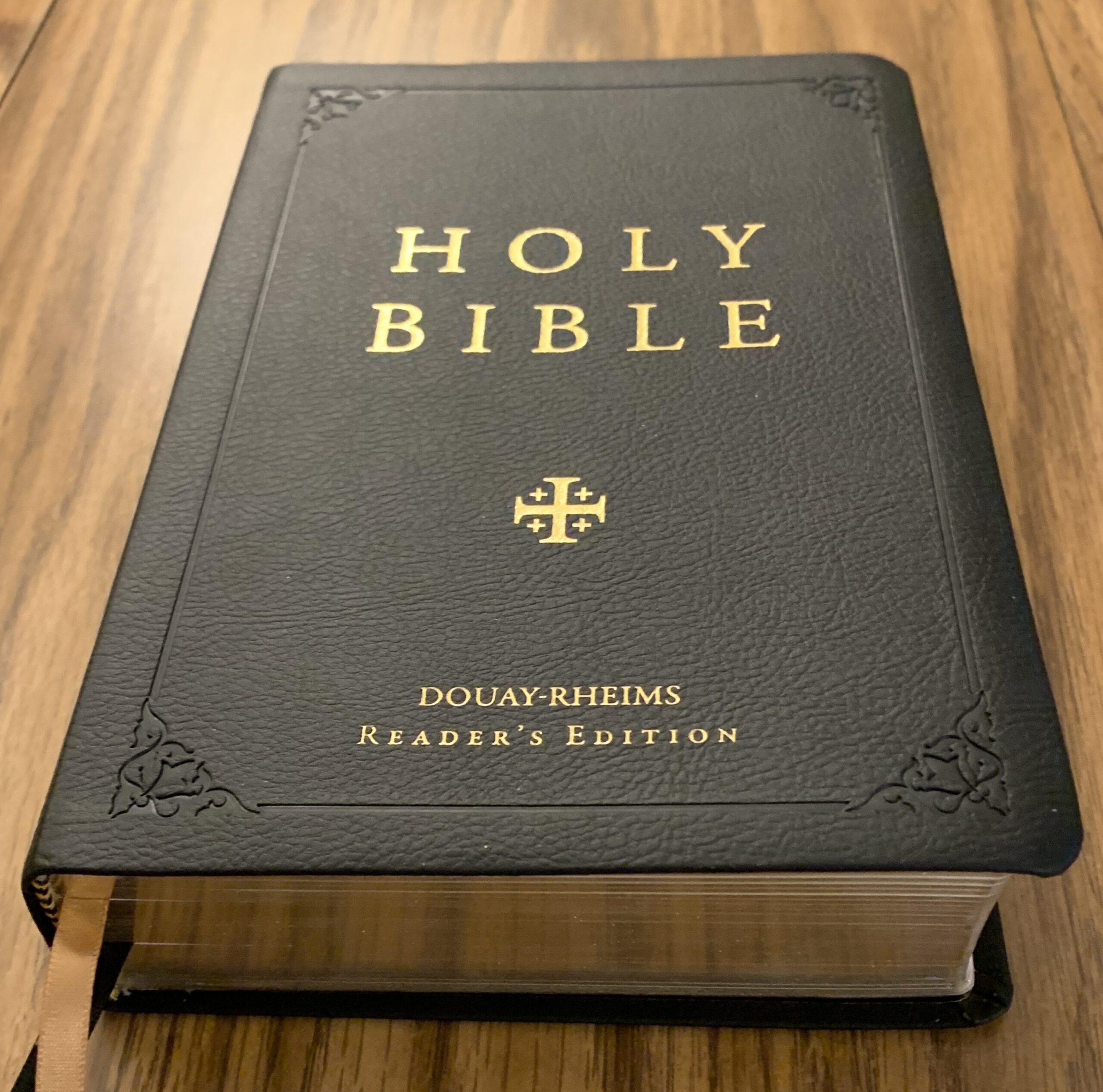
It was a blessing to be able to receive the new Tan Books Reader’s Edition Douay Rheims a bit early. I had pre-ordered from Target, but having seen a Reddit comment about it being on Amazon I immediately canceled that order and got the one on Amazon in 2 days! I was very much anticipating this release, and I thought I would share some pictures, a few comments, and reflections. I have been collecting Catholic Bibles and following the Catholic Bibles Blog and this blog since my conversion in 2009, and it is amazing what great Bibles we have since that time. I can’t help but wonder if that is in part due to the participation, criticism, and comments of the great people such as who are reading this post right now.
The Douay Rheims Bible has been an ongoing source of prayer and devotion for me. Its apologetic notes played a part in my conversion to the Catholic Church, and I have turned to its pages in difficult times of penance, prayer, and supplication. For me it is an important part of our Catholic heritage, drawing on an ancient understanding and interpretation of scripture. I know it is not everyone’s cup of tea but I think that its language is beautiful to read devotionally: silently and out loud. I love to read the passages that are tugging at my soul after receiving Holy Communion, and there are many times the Douay Rheims hits me in a profound way. I make a distinction between the Challoner DR and the modern English editions that are translations of “new” Latin and based on critical editions. In other words, I don’t consider the Pius XII Psalter translations and Confraternity NT to be successors to the Challoner, but they are a different animal altogether. Sometimes people think that the DR is for “trads” because of its use in many older missals, but I think that the DR is a treasure that appropriate for all of English speaking Christendom, not even just Catholics, as the Vulgate hearkens back to a time of ancient and apostolic unity.
Now on to the physical construction of the Bible. I was not disappointed in any way from the moment I unwrapped, and in the time I have spent in its pages thus far. The cover is very soft and attractive, the ribbons are of good quality and well spaced, and the paper and the construction seem very solid. It is a sewn binding, and the Bible will lay open about midway through Genesis but that may improve as I break it in. The binding does not seem tight or constricted at all and the pages open up wide with no crinkling. The Reader’s edition is slightly smaller than the medium size Baronius DR, but thicker than the previous Tan edition.
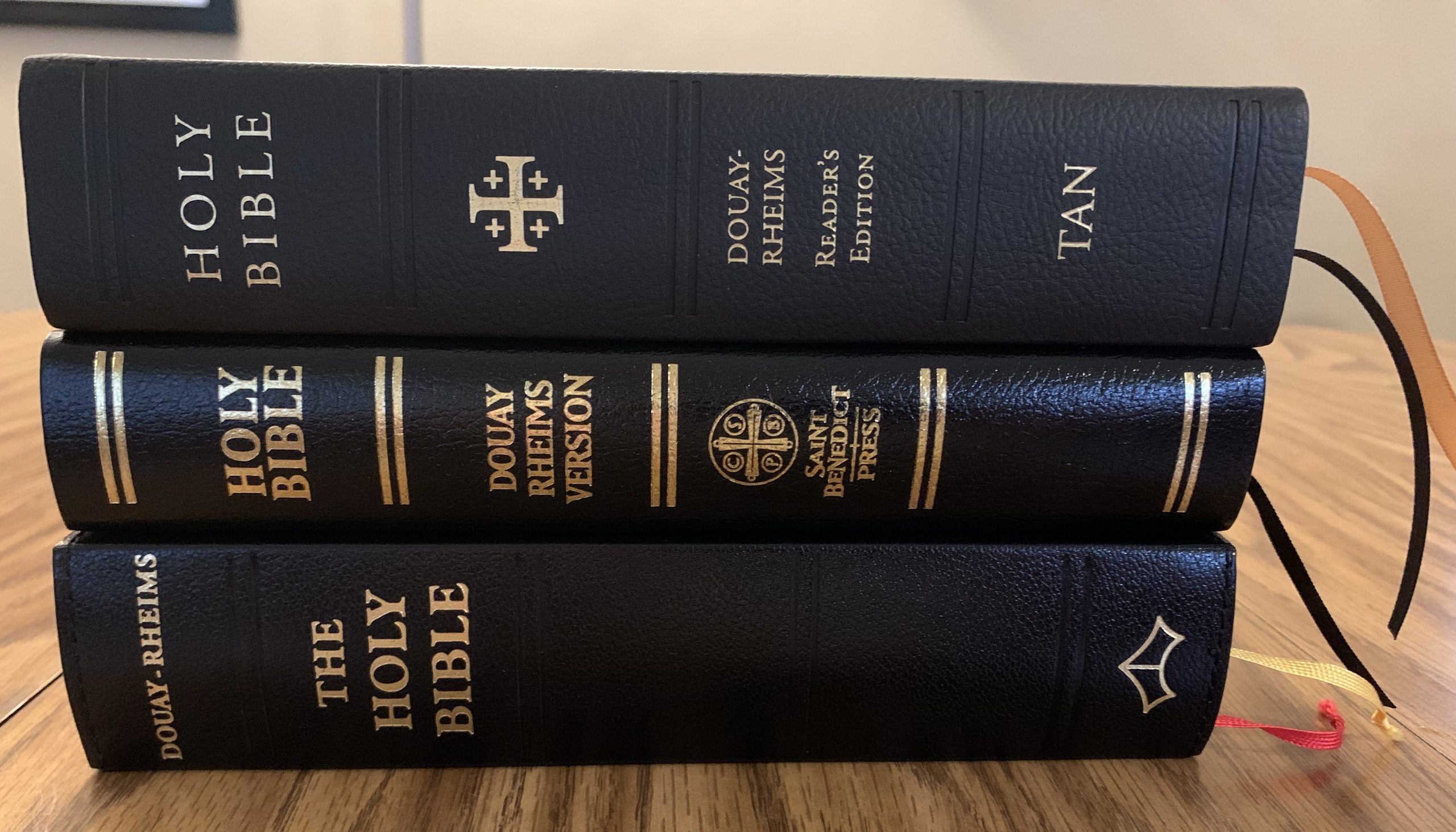
The new Tan version is about 420 pages longer, which is probably due to the generous margins. The book block is about 1.5″ thick and the pages show very little ghosting. At this point in my journey, I do not care about expensive leather covers, I just want a Book that looks and feels nice. If it is a Bible or devotional I prefer a soft cover with gold edges with a typeface that does not look tacky. A pet peeve of mine is when the text crowds any part of the book, especially the gutter. This reader’s edition checks all the boxes for what makes a physical Bible enjoyable for me.
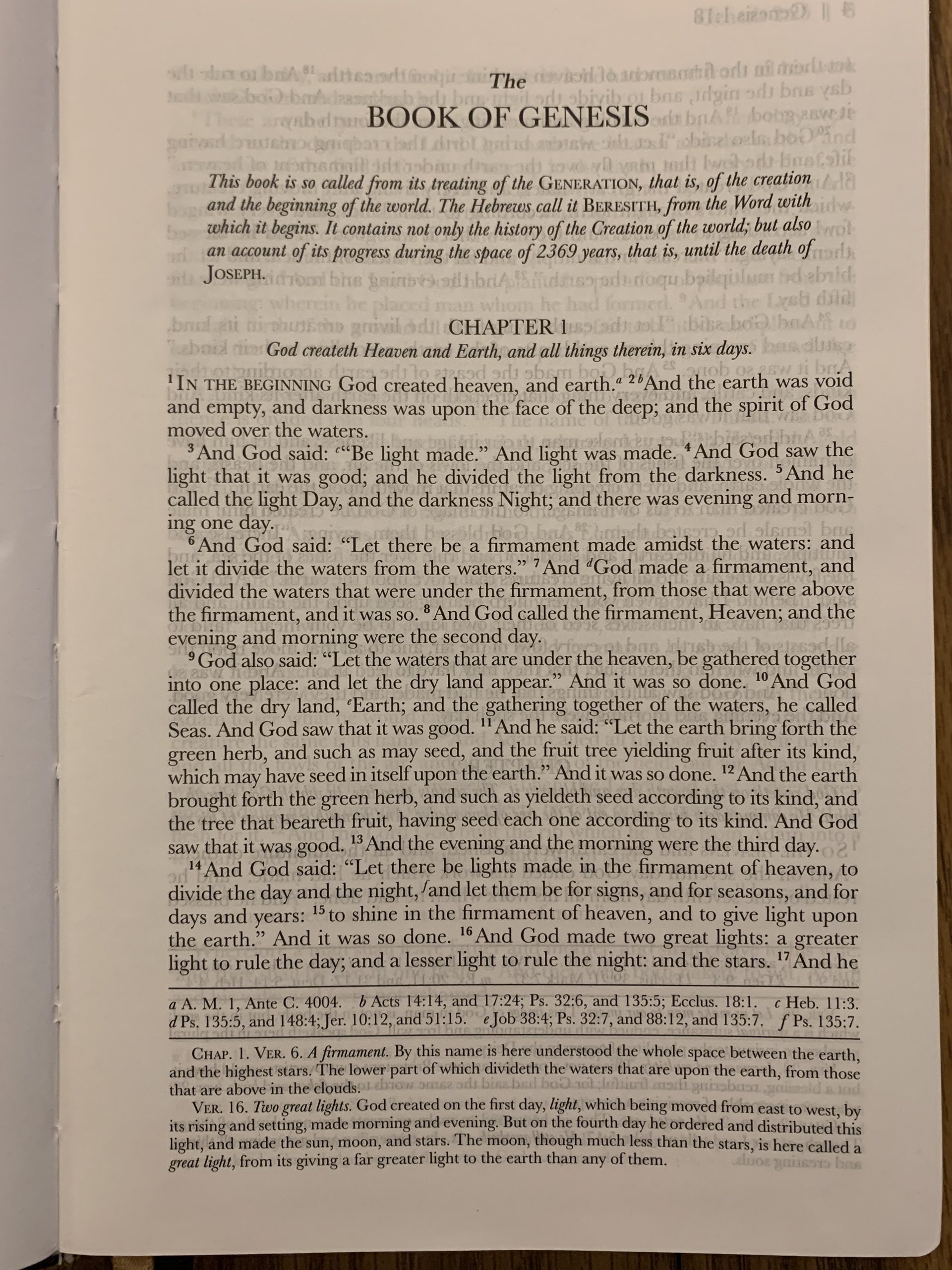
The biggest benefit of the new edition is of course the paragraph formatting and modern punctuation including the use of quotation marks. I have a lot of experience with the DR so the previous edition was not an obstacle, but this new edition will no doubt make the DR more accessible to first time readers. A few other noteworthy features of the new edition:
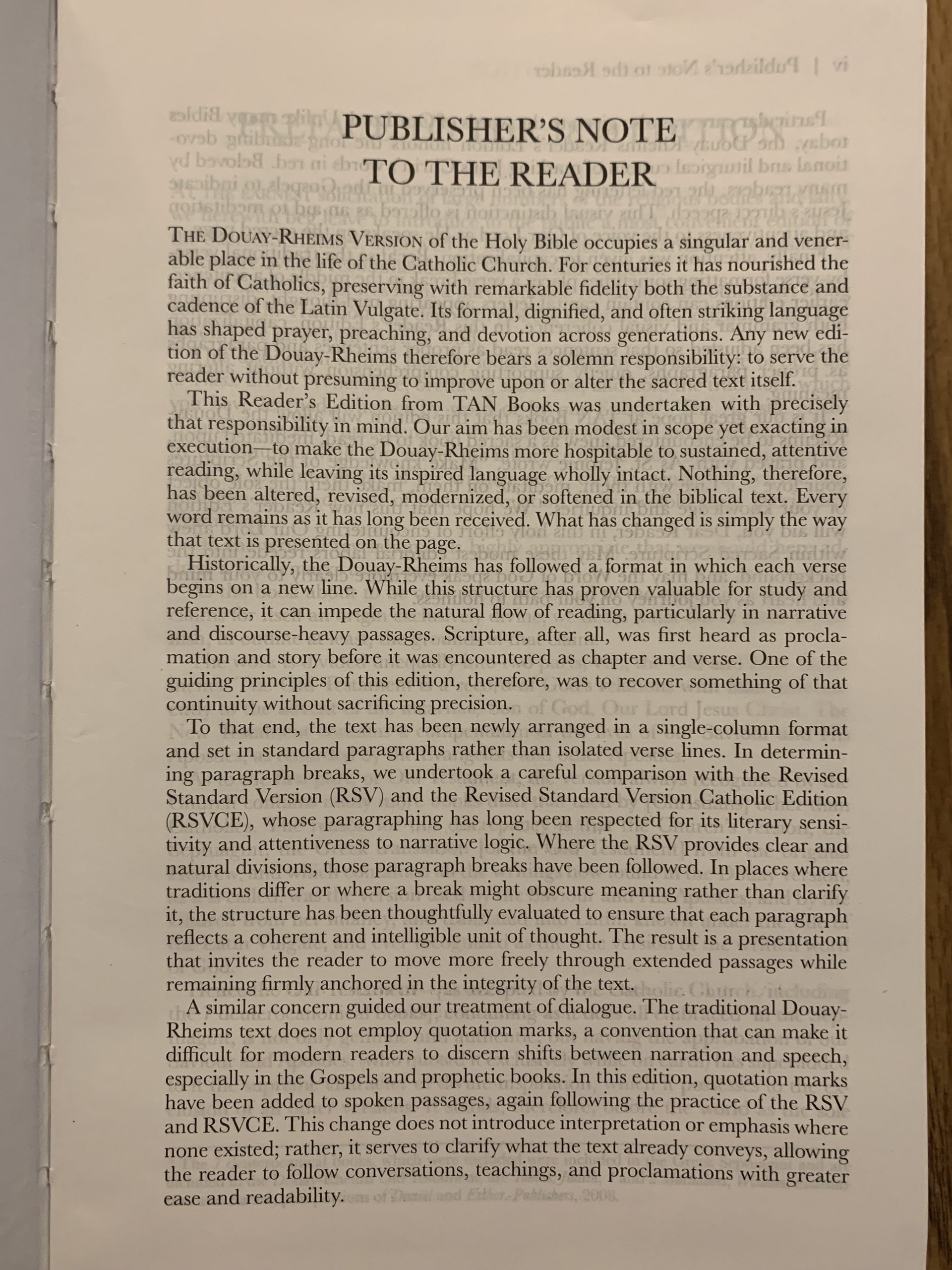
1. The Reader’s Edition actually contains a “Publisher’s Note to the Reader.” This is very thoughtful and considerate as we know that the Catholic Bible fans want to know the editorial decisions that went into the making of this edition. An important revelation here was that Tan referenced the RSV and RSV-CE extensively to standardize paragraphs and quotations when possible. Another important point was that this is faithfully the 1899 edition. The handful of minor typos that were discussed here previously do remain here for that reason. I did write Tan an email regarding this, but seeing how quickly these Bibles were available after their announcement I doubt my correspondence was received in enough time to make any changes.
2. The red letters are included for the words of Jesus on earth. That is to say, they begin in Matthew and end in Acts 1:8. The red print is well done, evenly spaced, and to my eyes do not present an obstacle for reading.
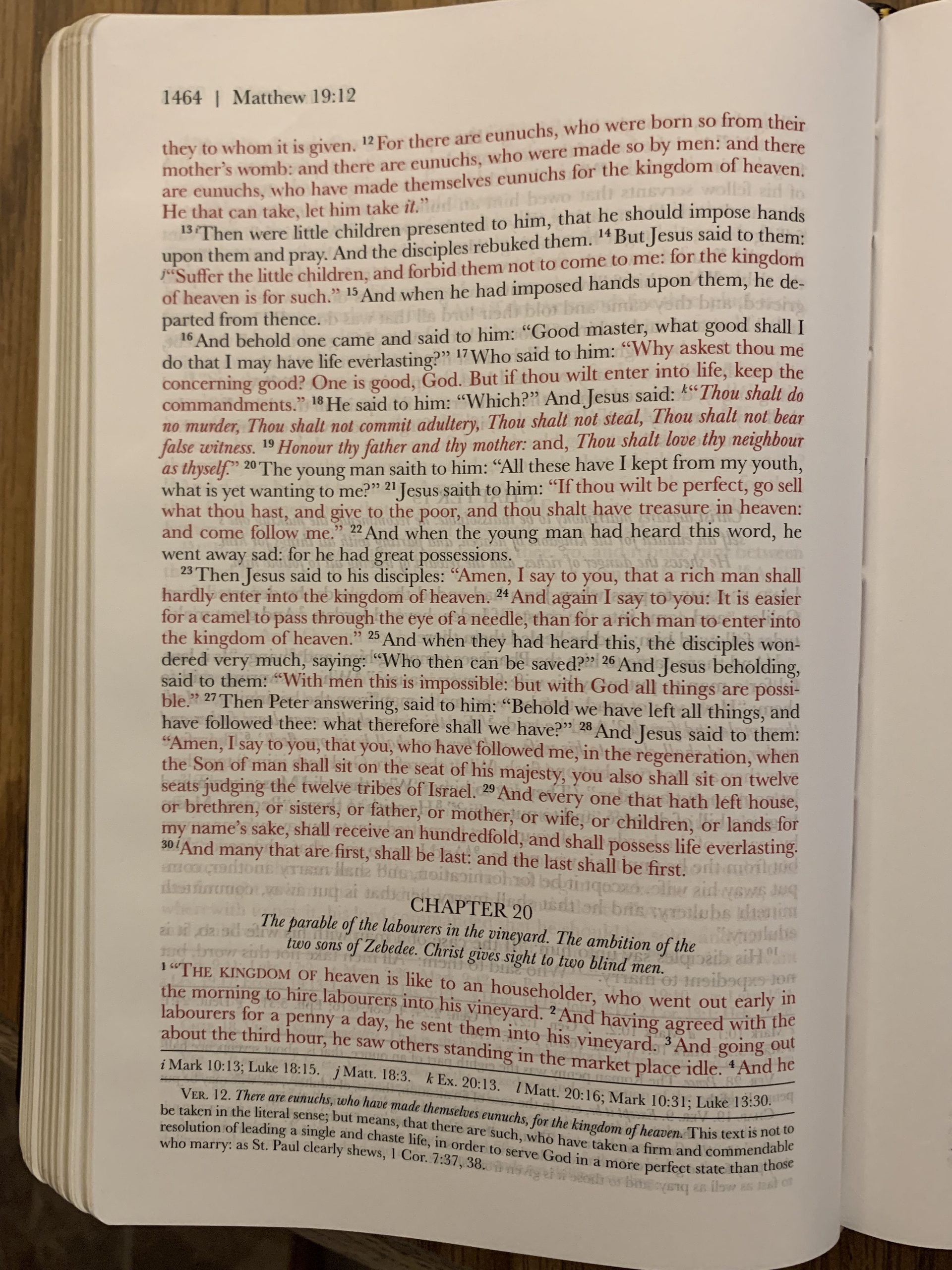
3. The use of Scripture quotations are presented well. Quotations are spaced out from the text and in italics.
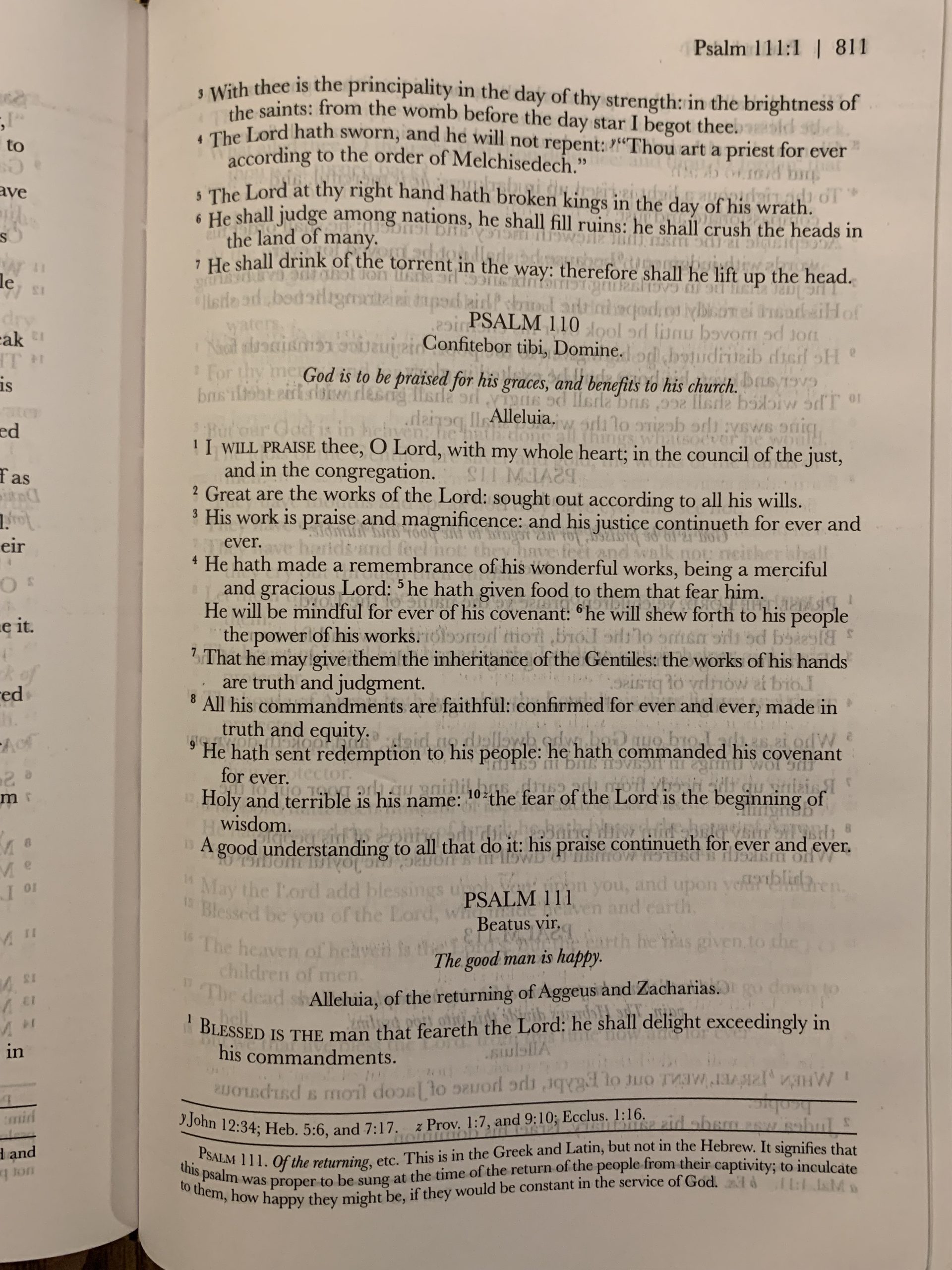
4. The poetic sections are faithful to the verse by verse presentation of the older editions, but the numbering is spaced out from the text, and it is also spaced out into stanzas. This, combined with the single column format make the poetry much more enjoyable and easier to read.
5. The Reader’s Edition retains the notes, references, and dates of the 1899 edition. Also included are the timelines, Tables of Epistles and Gospels, selected prayers, succession of Popes, and the same maps in previous Tan editions. Unlike previous offerings from Tan the maps in this edition are printed on Bible paper, not the thick, glossy inserts.
I have been collecting Bibles for many years, and with so many resources available online now I have become more selective of my physical purchases. This is one edition that I would wholeheartedly recommend picking up the physical copy. The only exception here is if you need large print, this is not large print. The print is comparable to the medium size Baronius and Tan Bibles of similar dimensions. I think it is possible that Tan will release a large print version of this especially if this sells well. Unless you do need large print, the Reader’s Edition is much easier on the eyes than any other available edition.
EDIT: Jonny provided a PDF file with a few additional images of the Bible text. The post-processing in the photos above has exaggerated the ghosting of text from subsequent pages. The PDF sample is more realistic to the amount of ghosting that is visible in person.
Are the words of Christ in the Apocalypse not in red?
The words in the Apocalypse are all in black. It is only the words of Jesus while on earth that are in red.
An Orthodox friend once remarked that it is odd, in many bibles, that the words God spoke in the Old Testament are not in red, but Jesus’ words in the New Testament are (in most such bibles, the last book is included). He found offense.
I wouldn’t call it offensive, but it is distracting, and, in deciding which words are the words of Christ, always involves a fair degree of ambiguity because it isn’t always clear, in particular in the Gospel of John, when Jesus stops talking and the narrator takes over
While I prefer the aesthetics of black text Bibles, I think a sound Catholic defense can be made for the devotional practice of having the words of Christ in the Gospels in red text. Yes, the Church teaches that all of the books of both Testaments, with all their parts, are inspired and have God as their author (Dei Verbum, §11); but it also teaches that “it is common knowledge that among all the Scriptures, even those of the New Testament, the Gospels have a special preeminence, and rightly so, for they are the principal witness for the life and teaching of the incarnate Word, our savior” (Dei Verbum, §18). The Catechism likewise calls the Gospels “the heart of all the Scriptures” (CCC 125) and says they have a “unique place in the Church” (CCC 127).
We see this echoed in the structure of the Mass as well, with the General Instruction of the Roman Missal calling the proclamation of the Gospel the “high point” of the Liturgy of the Word. It also says “the Liturgy itself teaches that great reverence is to be shown to it by setting it off from the other readings with special marks of honor,” which include the requirement that the faithful rise and either a priest or deacon proclaim it (§59,60).
So it is a “both/and” scenario: all of the Bible is the inspired word of God, and the Gospels have a special preeminence within the canon. By analogy, as the Church reserves special honors for the Gospels, printing Christ’s words in red within them can likewise serve as a devotional emphasis.
All true. The issue is that, in some cases, it’s not certain whether Christ Himself is speaking or the evangelist is commenting on Christ.
oof, that bleed-through looks rough.
These shots were taken with my iPhone and the image processing software exaggerated the ghosting. It’s just my inexperience taking photos… I should have used document scanning in the “Notes” app. Just for reference, the ghosting in my Schuyler RSV is slightly darker, and in the NOAB RSV darker still.
Thanks for this excellent review of TAN’s new edition of the Douay Rheims Bible – whoever you are (no name is affixed to the article). Although I love the Confraternity New Testament and the New Catholic Bible, I simultaneously have a love for the Douay Rheims Challoner version. I share your appreciation for the spiritual effects that reading this Bible has on the reader. I especially find the Gospels to have an otherworldly richness and eloquence, making it a superb Bible for adoration. And almost as important as the text, the footnotes are purely supportive of Catholic faith. By themselves they form a little biblical catechism. You never need to dread being jolted by some reckless comment that, rather than explain, instead explains away the meaning of the text. Yes, a gorgeous, precious, and ancient blessing from Saint Jerome that should never be neglected in the name of being modern.
Whoops, it’s by “Jonny.” The name is in the title, not the article.
Jonny, you mentioned the Douay Rheims Challoner footnotes and the help they gave you in converting. You ought to take a look at the footnotes in the original Douay Rheims. They are a manual of biblical apologetics all by themselves – much more so than in the Challoner version.
I downloaded scans of the original Douay Rheims years ago. They were cumbersome to read and after having purchased a very nice edition of the Haydock from Loreto I did not reference them much any more. I looked again online and found this amazing resource formatted for mobile:
http://www.thedouayrheims.com
This website not only has the original DR and notes in a handy, accessible format but also has the Vulgate, Challoner, Haydock, Knox, Confraternity, and CPDV. You can view these side by side and access the extensive commentaries. I have this saved as a link on my home screen!
Another great resource: the entire traditional Breviary is available in the Vulgate side by side with the Challoner DR. On the Apple Store it is called iMass by Anchoright Productions. I normally prefer a physical book for prayer, but having this on an app is really handy!
What a remarkable site. The actual physical books of the original Douay Rheims Bible can be bought here:
https://www.churchlatin.com/the-original-douay-rheims-bible
I understand the historical importance of the Douay-Rheims, but much like the KJV, I wonder why it is still in print. The language is antiquated (even though the standard edition dates from 1899); the text is corrupted with textual errors (such as adding verses that are not in the oldest and best manuscripts, like the Johannine Comma and Acts 8:37); and some of the translations are highly questionable, such as “do pennace,” a translation choice which seems to have been chosen more to “stick it” to Protestants than to accurately reflect the source, and “Judas hung himself with a halter.”, I genuinely have no idea where the “halter” came from, it isn’t in the Greek, and the Knox translation, also based on the Vulgate, doesn’t have that wording.
The Vulgate is an important text; it would definitely be very useful to have an English translation of the Vulgate, but the Douay-Rheims is flawed. I would say the Knox translation is better (and in general it is), but I can’t recommend it because he was forced to use language which is somehow even more antiquated than the 1899 Douay-Rheims.
I would like to see a translation of the Vulgate in modern English, if someone were willing to make one.
I much prefer the KJV. Thomas Nelson has a nice KJV w/apocrypha for 21 bucks.
I think the DR psalms have the edge.
Some of us love that “antiquated” language. Prayer can have its own vocabulary, as can truth. In both cases – for some of us – that spiritual vocabulary and general literary style are both inspirational and supportive of the spirit of prayer.
By contrast, Bibles that use language and style that sound like they were taken from one of Madaleine Albright’s campaign speeches is grotesque and distracting – to some of us – and the same is true for their footnotes.
As for the imperfections of the Douay Rheims Bible, don’t overstate them. With all the critical analysis available today, one can easily identify what few problems exist in the DRC. Even Fr. Hugh Pope’s work from the 1930s offers helpful criticism. But the beauty and majesty of the DRC version still prevail, as its substantial and highly devoted following proves. The fact is, its beauty motivates many people to read it regularly and devoutly. How can that be a bad thing?
I suppose some people would like the poetry of John Donne and William Wordsworth to be updated. But adapting it to the almighty modern standard would eliminate its grace, even if the basic themes and stories remained. Leave a little room for the mysterious and eccentric. Mathematical precision can dull the loveliest things.
That is, assuming you know what that antiquated language means, as with the KJV, there are what Mark Ward calls “false friends”, words we think we know but don’t, because their meanings have changed. We think we know what a verse is saying, but it is actually saying something different because the meaning of the words changed.
We see this even in common expressions: “The exception that proves the rule”, this expression is obvious nonsense; exceptions don’t prove rules; they disprove them.
The word “proof” is a “false friend” because the older meaning of “prove” is “test”, for example, if you buy a bottle of whisky that is “100 proof”, this means it was tested and found to consist of 50% alcohol.
That’s not a problem in the least. We’re not reading the DRC Bible on a desert island but alongside a dozen or two other Bible versions, not to mention with many Bible commentaries based on the DRC. It really isn’t a problem at all.
For those of us who love sacred poetry, this is heavenly:
“And for raiment why are you solicitous? Consider the lilies of the field, how they grow; they labour not, neither do they spin. But I say to you, that not even Solomon in all his glory was arrayed as one of these. And if the grass of the field, which is today, and tomorrow is cast into the oven, God doth so clothe; how much more you, O ye of little faith? Be not solicitous therefore, saying, What shall we eat; or what shall we drink; or wherewith shall we be clothed? For after all these things do the heathens seek. For your Father knoweth that you have need of all these things. Seek ye therefore first the kingdom of God, and his justice, and all these things shall be added unto you. Be not therefore solicitous for the morrow; for the morrow will be solicitous for itself. Sufficient for the day is the evil thereof.”
I think one can rather overdo the “false friends” argument. Most of the KJV and DR are comprehensible. Mark Ward’s obsession – he’s no friend of Catholicism – is driven by a desire to rebut KJV onlyists. He sounds like he’s trying to overcome a childhood trauma.
I will also make the controversial, but I think justifiable, point that “false friends” are less of an issue in the DR than in the KJV, and I even include the original DR in that. There were journal articles in the 1920s that I remember reading showing that the DR Gospels in particular were always written in a less archaic (even for the time) English than the KJV, and that the biggest strike against the DR (especially the original) was always its handling of the Pauline Epistles. When there’s a confusing word in both versions of the DR, it’s not because they’re misleading “false friends,” but rather because the word is so Latinate that it’s incomprehensible to most not already familiar with the Latin root. I would argue that a difficult, Latinate word is preferable to a “false friend” because at least the former forces you to slow down and use a dictionary, whereas the latter tricks you into thinking you know what it means.
The Protestant objections to the original Douay Rheims Bible appeared as soon as that Bible appeared. Scholars on both sides defended their respective translations. The whole affair is recorded in Fr. Hugh Pope’s fascinating book, “English Versions of the Bible.” The relevant chapter is called, “The Storm of Controversy.”
Since devotees of the Douay Rheims version often have to defend themselves for their traditional preference in Holy Scripture, I would suggest they get this book. There is actually quite a bit of historical information available on this subject. The story of the translation of this version by persecuted English Catholic biblical scholars is an inspiring one and it only adds to the veneration one can feel for the Douay Rheims Bible.
Here is a link to the book on Amazon:
https://www.amazon.com/English-Versions-Bible-Classic-Reprint/dp/0265564794/ref=tmm_hrd_swatch_0?_encoding=UTF8&dib_tag=se&dib=eyJ2IjoiMSJ9.4XYrjCMpNSVH9QL3198FSIAIrFz2MSnYQqYdgog-FGE2w_kbKsuXuTyTKxEGCMMgo9wbyuHI4UvnqpVGM53lM20CwSsu1tvTcurFn2egOJ0kcQJ6CxaRaoQug0iI_6OFdvr2m9Rqqo553QX9D6tmdmVuM_3-JaHRgXwbR1608gT9cc4PTqNCaRquCA-11JvJJXb8VXiM-nhFn_ZJYOcqfXaYAMJoGYYQXFsAn5t9onk.w2IHK7qCWSOd0QU_IOPaY3Qa-Q4vICyI2FaR9mg9gHk&qid=1792004818&sr=1-4
Timothy,
As someone with an original copy of Fr. Pope’s book, I wholeheartedly second your recommendation. It’s still a wealth of information, even with more recent books that purport to chronicle the history of the English Bible.
Thanks for writing the review, and I’m glad you’re happy with the purchase! It’s great to have more options out there! God be with you.
The way people “faithfully” reproduce typos… It drives me nuts.
Kudos to TAN for offering a new DR with a single-column paragraph format! I’m glad to see the effort they put into this new edition. The only complaint I have is that they didn’t break up the verses of the Psalms into multiple lines, like most Psalm verses are printed in modern translations. I’m sure that printing the Psalms verse-by-verse (with each verse number on a new line) helps to keep the page count lower, but it would be nice to see them fully embrace the poetic format. Other than that, though, this looks like a nicely-done Bible. I agree with Bren that the ghosting looks really lousy in the photos. Apparently it looks better in person?
The original pictures I sent you were over processed and sharpened by my iPhone XR camera app. I did a little trial and error and got better pictures in the Notes app. I used the document scanner, color mode, flash on. I sent some retakes of the previous pictures to your email to share here if you would like. These new pics are not the ones that showed the least ghosting but are the most accurate to how the Bible looks in person. I also included a pic of Hebrews 10 because it is a good example of how Scripture quotes are both used in paragraph and offset as their own paragraph, depending on the context.
After reading from the Bible for a couple days I have the binding pretty much broken in and it will lay flat from cover to cover. I have seen people forcefully crack the spine right in the middle… just so you know this is not my method. I like to take small sections, and starting from both ends gently open to relax the signatures gradually.
Thanks Jonny! I just updated the post to include a link at the bottom to the new sample images you sent. Here’s the link, in case anyone misses it at the bottom of the post:
https://catholicbibletalk.com/wp-content/uploads/2026/10/TanDRReadersEditionSample.pdf
Am I alone in thinking a CAB like this (but without red letters) would be just about perfect?
Joseph – 100%. Whoever makes a CAB in a reader’s format like this will get all my money.
You are not alone. That is on my wish list as well. With a real leather cover.
Thank you, Timothy, for the lead on Fr Hugh Pope’s book. I’ll definitely follow up. I know his (co-authored) essay on the development of the Rheims-Douay Bible in Dom Bernard Orchard’s Catholic Commentary on Holy Scripture (1953), a wonderful resource which all readers of this blog should have on their bookshelves. It seems Fr Pope was accused of modernism, a term incautiously and often unjustly bandied about in today’s febrile online Catholic discourse.
I agree, Edward. The expletive “modernism” – truly the synthesis of all heresies – is thrown at anyone who doesn’t fulfill an ultra-conservative Catholic profile. It often has nothing to do with whether or not one is faithful to defined Catholic teaching. And it is a terrible thing to misuse such terms.
I didn’t know about the charge against Fr. Hugh Pope. It surprises me, since I’ve always considered him to be a champion of the faith. Who exactly made the accusation and why?
Orchard’s commentary is among my most treasured resources. I use it alongside the daily Gospel reading from Mass.
My source is the ever infallible Wikipedia (!), which says that Fr Pope was accused of modernism in 1913 and had to leave Rome. He returned to England and became Prior of Woodchester. A German source – Dominican theologian Fr Elias Fullenbach – is cited but apparently Richard Finn’s “The Dominicans in the British Isles and Beyond” throws more light on events. He was dismissed from his professorship at the Angelicum and subsequently barred from teaching at Oscott, the Catholic seminary at Birmingham, where St John Henry Newman famously preached his Second Spring sermon in 1852 following the restoration of the Catholic hierarchy in England and Wales. Fr Pope’s dismissal would seem to be linked to his engagement with modern biblical scholarship and the question of scriptural inerrancy.
Well, that’s all news to me. Thanks for the depressing information.
My experience with Fr. Pope has been, along with the above-mentioned book, with his “Layman’s New Testament” and his two-volume “Catholic Student’s Aids to the Bible,” which has a Nihil Obstat and an Imprimi Potest. I haven’t read these books cover-to-cover but have used them topic-by-topic and have always found them to be orthodox and enlightening.
I don’t know. Could he have gone somewhat off the rails in the end, like a Tertullian, whom the Catechism of the Catholic Church quotes from about fifteen times, in spite of his later fall to Montanism?
If he was dismissed in 1913, it could have been that he was engaging with methods of Biblical scholarship that hadn’t been sufficiently vetted and nuanced by the Magisterium yet (Divino Afflante Spiritu was published 30 years later, after all), not that he was actually heterodox.
There is a happy ending to the story of Fr Hugh Pope OP. Fr Pope was sanctioned during the reign of Pope St Pius X but I read that his case was subsequently reviewed by Pope Benedict XV. He was exonerated and as a consequence resumed prominent academic and leadership roles within the Order of Preachers, including serving as Regent of Studies in England from 1920 to 1932. All’s well that ends well.
From the book “Hugh Pope of the Order of Preachers” by Kieran Mulvey, OP, on p. 41:
“The story of Father Hugh’s abrupt dismissal from Rome at the moment when he had reached the height of his academic career might well have caused bitterness and recrimination in a less magnanimous character than his. He was deeply grieved, of course; but it was not for himself that he minded; he could not endure, as a devoted son of St Dominic, that the Order should suffer any hurt or that its good name should be impugned through any attack made on his activities. And indeed the stigma which attached to him did not last long, for his rehabilitation at the hands of Benedict XV was a complete vindication.”
Further, on pg. 180:
“Acting on the advice of a friend in Rome, the late Abbot Langdon, O.S.B., who had been a faithful friend to Father Hugh when his orthodoxy was in question, he [Cardinal Gasquet] presented copies of the two volumes to Cardinal Gasparri, Secretary of State to H.H. Benedict XV. His Eminence, after studying them, presented them to the Holy Father, whose paternal approval was then communicated to Father Hugh in the letter which meant so much to him. This was the seal of approval of the Head of the Church. Hugh Pope, faithful son of Holy Church and of the Dominican Order, Doctor of Sacred Scripture, was vindicated authoritatively and finally.”
So in conclusion, yes, Fr. Pope was involved in some controversy, but was ultimately vindicated by no less than the Pope.
Very interesting, fathers and fellas, and mightily relieving. And thanks for your contributions to this fascinating little discussion. I did my own research about Fr. Pope, as well and found that the controversy clearly didn’t stick to him nor stain his future as a faithful son of the Church.
I remembered today that my main attachment to Fr. Hugh Pope (besides the fact that he was a Dominican and a great biblical scholar) was due to the central role he played in the formation and work of the Catholic Evidence Guild. I have long felt the deepest respect for the Guild and for Frank Sheed in particular. I think it was the most successful lay organization devoted to spreading Catholic truth ever established. In my mind, there’s no Guild without Fr. Hugh Pope. Not surprisingly, Karl Keating, founder of Catholic Answers, had highly praised the Layman’s New Testament, which is how I originally learned of Fr. Pope.
I picked one of these up and have loved reading it devotionally. So much so I sent it out to be rebound in goatskin.
To those who are frequently concerned with the country of origin of your Bibles, this Douay-Rheims Reader’s Edition is printed in India, not China. Additionally, a new printing of the Orthodox Study Bible by Thomas Nelson, available in genuine black leather and with better paper, matte-finish icon pages, a sewn binding, and much darker print, is also printed in India and set for a November release. So if you’re the kind of person who “boycotts” certain Bible editions due to being printed in China, it looks like some new options are opening up for you.