Hello again, it’s me, the unashamed New American Bible liker. It has been a long while since I wrote about my favorite translation family for this blog, but with the NABRE getting replaced by the Catholic American Bible next year on Ash Wednesday, I thought I should spend some time with an old friend.
While all the energy and marketing has been behind the Great Adventure Bible, the Bible in a Year Podcast, the (finally) complete Ignatius Catholic Study Bible, and the ESV-CE, it has quietly never been a better time to be a NABRE reader. After what seemed like years of shoddy editions with terrible page layouts, the last five years have seen a new and improved genuine leather Saint Benedict Press edition and two great NABREs from Catholic Bible Press. It seems like ages ago that we were celebrating that odd USCCB press NABRE with halfhearted fake leather like it was an oasis in the desert wastes.
In retrospect, the lack of decent NABRE editions was a little overstated, I think. Oxford has long offered a wonderful large print option—though the lack of any size between this giant and their comically small compact option has long struck me as odd, especially considering those wonderful 2005 RSV and NAB reader’s editions that still go for big money on eBay. Catholic Bible Press has also kept alive the Harper One hardback NABRE which to my mind has the best page layout of any Bible I own, bar none:
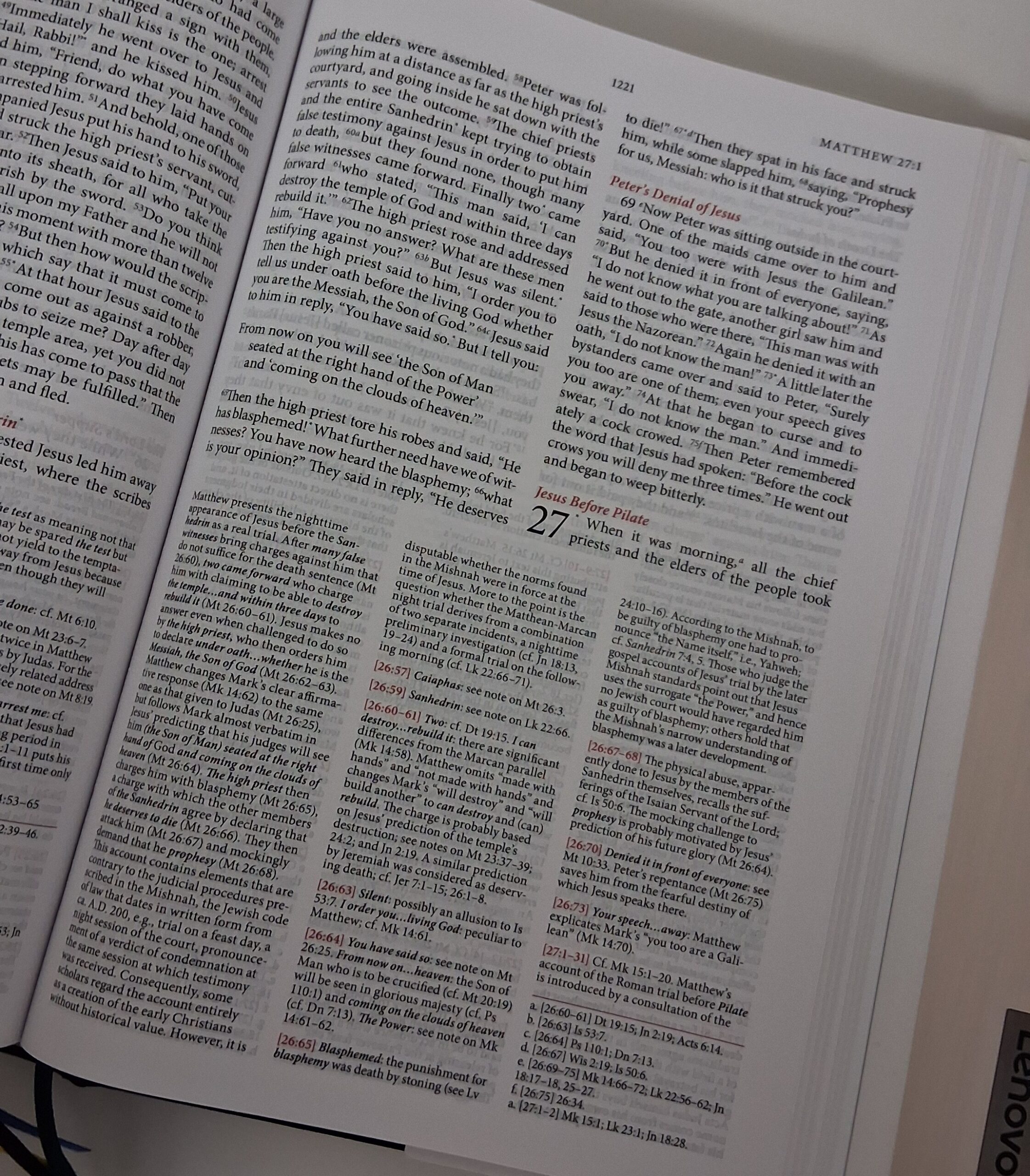
The good and the bad of NABRE editions and designs, however, will soon all be swept away like the antediluvian world. It is probably for the best. When everyone from Richard John Neuhaus to Trent Horn to Reddit users with user names I would not repeat in mixed company are on the record disliking your translation and accusing the footnotes of “quasi-heresy”, it might be time to change the name and delete a few annotations.
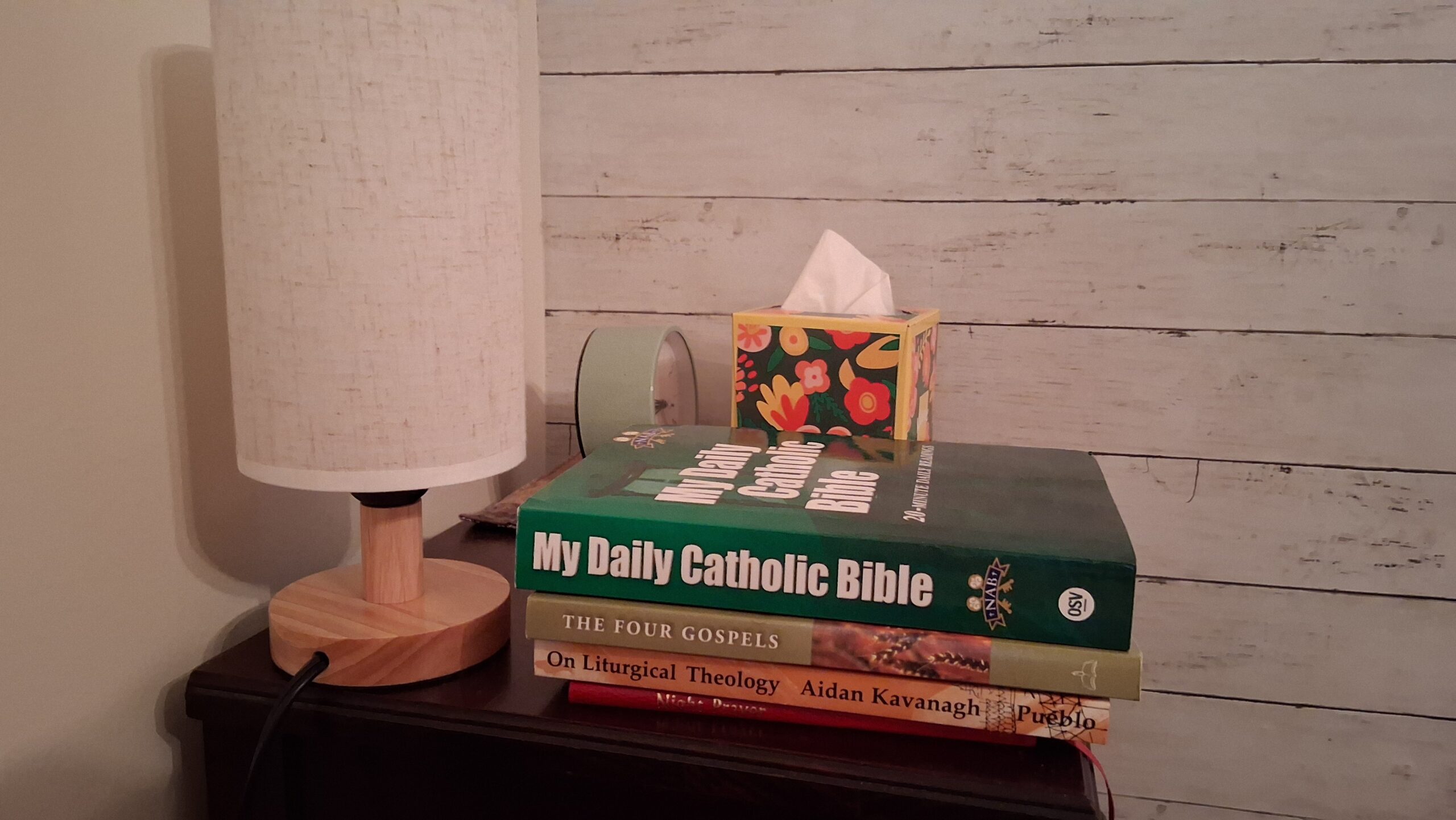
Before that happens, I will be taking the NABRE around the block one more time. I will be working through the NABRE edition of My Daily Catholic Bible (pictured above), an edition edited by the late Paul Thigpen in which the Bible is arranged in 365 daily chunks, purportedly of 20 minutes each. (You can read about the near identical RSV-CE edition in an earlier guest post of mine on this site.) I started late, so I will be catching up by reading an average of two chunks of daily reading per evening for a little while, at least until I catch up to the dates in the book, but maybe longer.
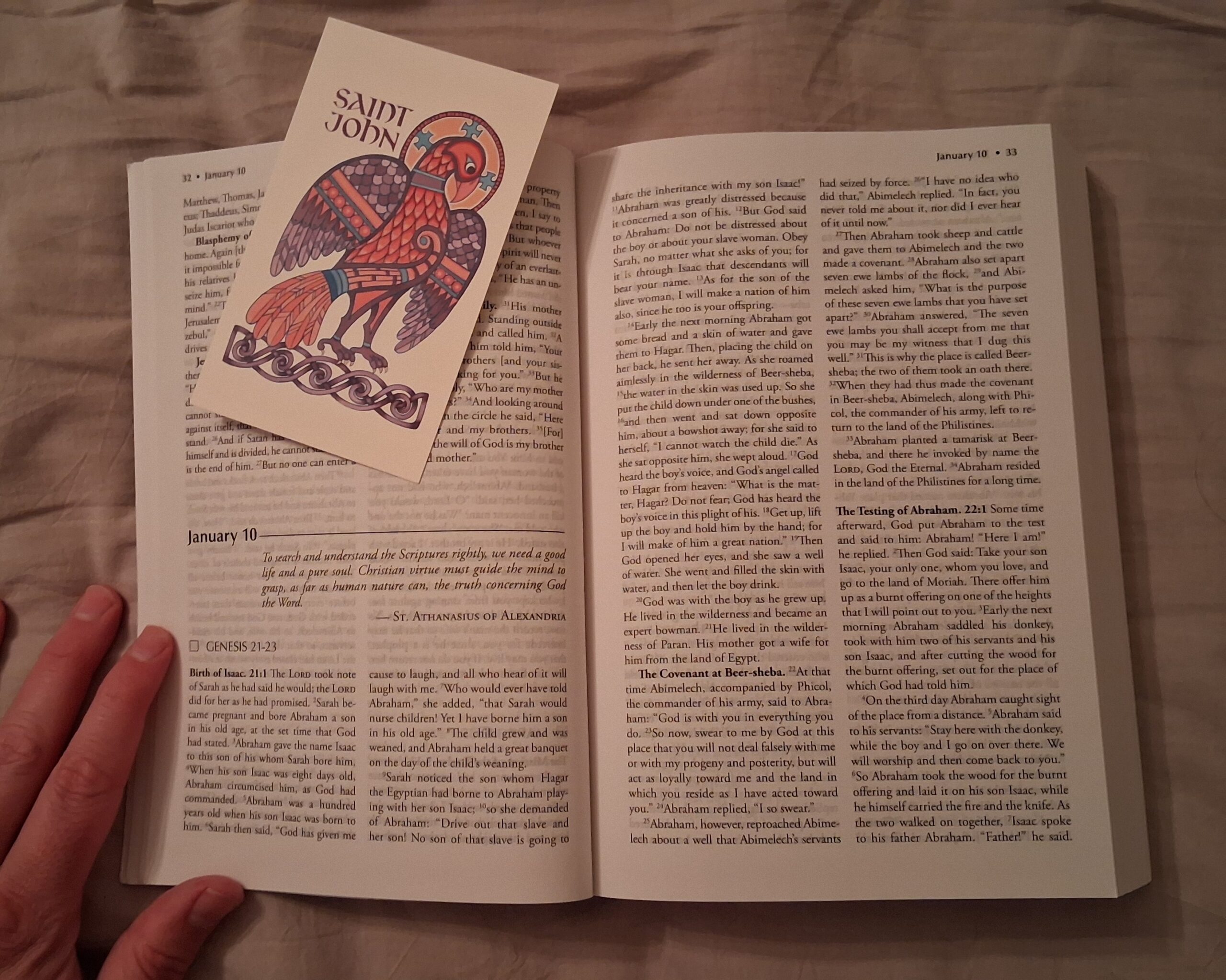
Besides that, I will also be pulling out a NABRE edition with the footnotes to work through a few books of the Bible for which I have only a surface understanding. I have never really done a full study of Ezekiel and Daniel, and especially after having done a deep dive into Jeremiah in the Lent of 2024, I want to know the work of these prophets better. I also want to strengthen my understanding of Deuteronomy. I recently remembered an offhand remark made in some book I read more than a decade ago that proposed that the biblical books with the greatest hold on the mind of the Jews in the Second Temple Period were Deuteronomy, Psalms, and Daniel.
Here are some stray thoughts on the state of the NABRE that are on my mind as the journey begins:
- I am convinced it is a translation that is better than you might think if all you are did was check out how it renders your favorite verse. I suggest reading John’s gospel or Job in full if you want a real window into what the NABRE has to offer.
- Strangely, as I have gotten more comfortable reading the Scriptures in a mode of faith and reverence, I have begun to appreciate the NABRE notes more, not less. It is true that they limit themselves to the literal sense, and often do so in a historical-critical stance, but in my Lectio Divina, what I really want notes to do is tell me what is going on with the literal sense of scripture. I do not want to be “on rails” with the other three senses.
Truly Catholic exegesis must be more than mechanically recalling a few of the canonized uses of allegorical interpretation: the queen in gold of Ophir=the Virgin Mary, the young Babylonians whose heads we ought to dash on rocks=temptations which are easier to fight when they are little thoughts, etc. If I was teaching out of the Bible in a school setting or working in OCIA or as part of the apologetical industrial complex, I would surely be using the Ignatius Catholic Study Bible. I certainly am glad to have one, and reference it often, but I find the NABRE more useful when I am deep in a Prophetic book and wondering what the original context of these words of Isaiah or Jeremiah. This is not the end of the exercise, but an important rung of the ladder that brings me out of Lectio and toward Contemplatio. - On a related subject, one my great hopes for the CAB is that it will have more editions that help people beginning their journey of reading the Bible with faith. I remember being a new Christian and needing reassurance that the Bible was not a Protestant book. Thirteen years on from that, I am convinced that the Bible is at home in the Church and I do not need an edition which relitigates the Reformation or shows me that the sacraments are really scriptural in their origin. Still, I sympathize with those who want or need that. There are, in my estimation at least, three editions of the NABRE that partly accomplish this.
The Little Rock Study Bible, by Liturgical Press, fits in this category with some friendly looking callout boxes and other material which could appeal to a Christian just dipping their toe into private Bible reading. If you get your Herods mixed up, this Bible has just the chart for you. This Bible does not have nearly the amount of helps, though, that the next two editions have.
Believe it or not, there is an edition of the Didache Bible with the NABRE text and not just the RSV2CE. If I remember correctly, for a while you pretty much had to order it directly from the Midwest Theological Forum. (If you are interested, it is on sale there for $30 plus shipping as I compose this post.) Based on my unscientific glances at the secondary market, I do not think this sold many copies. This edition contains all the Didache notes and all the NABRE notes, meaning that for sections of the Bible like the Creation or the Passion Narratives, you are looking at a page which is 75% notes. If you have always wanted a New American Bible with a chronology that will tell you the creation of Adam happened in either the 18th or 17th century BC, this is the one for you.
Liturgical Press also publishes the Liturgy and Life Study Bible, which features notes identifying where certain pericopes appear in the Lectionary, Liturgy of the Hours, and even places like the ritual books for Baptism. I think a combination of its price point and bespoke purpose has caused this edition to be sadly ignored. I have not owned it for very long, but enjoy it quite a bit. Don’t be surprised by my appreciation of this edition; I suppose I—a Benedictine oblate with an interest in liturgical theology who intentionally uses the NAB family of translations in an attempt to harmonize private Bible reading with the liturgy—was always going to be the market for this edition.
I suppose at some point I should review these three editions and we can ponder whether they will be missed when the NABRE slides into the purgatory of a defunct translation. - Is it just me, or have there been less complaints about hearing the NAB at Mass recently? Surely all the aesthetes did not convert to Orthodoxy or find a TLM community. My theory is that the lectionary seemed problematic to people who were already annoyed by the rather casual translation of the Missal we had before the 3rd edition of the Missal of St. Paul VI made its English debut in 2011. Could it be that people were mainly mad about the translations of the prayers, and the lectionary was catching strays?
- One odd piece of internet ephemera I will always remember from the NABRE era is an archived NPR story on the revision of the New American Bible in early 2011 in which their Weekend Edition show interviewed friend of the blog Mary Elizabeth Sperry. The host, a reporter named Lynn Neary, responded to the news that the NABRE psalter would be moving to the rendering “valley of the shadow of death” in the 23rd psalm by saying “well I’m glad to hear that actually.”
By what criteria could an NPR reporter with no special knowledge of Hebrew philology be glad to hear it? Certainly just because it was familiar. Perhaps I am being unfair—Neary was NPR’s religious beat reporter for a long time. Still, this seems to me to be a symptom of one of the most mind numbing aspects of amateur Bible discussions in English both in and out of the Church: there is part of us which will always suspect that a translation is only accurate inasmuch as the renderings plagiarize Tyndale, Coverdale, and the King James Version. This is mainly why you get points with the cognoscenti for translating anthropoi as exclusively male, but you don’t get any points docked for taking the proper noun ge-henna and rendering it as “hell”. As long as your vocabulary and diction, your dynamic equivalencies and infelicities of English style are in line with those found in the Authorized Version, you will have nothing to fear from most opinion havers. To once again paraphrase what Knox wrote in On Englishing the Bible, the problem with translating scripture is that everyone already thinks they know what it means. - Last year I saw a video online which bodes very well for those who want to see the NABRE tightened up even more when it emerges from its cocoon as the CAB. In April 2025, scripture scholar Mary Healy delivered a talk titled “How Catholics Can Reclaim the Authority of Sacred Scripture” at Saint Paul Seminary in Minnesota. For those who do not know her, she is a seminary professor who wrote the Mark and Hebrews volumes in the Catholic Commentary on Sacred Scripture series. Most impressively, she is on the Pontifical Biblical Commission. She was a protege of the late teacher and scripture scholar Francis Martin, and readers of this blog might like to know that she was a general editor of The Great Adventure Study Bible and that she is in favor of translations moving in a more literal direction.
After her talk, Healy was asked what translations of Scripture she prefers, and she gave a rather complete answer. She first mentions the ESV, saying it is “the best”. She explains that due to the stumbling blocks about permissions being given to Catholic presses trying to use it, it will likely never achieve large scale use in the Church. (She does not mention its adoption as a lectionary text in the UK.) She then mentions the Second Catholic Edition of the RSV as a great second choice. She seems about to trail off, but then gives a very interesting perspective on the NABRE that I will attempt to transcribe in full.
“I think the new New American Bible…the new new New American Bible [laughs], which will come out, as I said, in about a year, will be in some ways the most literal of any standard English translations we have available. It is…the NAB is already in certain respects more literal than the RSV, surprisingly. But it is more consistent, the new…it is only the New Testament that has been significantly revised. It is going to be much better.”
She mentions that she finds the RNJB to also be a major improvement over the NJB, and that after a generation dominated by dynamic equivalence, she finds translation quality is “on the upswing.” Her host then basically jumps out of his skin to mischievously ask, “…and the footnotes in the new New American Bible—how are these?”
“The footnotes,” Healy answered, “are…I should mention I am one of the people on the editorial board who oversaw that revision of the new New American Bible…”
“So they are awesome footnotes.” [Laughter].
“The footnotes are greatly pared down. They were way too long. In some cases the footnotes are…there is much more text of the notes than the biblical text itself. So they have been greatly pared down, simplified and there is nothing, as far as I’m aware, that is in any way undermining to Christian faith in the new notes.”
I suggest you watch the entire video. If you would like to check the quality of my transcription, skip to about an hour and four minutes in.
Dr. Healy’s comments bring up quite a few thoughts for me that I will only present in outline. Will the annotations be consistent in tone and frequency between the Old and New Testaments? Does this mean the NABRE will always be worth owning by virtue of its more ample notes? It is not just a possible anti-supernatural bias in certain notes that people dislike, or a scholarly disbelief in the prophecy. For some, the very idea that Saint Matthew did not write Matthew or that the Pastoral Epistles may not have been written by Paul is harmful to their faith.
When I was talking with Marc about this series of posts, we discussed how literal the 1986 New Testament is. Neither of us can imagine it getting much more literal, so I am quite surprised by Dr. Healy’s comments. I suppose there could be some tightening up. Perhaps measures of money, volume, and time could be expressed literally as opposed to so many days wages or in modern hours. I can’t think of much else. There is also the possibility that historical-critical information will be purged from introductions and notes, in which case the CAB will follow in the rich tradition of the translation family being an uneven reading experience; being always in progress and never finished. By this I mean that there is a risk of having an Old Testament with long scholarly introductions based on the sharpest 20th century scholarship with lots of annotations, and then a New Testament with not much of either.
One of the greatest virtues of the NABRE is that it was the first edition of the NAB in years to be a consistent reading experience. From 1970 to 1986 it was fairly dynamic, especially in the New Testament and Genesis, which had been the last books worked on. Then from 1986 to 1991 you had an Old Testament that was slightly uneven, but just leaning toward dynamic with no inclusive language, and a New Testament with some modest inclusive language that had gone almost as literal as the RSV. The 1991 Psalms were literal in a way, but represent a sort of high water mark in inclusive language, even avoiding using masculine pronouns for God. It is only since 2011 that we had a New American Bible which was fairly consistently literal, more so than the NRSV but less so than the RSV and ESV, and had consistent inclusive language. We will find out what comes next when Lent comes!
I will be providing updates every now and again as I progress through the farewell tour. In the comments tell me what you love and hate about the NABRE. Tell me what footnotes bother you the most. Rank the four Bibles to be published under the name New American Bible—1970, 1986, 1991, and the NABRE.
At the end of 15 years of service, the NABRE will pass the way of all flesh. Let these posts and their comment sections be a respectful but freewheeling Irish wake for this fine achievement by America’s finest Catholic biblical scholars. Let’s all say a prayer as well for all those translators and typists who worked on the Confraternity and New American Bible projects and now rest in the earth. May the Catholic American Bible be a crown upon their labors.
What a great post! I look forward to the rest of the series. With the exception of a handful of clunky spots (Isaiah 9:6 hehe), the NABRE Old Testament is probably my favorite OT currently in circulation.
I know this will never happen, but rather than letting it go into the dustbin of history, wouldn’t it be wonderful if the USCCB were to place the NABRE into the public domain, or at least under a generous Creative Commons license? If you want an approved Catholic English translation that you can freely copy or post to the Internet or use in a cellphone app without copyright concerns, your current options are —– the Douay Rheims, from 275 years ago. I suspect even a lot of critics of the NABRE would prefer to have it as the translation in their free bible app over the DR.