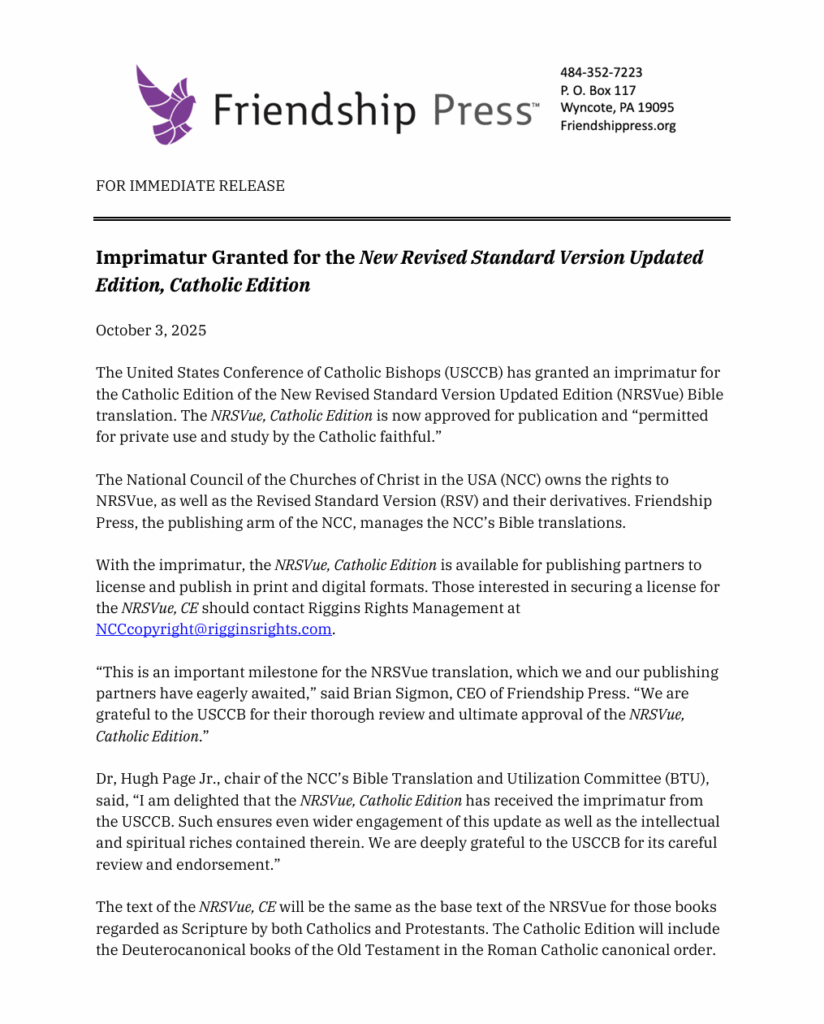
Friendship Press has published an official press release announcing the imprimatur for the NRSVue, Catholic Edition. It includes comments from Dr. Brian Sigmon, CEO of Friendship Press, and Dr. Hugh Page, Jr, chair of the Bible Translation and Utilization Committe of the National Council of Churches (NCC). It also confirms that there are no differences between the NRSVue and the NRSVue-CE except for the inclusion of the deuterocanonical books in the Catholic canonical order (a detail that was originally reported in the comments here on the blog).
I’m pretty surprised that granted an imprimatur to the NRSVue-CE. Not necessarily because of the controversial translation choices but because the latest revision to the NABRE was just completed and approved and will be integrated with the new LoTH and Lectionary. I mean, purely from a business perspective, I wouldn’t want to be adding to the competition; though I’m not sure how many people will actually pick up this latest translation. I personally like the NRSV-CE – I’ve never actually read the NRSVue-CE – but I don’t know anyone else aside from myself that uses it. Most people I know gravitate towards the RSV-2CE or the NABRE, so I’m doubtful the NRSVue-CE will catch on.
I probably won’t pick up the NRSVue-CE for the most superficial of reasons: the acronym is too long! But on a more serious note, primarily because I’m more interested in the latest revision to the NABRE. And I would like a translation that matches what I hear at Mass and read in the LoTH. I like uniformity. But if someone makes a sleek bible in the NRSVue-CE, I may be persuaded to pick up a copy.
I get the argument, but I think that it would be both petty and a wild abuse of ecclesiastical authority to spike a translation just so that the in-house translation doesn’t have rivals. An imprimatur doesn’t mean that it’s the recommended translation, or even that it is endorsed as a go-to translation. It just means that one can read it, use it for teaching, and feel safe that they aren’t being directly lied to (like the NWT or Passion Translation). I’m certain the revised NAB will receive explicit endorsements and support (and maybe editions from Ascension and WoF?).
Now that you mention it, I would actually be quite interested in seeing Word on Fire print the revised NABRE “Liturgical Bible.” Never thought about that.
Can we give it a new acronym that works?
How about the “American Liturgical Bible” (ALB for short)?
I didn’t really think about it like that. Still though, I do find the timing of it curious.
Garry, on the contrary, I’d be pretty surprised if the bishops based an imprimatur on a “business perspective”! That’s not what it’s for, my friend.
You might not realize it, but the NRSV is probably the most widely used Bible translation in the English-speaking world. It is the Bible of the mainline Protestant churches and the Catholic Church in Canada. It is also the Bible of academia; every single college student who takes a Bible class uses the NRSV, which is why every August-September the NRSV rockets up the sales charts. The National Council of Churches is a dying institution kept alive by the revenues generated by the NRSV and the RSV, and make no mistake, the NRSV is the bigger seller.
There is not a chance in hell that the NRSV is read more widely than the KJV, NKJV, or NIV. Also, I doubt its more widely used than even the ESV or NLT.
I looked it up out of curiosity. According to the ECPA Bestsellers List, the NRSV ranks #8 as of October 2025. NIV was #1, ESV was #2, KJV was #3, and NLT was #4.
https://christianbookexpo.com/bestseller/translations.php?id=1025
But in terms of translations that have an approved Catholic version, it’d be #3 just behind the ESV and NLT.
Also, it looks like it’s to be:
NRSVue, CE or NRSVue, Catholic Edition
not
NRSVue-CE
Wonder if it gets its own copyright date?
New! Revised! Updated!
Standard Version! Updated Edition! Catholic Edition!
I think it lacks more words in the name to be even less confusing 🙂
(Since we already have the Biblical Catholic and the Ballistic Catholic here, I’ll join the Catholic clan as the Bewildered Catholic)
The English language cannot provide enough synonyms for the adjective “new” to keep up with the needs of modern Bible translations.
Yes, just adding more letters is getting tiring. I kinda like the RSV-2CE name. The next version can just increment the integer.
We also seem to be well into a translation saturation situation. We may live to see the day when a new translation is published and it is later discovered that the translation team inadvertently made the same choices as a previously published existing translation. The two being nearly identical, both released into the wild without realizing they had created a shadow. I think I need a nap…..
The naming of Bibles has become a sport; it’s light and humorous religious entertainment. I thought the “Revised New Jerusalem Bible” name was a clever managing of new-synonyms. And it’s all set for the next version, which will be the “New Revised New Jerusalem Bible,” followed by the “Revised New Revised New Jerusalem Bible.”
As for the forthcoming successor of the “New American Bible Revised Edition,” I presume it will be either the “New American Bible New Revised Edition,” or the “Revised New American Bible Revised Edition,” which is getting just far too clunky to say out loud. And all this, usually over the latest and totally coolest advancement into inclusive language.
If the NAB-whatever eventually indulges in transgender-sensitive language, I suppose all the “he’s” and “his’s” will be replaced with “they’s” and “their’s,” in which case the version should be simply named the “New American Babel.” There; I solved the new-synonym problem for our totally awesome biblical scholars.
See, I first encountered the NJB as a Protestant, without knowing there was a prior Jerusalem Bible.
So I never heard the title as the “New” Jerusalem Bible.
I always thought it was the “New Jerusalem” Bible. Like a Bible named for the coming City of God in Revelation.
That still sticks in my ears today: it’s the Revised “New Jerusalem” Bible. 🙂
Yeah, I agree. I wish they’d just stick with the original name, but go with “editions” to distinguish between different revisions. E.g., New American Bible: third edition.
Simply hilarious! Love it.
CatusDei, I like your idea. Why has no other translation used this commonsensical solution? Although, it’s somewhat complicated by the publishing of editions in which only portions have been revised – only the Psalms or only the Old or New Testament. So, the forthcoming NAB would probably be named the New American Bible Fifth Edition. It’s still comical.
I think for right now I will wait on the nrsvue-ce. I still need two versions of WoF and we have the new liturgical bible coming out.
Same here. I don’t need another translation right now so I can wait and see what the members here have to say over time.
The two translations are identical for 98% of the text, so there’s not a big difference. If you like the NRSV, there is a good chance you will like the NRSVue better because almost all of the changes are corrections of inaccuracies and strange wordings in the NRSV.
I’m fond of the NRSV and the updates made in the NRSVue. I just hope for the catholic editions they keep the American text/spellings and don’t go straight to anglicized text. I remember reading that Cambridge would at least be printing what they call an international (American) text version sometime in the near future. Hoping the Diadem they plan on publishing will get the same treatment.
Yes, Cambridge has confirmed that they are still planning to publish an NRSVue Diadem reference edition before the end of this year, and it will use the “international” (American) text of the NRSVue.
Clearly my email to the Bible Society last year, saying their publication of the NRSVUE-CE was premature, was wrong.
https://www.biblesociety.org.uk/products/9780564037216/
What’s kinda funny is that, in light of the errata list, it seems all a Catholic has to do is get a pen, go to 1 Cor 6:9 and 1 Tim 1:10, cross out the offending translation text, circle the alternate translation text in the footnote, and that’s it, the NRSVue-CE is now usable. I’ve certainly read enough Catholic books, both academic and for laity, where the author has to explain with every other quotation that they’re using a footnoted reading in the NRSV-CE or RSV-2CE. Like many others, I’ll defer for a few more years until a good reference edition comes out and they flag more errata, but I think the reaction is a tad overblown.
Personally, I’ve been getting into the REB more and more the more I use it, and yet Cambridge/Oxford seems to slowly be phasing it out more and more! The only edition that includes the apocrypha anymore is the Oxford Study Bible (not to be confused with the NOAB) and they’re no longer offering imitation leather options outside the New Testament. Meanwhile, Cambridge seems to be offering the Christian Standard Bible (which is basically evangelical/baptist) in all kinds of new options. Alas!
I struggle to understand Cambridge’s move into recent Protestant translations. I guess they see a chance to make a profit. I’m all for drawing on a multiplicity of translations – although I have a personal policy of steering clear of Bibles without the so-called deuterocanon – but I question the value of yet another translation such as the CSB which is, essentially, a minor variation of an existing theme.
Well, truthfully, ever since Tyndale, every Bible translation has been “a variation of a theme.” One either follows Tyndale or is very conspicuous about not following Tyndale.
Unfortunately, despite its overall quality, the REB has never gotten any traction, even in its native England; perhaps sales just aren’t what Cambridge and Oxford have hoped for.
The Christian Standard Version is a fairly good translation. It is the official translation of the Southern Baptist Convention, but it doesn’t appear to have any bias in that direction, for example, by translating “immerse” instead of “baptize”. Since I was a teenager, I have had Baptists tell me that “baptism means immersion”. But the CSB avoids this kind of obvious bias. Except for the fact that it contains only the truncated Protestant canon, there is really nothing in it for Catholics to object to. It is supposedly the second-best-selling Bible translation after the NIV, according to the Evangelical Christian Publishers Association (meaning that Catholic translations are not even counted).
If there is one problem with the text, it is that it is unusually unstable. It was first published in 2004, and it had several unique features. It was revised in 2009 and doubled down on those features. Then it underwent a radical revision in 2016, which removed everything unique about the text, and then underwent another revision the very next year.
I don’t know why there have been such radical revisions in such a short time, except that I assume it reflects turmoil within the Southern Baptist Convention, which has undergone several fairly radical transitions in leadership so far this century.
I’m sure spurning the CSB is my loss. I just can’t get over what is for me is a seemingly insurmountable hurdle, that several books are missing. My loss, I’m sure, and I’m probably reacting against all those Protestant videos telling me I need a “premium” edition of the latest version based on some obscure manuscript tradition that nobody worries about other than a few hardcore diehards. I regularly read from all the translations in the Tyndale/KJV tradition, through the RSV, NRSV and ESV, and from time-to-time from the JB tradition, although I’m not sorry to see the back of the JB lectionary here in Britain, despite some niggles about the ESV. And I am using the DR as an accompaniment to St Augustine’s expositions of the psalms. Life is too short for more – quite literally at my age!
Oh, I am not saying you are missing anything; I’m saying that if publishers are switching from the REB to the CSB, it is probably because it is a decent translation and gets good sales, it is very “in” right now.
I bet internet culture has a lot to do with it… A bunch of armchair experts have immediate and total access to the whole text and can provide instant feedback, particularities of the text essentially become widely circulated memes (like the ESV’s Genesis 3:16), and widespread likes and dislikes are easily studied by the translating body. So, to me, that would lend itself to quick and too-frequent amendments to the text.
Modest changes like the ESV, sure, but the changes with the CSB have been fairly extreme. It was renowned for being a translation that used the name of God, Yahweh, rather than substituting “LORD” like most translations do. Its second edition in 2009, doubled down on this, using Yahweh hundreds more than the first edition. They not only did this, but also advertised it as the main reason to prefer it over other translations.
A mere 7 years later, in 2016, all the “Yahweh”s were stripped out of it completely. This was not just a modest revision like the 2016 ESV compared to the 2020 edition. It was a complete bottom-up re-translation.
It was revised again, in less radical ways, in 2017 and 2020.
But what did happen in the Southern Baptist Convention between 2009 and 2016 was the complete collapse of the conservatives who had led the denomination for over 20 years and their replacement by a much more liberal group that repudiated a lot of the previous policies of the conservatives.
An important article from Catholic Culture on the NRSVue:
https://www.catholicculture.org/commentary/gay-washed-bible-again/
Thanks, but no.
That conversation has already played out over on the other thread:
https://catholicbibletalk.com/2025/09/nrsvue-ce-approved/
Short version:
1) Original author Robert Gagnon weighed in to clarify that his comment was about one translation choice of one word, not the whole translation.
2) The continued misrepresentation of his statement by Catholic Culture, Complicit Clergy, and Catholic Answers says more about their agenda than about the translation.
3) Translation validly approved by valid ecclesiastical authority. If it’s not your favorite approved version, don’t use it.
No need to get testy. I’m only offering information some people might care to have.
And I’m just pointing out where that information is, so as not to replay the whole episode here too.
Literally, the author of the original remark being quoted explains his meaning and corrects the out-of-context use. Validly stands by his disagreement with their translation choice, but points out these blogs are overstating the case he was trying to make.
Nothing “defensive and hand-wavey,” as Transhuman dismissed it.
More like “tired and wanting to avoid being dragged down the same rathole twice.”
Eh, sounds pretty defensive and handwavey. In any case, I wouldn’t trust random internet commenters for “debunking” vs organizations who have staked their reputations on it. If Catholic Culture is pedaling a false narrative, I’d expect Friendship Press or one of their scholarly groups to put out a statement or FAQ.
That they have not, is rather telling.
NPR Really Secular Version ultra egalitarian
New Really Surely Very Updated Edition
Hi I’m new here. I wonder what Catholic publisher (or a protestant one that publishes Catholic Bibles),
will publish this translation. Although if you buy an edition with the apocrypha (duetercanonicals), and you read the full Catholic canon, then it’s apparently the same text as the “Catholic edition” (CE).
I think friendship press said that the protestant edition is the same as the Catholic edition.
Yes, that’s correct. The text is the same between the Protestant and Catholic editions. The only difference is the inclusion of the deuterocanonical books which are part of the Catholic canon of Scripture.
I expect that Catholic Bible Press (a subsidiary of Harper Collins) will be publishing the NRSVue Catholic Edition. They have been publishing a variety of editions of the NRSV-CE. Since Friendship Press is phasing out the old NRSV, I suspect that Catholic Bible Press will update their editions to use the NRSVue.
I’m figuring anyway that I’ll get the NRSVUE with apocrypha hardcover from SPCK since it is the same text. Plus, I can read the Eastern Catholic Churches canon as well. I prefer hardcover (I seem to like hardcover Bibles as of now.)
(Correction)
Yep. I was thinking that CBP would publish it (they will probably publish it first),
as they already publish the NRSV. I actually own one of their NRSV-CE editions!
I will probably get the SPCK NRSV-UE with apocrypha as the biblical text is the same,
and I can the books that the Eastern Catholic Churches accept as canonical (even tho I’m RC).
Actually, (as an Eastern Catholic myself) the Eastern Catholic Churches accept the same canon as the whole of the Catholic Church.
1) This is a dogmatic question, not a rite one, so there would be no differences here.
2) The Council of Florence, in its acts of union with the Eastern Churches, referenced the Catholic canon.
3) The Catechism of the Catholic Church lists only one canon, although it always states the differences between rites if there are some.
4) The Catechism of the Ukrainian Greek Catholic Church lists the Catholic canon (the only difference being listing the Letter of Jeremiah as a separate book).
5) The only apocryphal text used in the liturgy is the Prayer of Manasseh, but it’s used just as a prayer, not as a biblical text. In the same way, the traditional Roman rite quoted from the Apocrypha like 3 (1) and 4 (2) Esdras.
Thank you for clarifying. We actually use the prayer of Manasseh (it’s very chopped up), but we use it regardless. It’s really like an apocryphal text. I like to view the Books like “Extra books” (for spiritual reading) in a sense.
Honestly I think I’m confused about the books like 3, 4 edras etc…i think I’m confused about the separation of some books and how some books are divided differently or such. I don’t even know those books and what they are and what their about.
Correction: Yep. I was thinking that CBP would publish it (they will probably publish it first),
as they already publish the NRSV. I actually own one of their NRSV-CE editions!
The Eastern Catholic Churches have different books in their canon because they have different views on how books are in their canon (Eastern traditions) but never the less, their canon is accepted by the Catholic Church.
The Eastern Catholics have the same exact canon as in the Latin Rite because they also affirm the Council of Trent’s canon list, because they are part of the Catholic Church: 73 books (74 if the Letter of Jeremiah is separated from Baruch).
“The text of the NRSVue, CE will be the same as the base text of the NRSVue for those books
regarded as Scripture by both Catholics and Protestants. The Catholic Edition will include
the Deuterocanonical books of the Old Testament in the Roman Catholic canonical order. ”
What’s the point of the Catholic Ed., without the Catholic specific changes? E.g. RSVCE / 2CE changes like Lk. 1.28 (full of grace) or Isaiah 7:14 (… Behold, a *virgin* shall conceive and bear a son, …).
I don’t see the point of buying a Catholic Edition and it not being Catholic in nature or more generally Christian. I’ll just skip it and go with the regular edition of the NRSVue that comes with friends. 😉
What we really need to determine is: what constitutes a Catholic version of Scripture? The simple answer is that it’s a Bible that contains the Catholic cannon of Scripture. For both the NRSV and NRSVue, they have 3 editions: the standard text (Protestant cannon), the text with Apocrypha (which generally contains all “Apocryphal” books in the Catholic and Orthodox cannon), and a Catholic Edition (full Catholic Cannon).
As a Catholic, what do you value most: 1) the most accurate reconstruction of the original text regardless of doctrine or tradition; 2) the most accurate reconstruction of current Catholic Biblical tradition, represented by the Nova Vulgata (New Vulgate, NV); or 3) the Biblical tradition of St. Jerome and the Church leading up to the promulgation of the Nova Vulgata (represented by the Clementine Vulgate and the English Douay Rheims and Knox Translation). Considering we do not have a Bible in English that completely follows the textual tradition of the Nova Vulgata, we have to either compromise with a version that somewhat approximates the textual tradition of the NV, or one that you think most accurately reconstructs the original text. Or you could be in the traditionalist camp and only use the DR or Knox.
The NRSV and the NRSVue, while under the umbrella of the Nathion Council of Churches, are both translations that aim more towards an accurate reconstruction of the original texts without regard to religious tradition. That is one of the reasons why it is a favorite in the academic world. I am not asserting that there is no religious or political bias in the NRSV and NRSVue, because there very well could be. But by and large, it has less of a religious or denominational bent to it than most popular translations.
That said, for a translation that is not trying to represent the Catholic Biblical tradition more than the books that are in the Catholic cannon, I am totally fine with non-traditional variant choices and wording. In fact, I like the NRSV/NRSVue for the sheer fact that they prove the Catholic faith without any attempt to do so. In their effort to slavishly reconstruct the original text, even at the expense of traditional choices, they are laying bare what might be the closest representation of the original Biblical text. I should emphasize again, “might be”. I am not sure if it is. But for me there is a lot of value in having an agnostic translation that still supports, defends, and proves the truth of the Catholic faith.
Bottom line: If you want a Bible more in line with Catholic tradition, the only 4 modern translations that use “Hail full of grace” AND “behold, a virgin” are the RSV-CE, RSV-2CE, RNJB, and the NCB. The Douay Rheims and Knox also have it. Time will tell how much the forthcoming revised NABRE and CSV (Catholic Standard Version) will lean in the Catholic tradition direction.
I appreciate your comment, thank you.
1) “both translations that aim more towards an accurate reconstruction of the original texts without regard to religious tradition.” I literally don’t see the point of this when it comes to a Catholic edition for the purpose of it is to *nourish people’s souls* and preach the *correct faith.*
2) The Nova Vulgata is translated from Greek and Hebrew critical editions with traditional Vulgate renderings into Latin.
3) My goal here is to protect souls by getting the NRSVue, CE to follow tradition. 😉
You can see my comments on reddit on this issue: https://www.reddit.com/user/DidymusJT/submitted/
On your second point, the New Testament of the NV is similar to most modern English translations in that its largely based on the Nestle-Aland (NA) critical text. That makes the differences are more minimal, but the NV does retain various traditional renderings that aren’t the primary choice in the critical text.
The Old Testament, however, does not have a comprehensive “eclectic” critical text comparable to the NA, though there is one in production with only one volume released so far (https://verbum.com/product/356039/proverbs-an-eclectic-edition-with-introduction-and-textual-commentary?queryId=05775960d12ecfafd1afbb4ae9f75c60) . There is a critical Hebrew text (Biblia Hebraica) and a couple critical Septuagint texts (Göttingen and Rahlfs-Hanhart), but they are critical editions of the MT and Septuagint only, not the OT as a whole across all ancient editions, including the Targums, Dead Sea Scrolls, Vulgate, Samaritan, and Syriac.
What ends up happening is each translation creates their own composite Old Testament from all of those sources, but they vary unpredictably given all of the variant options. There are literally thousands of places where these ancient versions have variant texts for the same verses, and each translation picks and chooses as they think best. For example, fundamentalist-leaning Protestant translations view the MT as more authoritative and translate primarily from that (e.g. NASB, LSB, ESV), whereas most Catholic edition translations use a lot more variants from the Septuagint and other ancient versions (e.g. NRSV/ue, NABRE, REB, RNJB, NCB).
That is what makes the Nova Vulgata Old Testament so important. In the absence of widely acclaimed OT critical text, as Catholic we can look to the NV as the reference point. Since the NV is more in line with the translations listed above that lean more on the Septuagint and other ancient texts, those are the best representatives of Catholic Biblical tradition. Even when they do complete the “The Hebrew Bible: A Critical Edition” series a few decades from now, there will be a substantial amount of guesswork in is its reconstruct of the original text because of the vast array of ancient editions and variants; so the NV will remain an essential authority on the matter.
The NRSV/ue is the translation that best represents a scholarly reconstruction of the Old Testament, IMO. They document in the footnotes every time they depart from the MT in favor of a different variant, and they tell you which of the ancient versions attest to the variant they chose (something no other translation does consistently, except maybe the NET). They also aren’t choosing variants specifically to be more in line with New Testament references or to be more Christological. They are essentially agnostic and thus impartial when it comes to doctrinal matters and variant choices, which makes it very valuable as a either a primary text or as a reference text.
As a translation that is not trying to represent the Catholic Biblical tradition more than the books that are in the Catholic cannon, I am totally fine with non-traditional variant choices and wording. In fact, I like the NRSV/NRSVue precisely for that reason. There is a lot of value in having an agnostic translation that without attempting to do so, still reaffirms all of the truths of the Catholic faith.
Yeah, a none-traditional Bible translation totally can prove the truth of the Catholic Faith because the truths of the Catholic Faith can (are) be affirmed by the Bible.
Random point, but I was looking at the original DR Bible, and was struck by the translator’s decision not to translate the Latin word “depositum” in 1 Timothy 6:20: “O Timothy, keep the depositum, avoiding the profane novelties of voices, and oppositions of falsely called knowledge.” What then struck me is how the ESV and, yes, the NRSVue (but not the original NRSV) seem to throw a bone to the old Catholics here where modern Catholic translations do not. See:
ESV (and CE): “O Timothy, guard the deposit entrusted to you. Avoid the irreverent babble and contradictions of what is falsely called “‘knowledge’”
NRSVue (and CE): “Timothy, guard the deposit entrusted to you. Avoid the profane chatter and contradictions of what is falsely called knowledge”
And contrast with these:
DR (Challoner): “O Timothy, keep that which is committed to thy trust, avoiding the profane novelties of words, and oppositions of knowledge falsely so called”
NRSV (89 and CE): “Timothy, guard what has been entrusted to you. Avoid the profane chatter and contradictions of what is falsely called knowledge”
RSV-CE (1st and 2nd editions): “O Timothy, guard what has been entrusted to you. Avoid the godless chatter and contradictions of what is falsely called knowledge”
NABRE: “O Timothy, guard what has been entrusted to you. Avoid profane babbling and the absurdities of so-called knowledge”
JB: “My dear Timothy, take great care of all that has been entrusted to you. Have nothing to do with the pointless philosophical discussions and antagonistic beliefs of the ‘knowledge’ which is not knowledge at all”
NJB: “My dear Timothy, take great care of all that has been entrusted to you. Turn away from godless philosophical discussions and the contradictions of the ‘knowledge’ which is not knowledge at all”
RNJB: “Timothy, take great care of what has been entrusted to you. Turn away from empty secular talk and the contradictions of what is falsely called ‘knowledge'”
It’s worth noting that the untranslated “depositum” is also used in 2 Timothy 1:12 and 14 of the original DR, and the ESV, CSB, and even the NIV use “deposit” in v. 14, but not Challoner, not the RSV-CE, and not the NABRE. And yet the NRSVue uses it in both, and the ESV uses it in v. 14, though not v. 12. I have to say, this is rather awkward when translations that tend to be viewed more with skepticism from certain Catholics happen to have a more traditional Catholic translation choice in places that the original DR Bible placed a lot of emphasis on (to the point of refusing to translate a Latin word altogether).