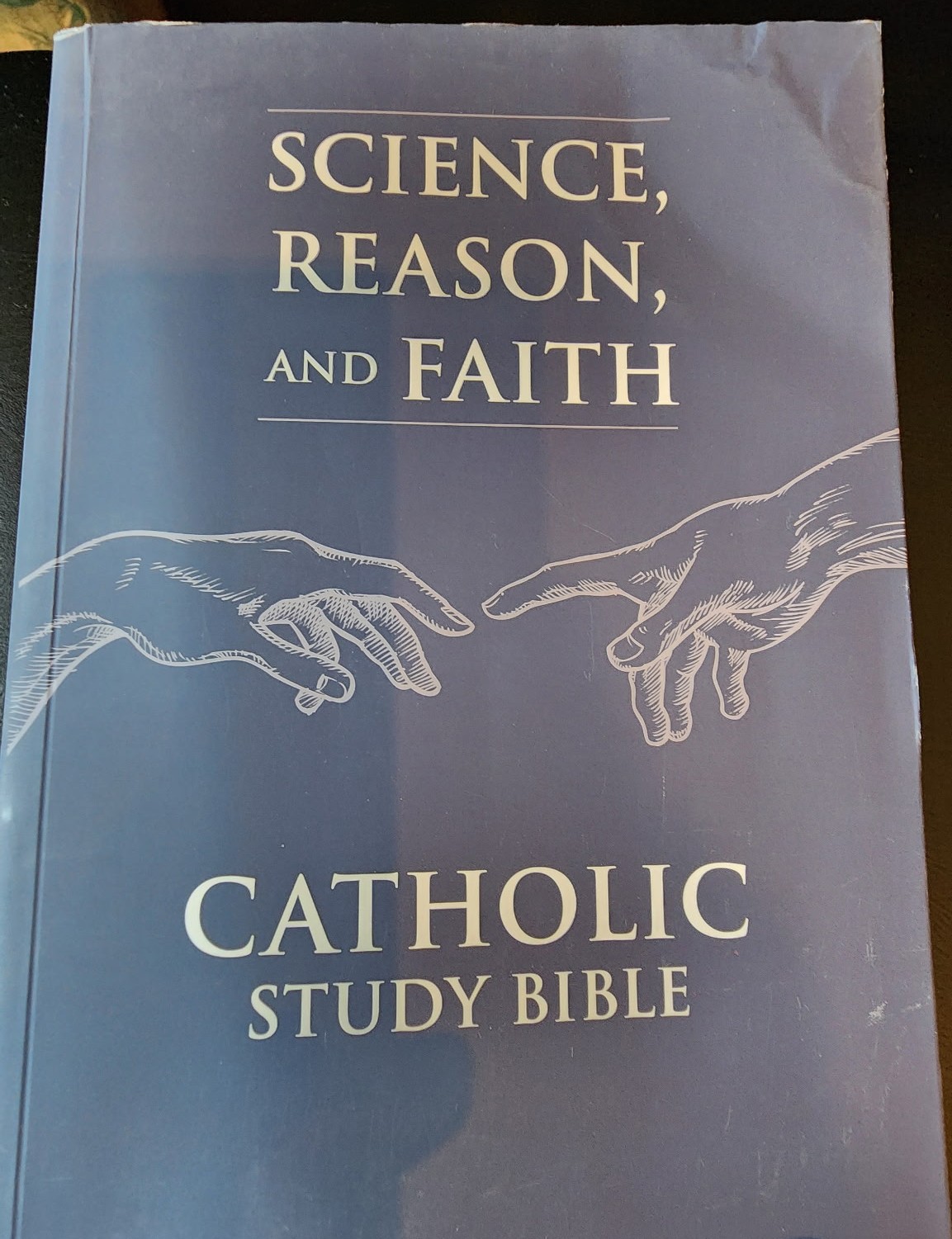
Fr. Robert Spitzer SJ, president of the Magis Center for Reason and Faith and past president of Gonzaga University, has published a brand new study Bible with OSV Press using the RSV-CE biblical text. I purchased a copy from Amazon in July, and I’ve been working my way through the informational essays, book introductions, and a portion of the commentary sidebars throughout the biblical text. As of this writing, I’ve read all of the introductory material on the Old Testament, most of the OT book introductions, and most of the commentary sidebars in the Pentateuch. I’ve also read the first part of the introductory essays on the New Testament.
Brief Synopsis
This Bible is educational and thought-provoking with readable font, average ghosting, and a single-column text layout in most biblical books (except for poetic and some prophetic books, which are printed in two columns). It builds a case for interpreting Scripture in light of science and Catholic doctrine, taking both science and doctrine seriously as sources of truth. Some of the introductory essays seem tangential to Scripture and are focused on common hobby-horses in Fr. Spitzer’s other work (near-death experiences, evidence for the soul, scientific study of the Shroud of Turin, etc.). Additionally, some of the essays build a quite speculative argument for reconciling specific findings of science with faith based on the writings of a few scholars whose conclusions are either controversial or possibly out-of-date. But the core essays on biblical interpretation provide a clear, non-fundamentalist approach to Scripture which is informed by Catholic tradition and recent papal teaching.
Physical Construction and Typesetting
This Bible is only available in paperback, but it has a sewn binding. (Yes, you read that right.). Sewn signatures are clearly visible along the spine.

The biblical text and the introductory essays are generally printed in single-column format, except for some poetic and prophetic books, which are printed in double-column format (presumably to fit more text onto a page). Here is a full list of books printed in two columns:
Job, Psalms, Proverbs, Song of Songs, Wisdom, Sirach, Isaiah, Jeremiah, Hosea, Joel, Amos, Obadiah, Micah, Nahum, Habakkuk, Zephaniah
The font is comfortable to read with good line spacing. There is more ghosting than I would ideally like, but it is basically average for a Bible. It generally doesn’t interfere with reading for me, although it is definitely noticeable.
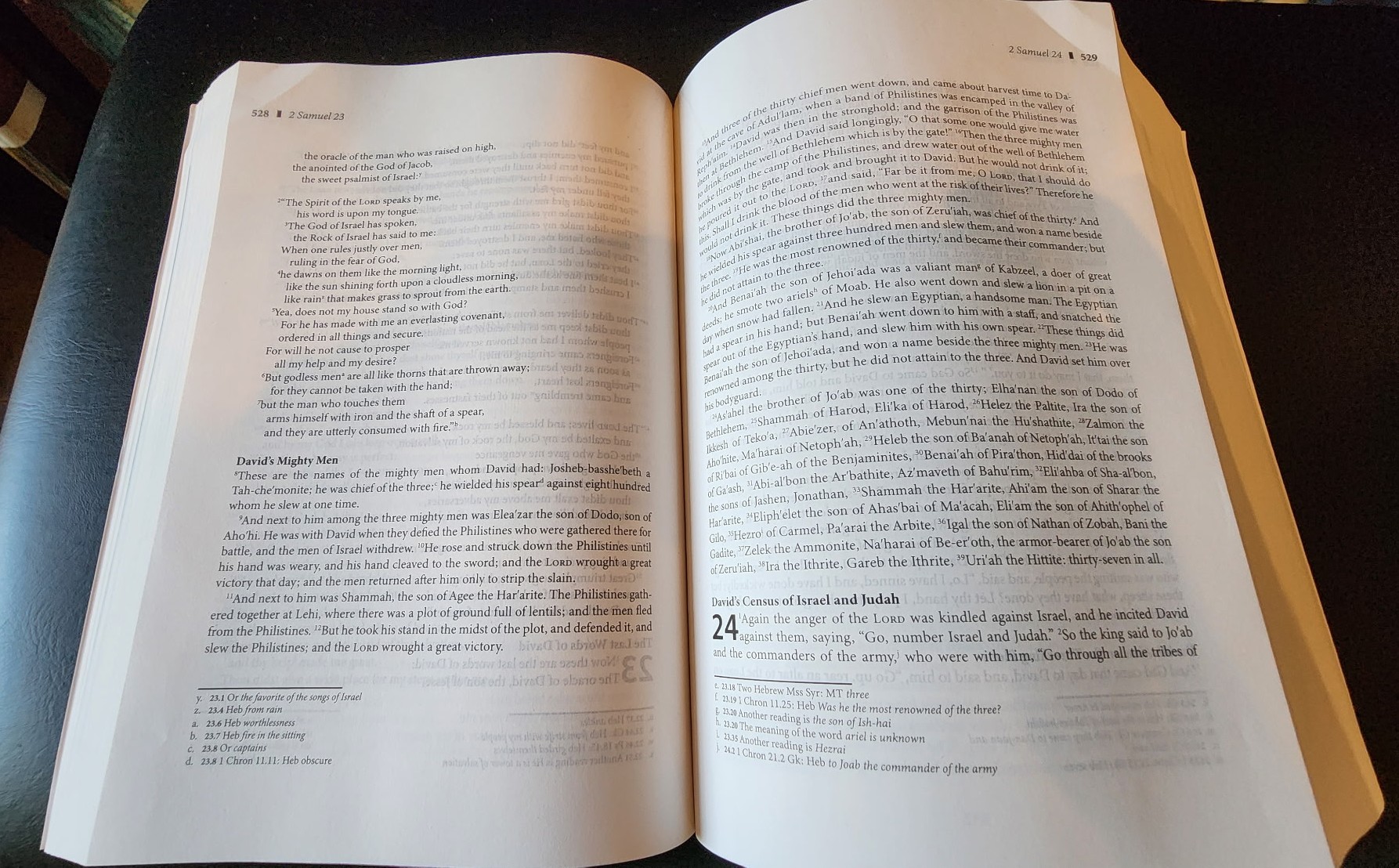
Book introductions are printed in blue ink, and commentary throughout the biblical text is printed in sidebars with black text and a blue background. Introductory essays are printed in black ink using the same font size as the biblical text.
Similar to the Saints Devotional Bible (NABRE) from OSV Press which I reviewed here, this Bible arrived with a banged-up corner, which bent the pages from Genesis through Job. It was packaged with no shrink wrap or padding, so it was pretty inevitable that it would sustain some bruises during shipping.
Essays, Book Introductions, and Commentary Sidebars
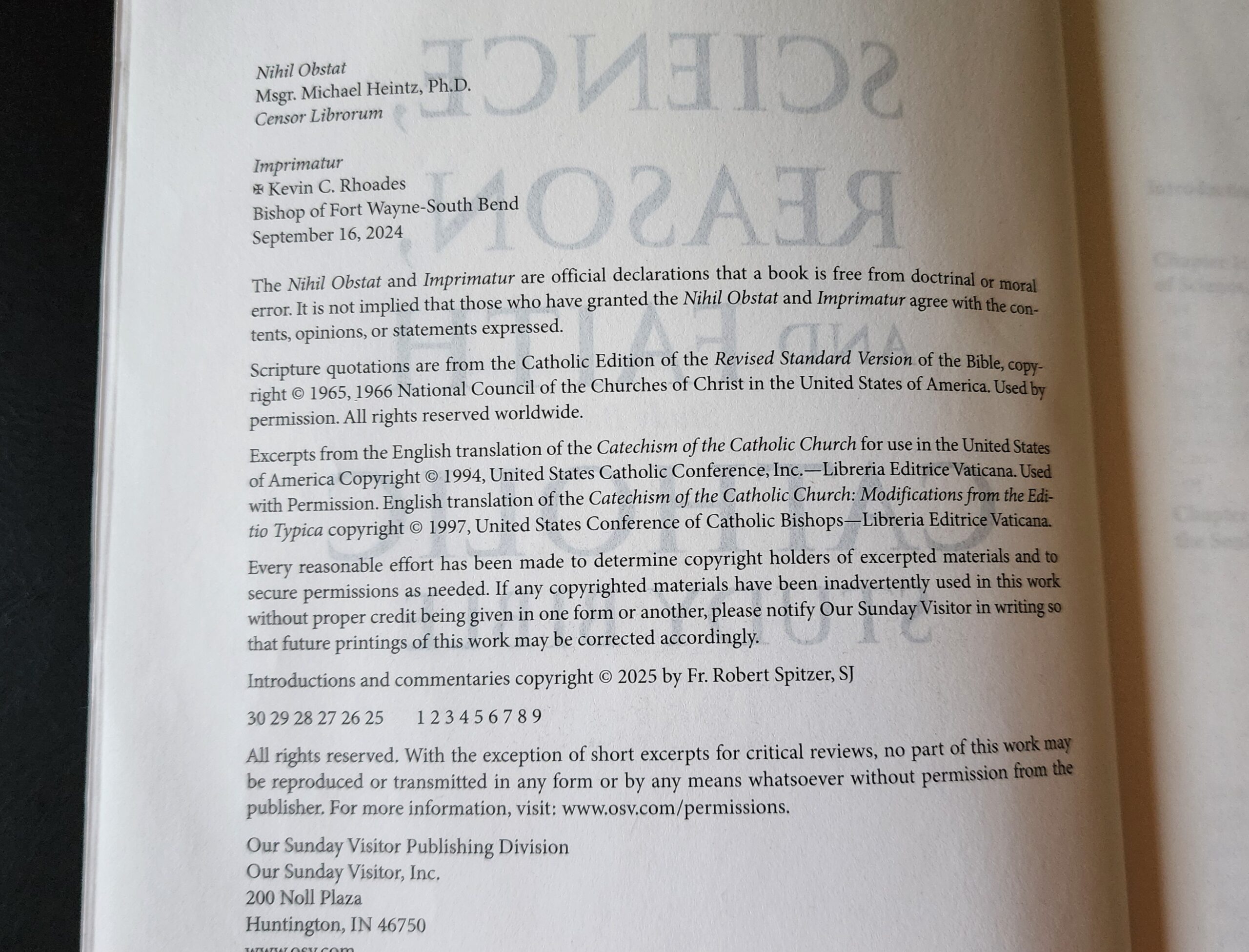
There are 72 pages of introductory essays for the Old Testament and 72 pages for the New Testament. All of the commentary bears a nihil obstat and imprimatur.
The Old Testament essays cover a variety of topics related to science, historicity, and the Bible, along with principles of Scriptural interpretation and arguments for the existence of God and the human soul. New Testament essays focus predominantly on the historicity of the gospels and the passion and resurrection of Jesus (with some information on the Shroud of Turin in the chapter on Jesus’s passion).
The sections on the existence of God and the reality of the human soul struck me as somewhat tangential to a study Bible and directed more toward apologetics and building a constructive case for why the Catholic faith is reasonable. To me, these sections would make more sense in a standalone book on faith and science, rather than an introduction to the Old Testament. On the other hand, one of Fr. Spitzer’s primary goals for this Bible (as he discusses in this YouTube video) is to provide a one-stop-shop with useful information directly on the page with Scripture to show young Catholics in high school and college how faith and Scripture are compatible with reason. With that goal in mind, the range of topics covered in the introductory essays makes a bit more sense.
The parts of the OT essays which deal with biblical interpretation are excellent, and they lay out several basic principles which are applied consistently throughout the sidebars in the biblical text (quotes are cited from Spitzer’s essays):
- St. Robert Bellarmine’s principle: “If an interpretation of Scripture contradicts scientifically demonstrated fact, then the interpretation of Scripture should be modified to conform to this fact.”
- Pope Pius XII’s principle: “The purpose of Scripture is to give sacred truths needed for salvation. The purpose of natural science is to give a correct mathematical-empirical, demonstrable explanation of the physical universe. All Scripture is inspired by the Holy Spirit, but the Holy Spirit does not intend that Scripture inerrantly teach scientific truths (demonstrable explanations of the physical universe), because such truths are not needed for salvation.”
- The co-participative view of inspiration: “…God works with the biblical author, who uses the conceptual frameworks and worldview of his time and culture.” Therefore, “…the true meaning of the text requires knowledge of the biblical author’s conceptual frameworks, religious viewpoint, worldview, and socio-cultural situation, as well as his use of literary genre, metaphors, numeric designations, and other non-historical, non-literal dimensions…”
- Ratzinger’s principle: “There are two components to scriptural expression: the essential core of the message, which is divinely revealed and inerrant; and the outward form of the expression, which is human, and therefore subject to the changeable dimensions of time and culture — not inerrant.”
- Moral development: moral understanding develops gradually over time “in dialogue between God and His people.”
- Christ is the fulness of revelation and sometimes corrects or supersedes other provisional ideas that were based on the human situation of the biblical authors (the outward form of the expression, in Ratzinger’s terminology).
Spitzer applies these principles with clarity and confidence. He restates them throughout the introductory essays multiple times (a technique which was effective in helping me remember the principles), applying them to specific questions at the intersection of modern science and Scripture. To give a sample of how these principles guide Spitzer’s approach to the Pentateuch, here are several points which Spitzer makes in the introductions and sidebars:
- Big bang cosmology is well-established science and estimates the age of the universe to be 13.8 billion years
- The evolution of species (including the human body) is established on multiple lines of evidence. Life gradually developed on earth over the course of a few billion years. However, the laws of biology are not reducible to the laws of physics, and they were likely part of God’s design from the beginning. God specially creates each human soul.
- The first eleven chapters of Genesis are primarily responding to and countering origin myths from surrounding cultures. They are neither science nor history.
- God did not actually tell Abraham to sacrifice his son Isaac. This can be demonstrated in light of God’s explicit condemnation of human sacrifice in the Law of Moses. We should interpret this as Abraham’s own understanding of God’s desire for a sign of his fidelity — an understanding which was mistaken about the specifics of what God wanted, and which God worked around by giving Abraham a ram to sacrifice instead.
- The exodus was probably a historical event, but the numbers of people reported as leaving Egypt in the book of Numbers are probably not historical. The number of people who left Egypt may have been several thousand.
Spitzer accepts the documentary hypothesis (the multi-source theory for the composition of the Pentateuch) and cites the New Jerome Biblical Commentary frequently throughout the book introductions and sidebars as an authoritative source on literary genre and historical background for the biblical books.
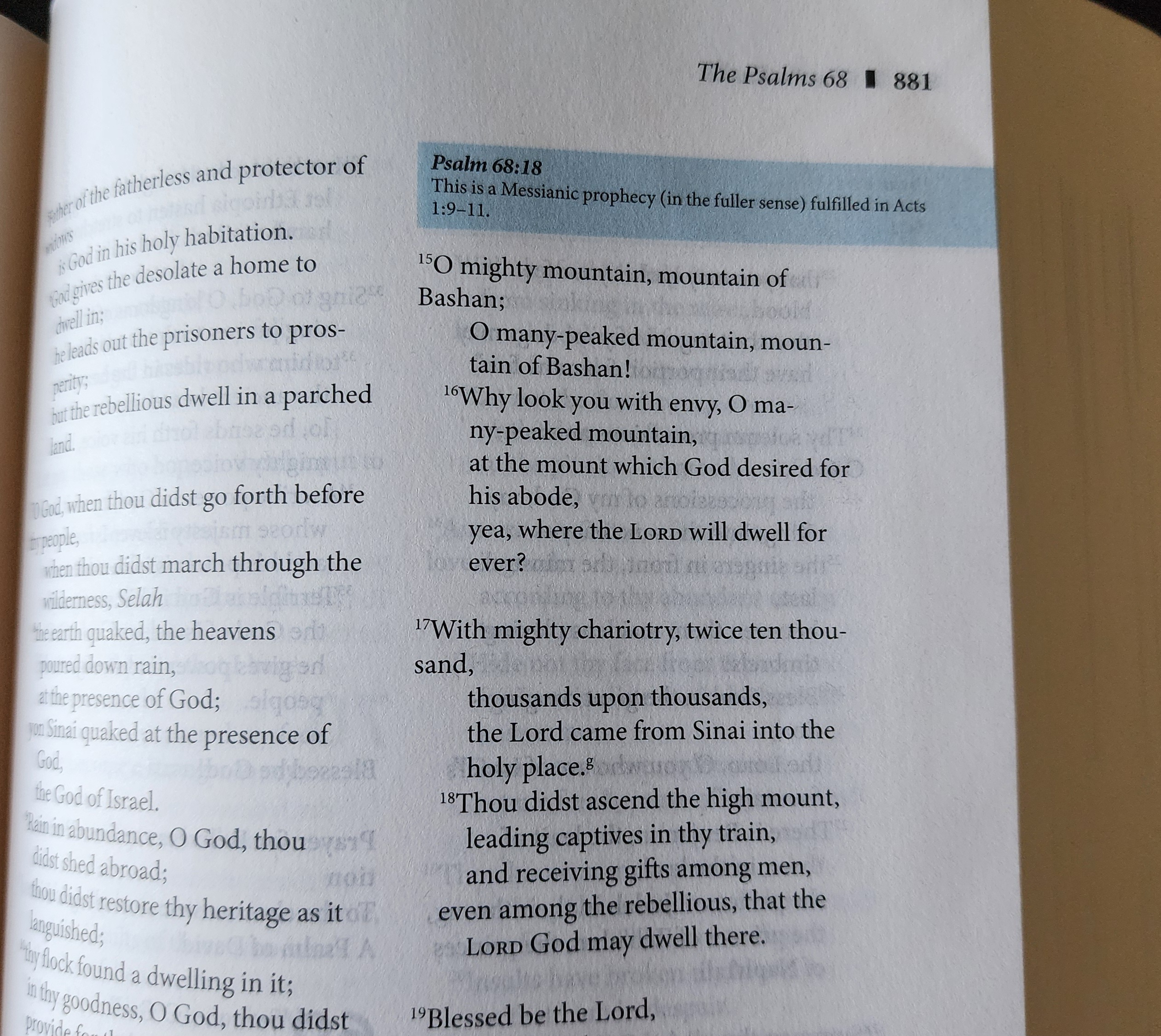
It’s worth emphasizing that although Spitzer’s commentary is strongly scientific and historical-critical, and indeed it is primarily focused on answering common questions about science, reason, and faith, he is also concerned with interpreting Scripture as the inspired word of God through the lens of Catholic teaching and tradition. Throughout the Psalms, the sidebars highlight verses which are cited in the New Testament as prophecies of Christ. Here is a sidebar for Psalm 68:18:
For the most part, I find Spitzer’s unapologetic acceptance of the results of science and historical scholarship to be refreshing and intellectually engaging. He moves forward with confidence, encouraging the reader to seek the truth in its many sources (science, Scripture, and Church teaching) without fear of conflicts or problems.
It’s worth pointing out, though, that Spitzer veers into speculation on the basis of conjectural evidence at times. I will highlight three examples:
In his section on the existence of a transphysical soul, he relies on linguistic evidence from Berwick and Chomsky’s 2016 book Why Only Us: Language and Evolution to support the conclusion that God first infused a transphysical soul into homo sapiens about 60,000 years ago (over 200,000 years after homo sapiens first evolved). To Spitzer’s credit, he does not present this as a definitive fact, but it is a highly speculative case built on a book which makes a notably different argument (Chomsky and Berwick argue that a particular linguistic ability known as “merge” evolved in the brain of homo sapiens about 60,000 years ago).
Perhaps less controversially, Spitzer also relies heavily on Richard Bauckham’s book Jesus and the Eyewitnesses: The Gospels as Eyewitness Testimony to build a case for the historical reliability of the gospels. As I understand it, Bauckham’s book sparked scholarly interest and debate, but his conclusions are not universally accepted among scholars. Spitzer presents these conclusions as largely established facts. I am interested in the evidence Bauckham brings to the table, but I think it would be wiser to admit the limits of such evidence rather than presenting it as incontrovertible.
Finally, Spitzer appeals to John Bright’s book A History of Israel in making the case that archaeology and history support key details of the history of Israel narrated in the Pentateuch (including the migration of the Hebrews to Egypt, the Exodus, and the conquest of Canaan). However, according to Catholic OT scholar John J. Collins, the scholarly consensus which previously existed on this question in the middle of the 20th century has broken down in recent decades.
It is certainly worth noting that Spitzer may turn out to be correct on one, two, or even all of these points, but I think a fair reading which is open to the truth wherever it may be found should acknowledge that he is veering into speculative and debated territory in all of them.
Conclusion
I’m left with somewhat mixed feelings about this Bible. It offers good food for thought, and its explanation of principles of OT interpretation is excellent. It is also a nicely-produced Bible with readable text. Perhaps most of all, I appreciate Spitzer’s attempt to bring together science, reason, doctrine, and Scripture in a coherent hermeneutical framework. This strikes me as important and needed today, when the results of specialized academic disciplines often feel disconnected and disjointed from each other.
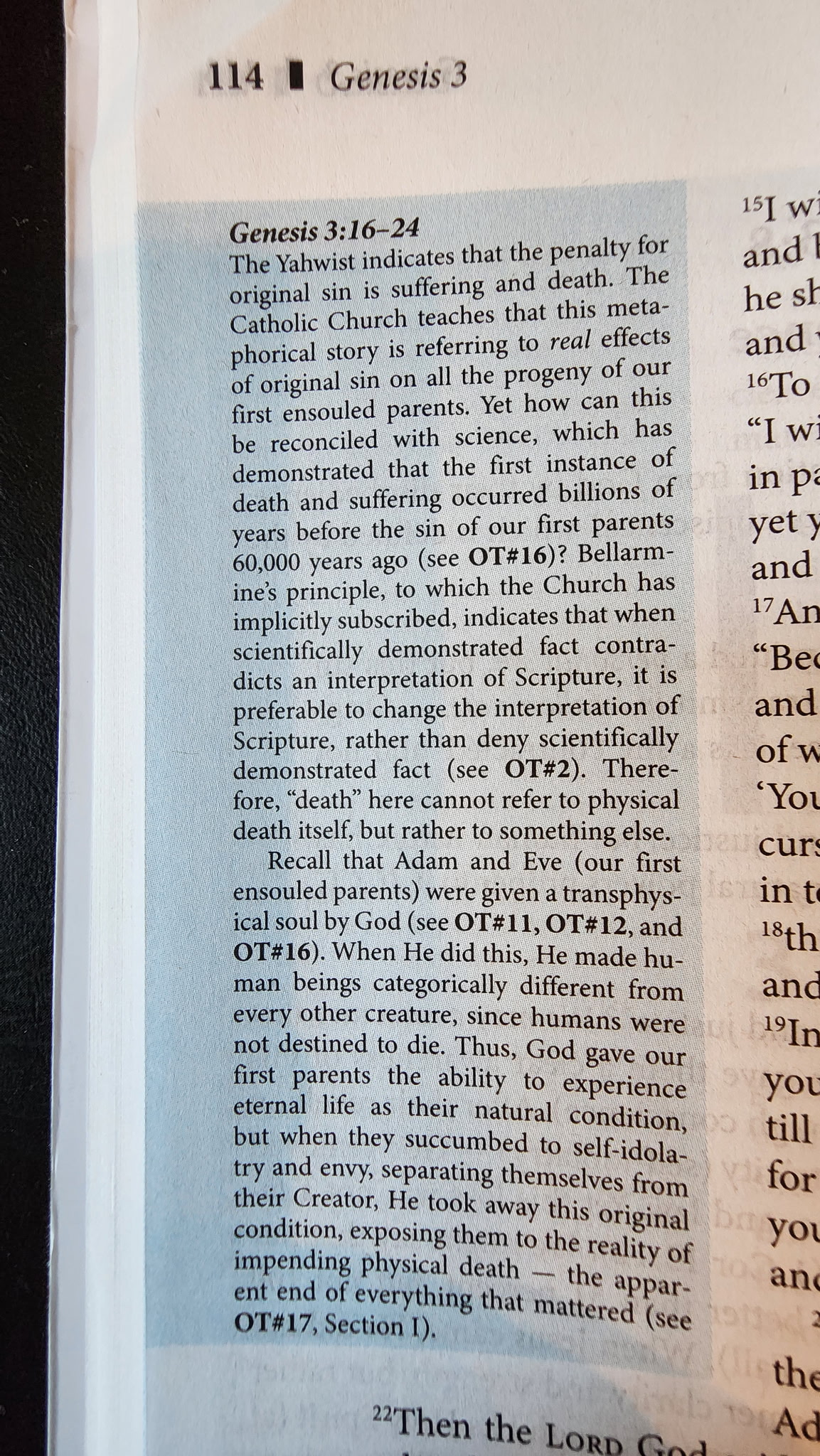
On the other hand, any attempt to integrate ancient texts into a coherent modern framework will always run into questions about the distance between what the text meant to its original hearers and what it means today. If physical death was not truly a consequence of human sin (and scientific evidence certainly suggests that sin was not the efficient cause of physical death), is Spitzer’s explanation (shown in the photo above) really faithful to the meaning of Genesis 3:16-24? Does it evacuate the text of its clear meaning? Or alternatively, is it a form of doctrinal fundamentalism that treats medieval theological categories as given rather than also understanding them as subject to Ratzinger’s principle (‘the essential core of the message, which is divinely revealed and inerrant; and the outward form of the expression, which is human, and therefore subject to the changeable dimensions of time and culture — not inerrant”)?
Similarly, what about the sacrifice of Isaac? Although Spitzer’s conclusion that God did not command Abraham to sacrifice Isaac seems logically correct, does it evacuate the story of its poignance and pathos? And what about the long-standing Christian tradition that Isaac was a type of Christ? I could argue that God made a fuller meaning out of Abraham’s mistake, and perhaps I must argue that as a logical conclusion from God’s revelation of the dignity of every human person and the horror of human sacrifice.
Finally, although I appreciate Spitzer’s confidence in charting a way through the thicket of specialized data from multiple disciplines, his approach here strikes me as highly rationalistic. On the one hand, this appears to result in a remarkably clear vision of how science, reason, and faith fit together. But on the other hand, it leaves many unanswered questions.
On the whole, I think the commentary in this Bible is worth reading, simply as a thought-provoking explanation of principles of interpretation. It’s worth noting, though, that the introductory essays are apparently based on Fr. Spitzer’s book Science, Reason, and Faith: Discovering the Bible. I don’t own a copy of the book, but the introduction to the Science, Reason, and Faith Catholic Study Bible points readers to the book for a more extended treatment of the same topics and references for further research. In my view, the introductory essays are the biggest asset in this Bible, and many of the sidebars simply apply the principles from the essays to individual passages. In light of that, it may be more worthwhile for most readers to buy the book rather than the study bible.
You mentioned Fr Spitzer’s book. If you had to recommend this Bible vs that book, do you have a preference which one you would prefer?
Thanks!
I would lean toward the book. For me, the introductory essays are the main value of the Bible, and as far as I can tell, they appear to be an abridged version of the material from the book.
Agreed.
While I certainly appreciate Fr. Spitzer bringing in the likes of Bauckham’s “Jesus and the Eyewitnesses,” I’m less sure of his other options. For “making the case that archaeology and history support key details of the history of Israel narrated in the Pentateuch,” I would’ve much preferred James K. Hoffmeier and the late Kenneth Kitchen instead as his sources, for instance. Also re: Bauckham, if Fr. Spitzer utilized his famous “Argument from Name Popularity” and his corresponding data, it’s worth pointing out that his work is a bit dated there, as Christian apologists and data analysts have made strides since Bauckham in significantly improving that argument. All that said, I agree that, whether one takes Fr. Spitzer’s positions or not, it is refreshing to see a Catholic author who takes all the historical-critical scholarship head-on and plows through anyway, not letting it be a hindrance, defanging the “threats” from said scholarship in such a way as to show that you don’t need to be afraid of it. It reminds me of how the Ignatius Catholic Study Bible’s introductions would mention the higher-criticism point of view, thus not hiding it from the reader, but always challenge it. While there’s a benefit to how many Evangelical Study Bibles sometimes completely omit the higher-criticism points of view, I would much rather have a Bible willing to wrestle with the critics than one that pretends they don’t exist.
I have read the book Science, Reason, and Faith: Discovering the Bible. It was quite good. I am not as much interested in theories about the Shroud and NDE’s. However, the essays on biblical interpretation are good and mirror those in this Bible. They can be very helpful in dealing with the usual questions from atheists and others who ironically take a fundamentalist view of the Bible, in some cases precisely to avoid a more informed view that would challenge their atheism. I recommend the book and just got the Bible. I think all such Bibles are dated as soon as published, there is always more scholarship, but that is no reason not to publish them. I think it compliments the Ignatius Catholic Study Bible.
To the blog owner:
I was wondering if you were planning on reviewing the recently released Pocket Gospels and Psalms (in the Nrsvue-Catholic Edition) edition? From Our Sunday Visitor?
Oh, I had that one on my radar screen and then forgot about it. I don’t think I’m going to buy a copy of it. The previous NRSV-CE edition of the Pocket Gospels and Psalms was printed in double-column format, which I found disappointing for a small book with Psalms. I’d love to see a single-column edition like this.
No, that’s valid. As I’ve got older, I tend to avoid smaller print books, too. I’m just impatiently waiting for some news from our Catholic publishers on a NRSVue-CE.
Many years ago, I remember I used to follow the Catholic Bible Blog, the one a Mr. Timothy operated. Well, one year he posted something about only using one translation for an entire year. At that time I had been bouncing back and forth between a myriad of different translations and when he mentioned his challenge to stick to one version, I was intrigued. So, I decided to do it, too, and have been ever since. This year I’ve been using the NRSV-CE and was surprised at how much I’ve enjoyed using it. From some of the comparisons I’ve made between the NRSV-CE and the NRSVue I think the latter is, over all, an improvement.