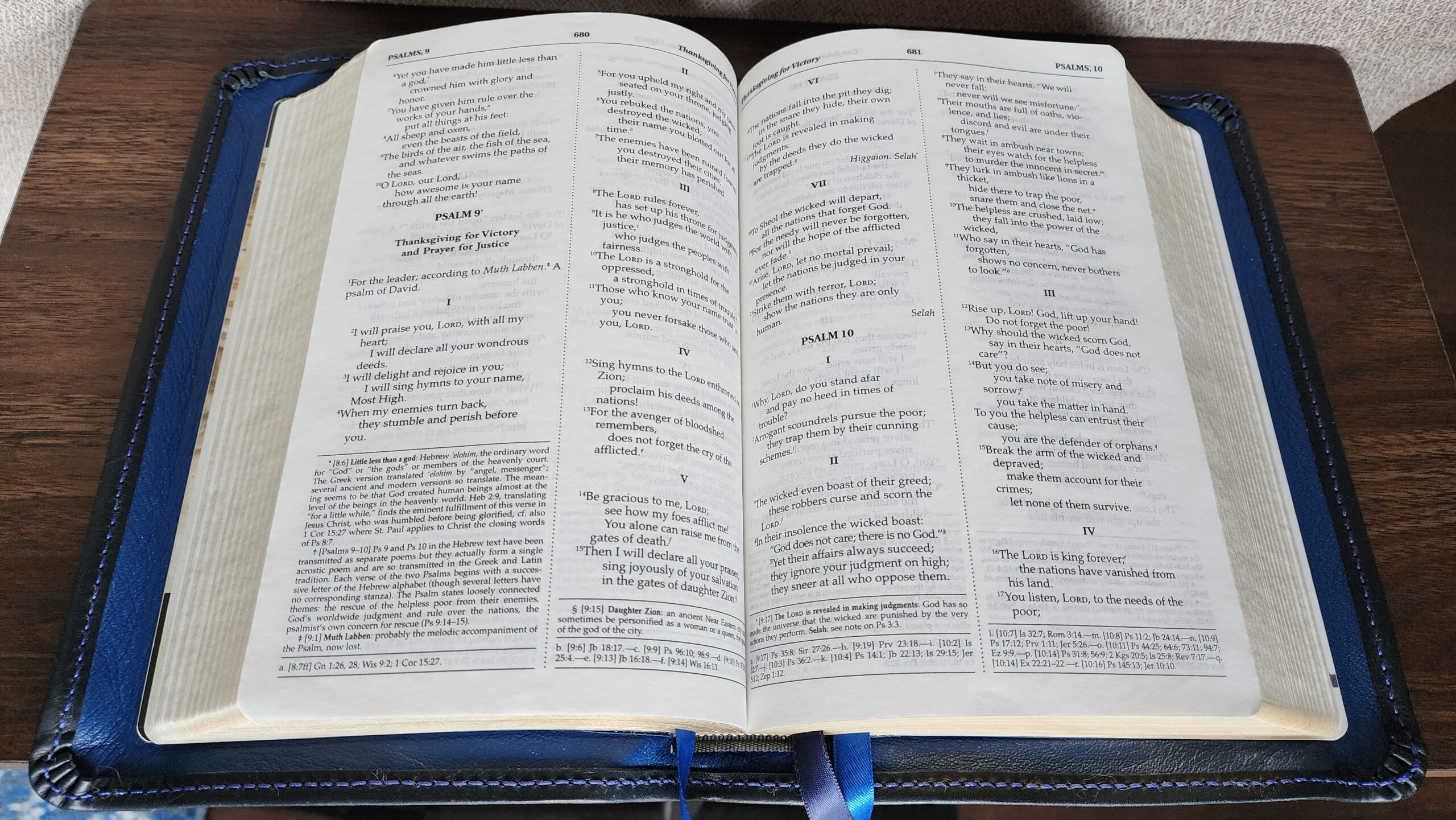
About two months ago, I decided to try rebinding one of my Bibles in leather for the first time. I’ve seen reviews of Bible rebinds many times over the years (including several at Timothy’s old blog), but I haven’t been compelled to try it myself. That changed after I made my Top Non-Study Bibles post in early September.
Motivation and Thought Process
I realized that although I ranked the Fireside Librosario NABRE as my #1 edition of the NABRE, the St. Benedict Press NABRE (which I reviewed in this post) is better than the Fireside in many ways. It didn’t make the top two in my ranking for the simple reason that I couldn’t bring myself to take it with me away from home. The leatherette cover had very little yapp to protect the page edges, and it didn’t come with a slip case. I was afraid of dinging and scratching the gilding if I started taking it in my car or bringing it with me on trips.
In addition, I’ve been gradually growing in my appreciation of the NABRE translation over the past year and a half. To my mind, a good translation should be clear when the meaning of the original language is clear and ambiguous when the meaning of the original language is ambiguous. In my experience, I feel that the NABRE lives up to that standard quite well. By comparison, the ESV strikes me as occasionally unclear or difficult to read when the meaning of the original is generally not in doubt, and on the other hand, the NRSV sometimes chooses a single interpretation among many when translating ambiguous verses.
An example of this which I came across recently is in Exodus 4:24-26 (the enigmatic account of the circumcision of Moses’s son). The NRSV tries to clarify the passage by saying that Zipporah touched Moses’s feet, while the NABRE simply says “his feet” and leaves the meaning ambiguous like the original Hebrew apparently is. (Incidentally, this is a case where the NRSVue nudges the NRSV text in a more literal direction and agrees with the NABRE).
A final factor which influenced my decision to rebind the St. Benedict Press NABRE was the upcoming release of the CAB. I fully expect that the CAB will be an excellent translation in its own right, but I have come to like the NABRE Psalms, and I enjoy the extensive NABRE notes in the New Testament (even if I don’t always agree with every detail). I could imagine myself continuing to use the NABRE even after the CAB is released.
So, after mulling over all these considerations, I started seriously considering rebinding my St. Benedict Press NABRE and using it as one of my primary Bibles. The next question was: which rebinder should I work with? There are many online, and video reviews of rebinds are abundant on YouTube. I decided to follow a recommendation from Fr. JT in the comments on this blog almost a year ago and reach out to Melissa from Mooseworks Bibles on Etsy.
Design, Communication, and Placing the Order
I was envisioning either a green or blue leather cover for this Bible, so I asked Melissa (via an Etsy message) about what leathers she had available in those colors. The choice of colors will depend on what she has in stock at any given time. For green or blue, she sent me photos of either a forest green goatskin or a navy blue “pull up” cowhide from the Italian tannery Badalassi Carlo.
I was not familiar with the term “pull up” for leather, so I searched for information online. As I understand it, the term refers to a specific tanning process which infuses extra oils and/or waxes into the hide. The end result is supposed to be durable and require less conditioning than other types of leather. It also results in a characteristic “distressed” look. When the leather is creased, stressed, or folded, the oils and waxes shift in the surface layer of the hide, resulting in a lighter coloration along the crease. Tim Nickels of “A Nickels Worth Bible Reviews” on YouTube shows the effect in this video.
To be honest, this almost convinced me to avoid the Badalassi Carlo cowhide. I prefer a clean, well-maintained appearance, rather than something that looks like it has been beaten up. But after doing more research, I found some anecdotal reports online that Badalassi Carlo’s dark colors (like navy blue and black) do not show color changes as much as their lighter colors. After mulling it over, I decided to move ahead with the navy blue cowhide, because my first preference was to go with a blue color scheme if possible.
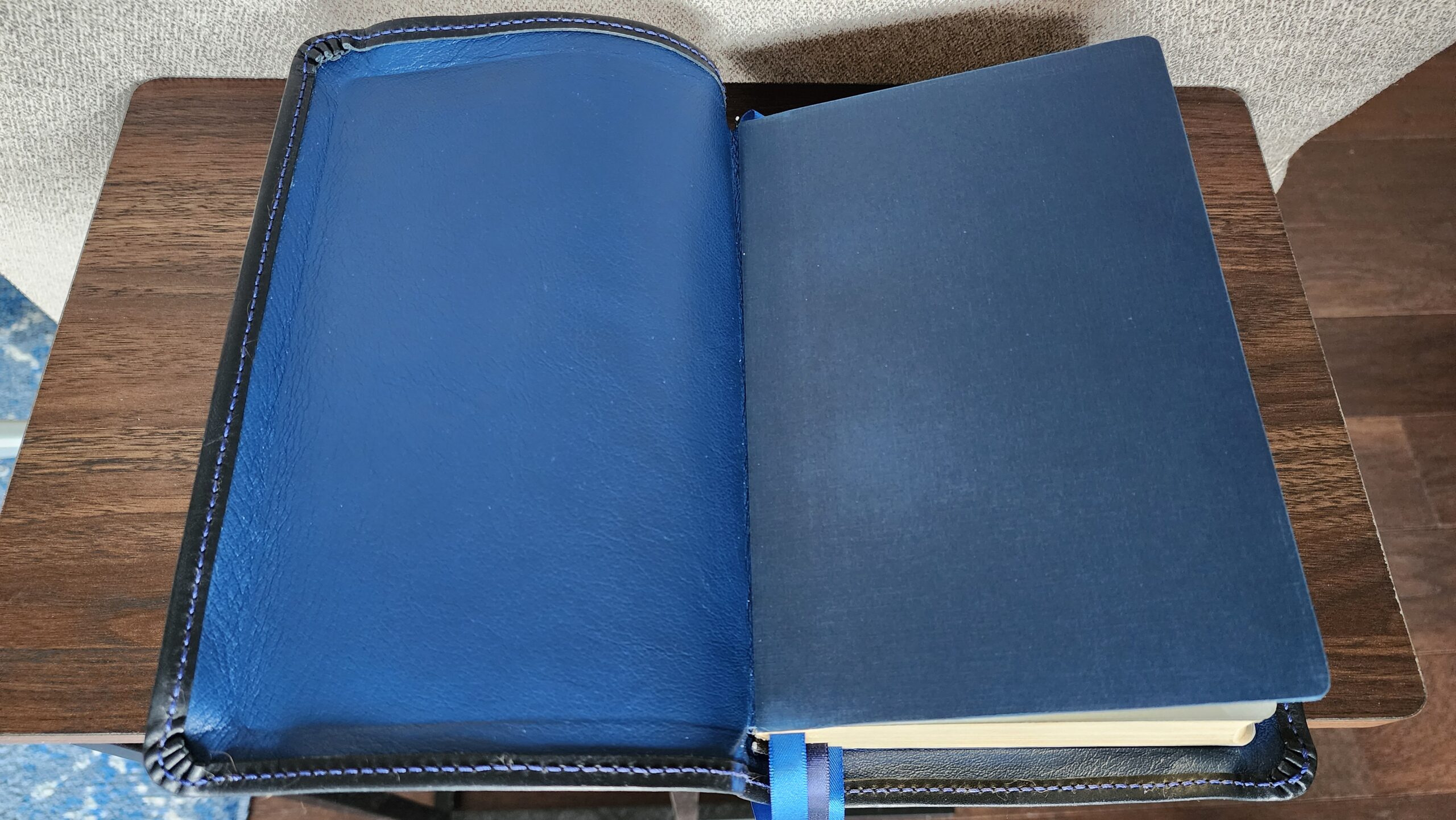
With the cover material picked out, we moved on to discussing options for the liner. I was especially impressed by a cobalt blue lambskin option. Finally, we discussed other design details. Melissa had ribbons and thread for the perimeter stitching which would be a close match to the cobalt blue color of the liner. She normally includes three ribbons with a rebind, and I chose to have two cobalt blue ribbons and one navy blue ribbon (to match the cowhide cover). Judging from other review photos on Etsy, many of Melissa’s rebinds feature raised spine hubs and a raised cross on the spine, and I liked both of those options.
I also requested a 5/8-inch semi-yapp for the cover. This means that the edges of the cover extend 5/8 inches beyond the edge of the pages. When I first became aware of leather rebinds, I was often puzzled why anyone would want an extended yapp on a Bible. It looked ugly and unseemly to me. But now that I own a couple of premium Bibles with an extended yapp (the RL Allan NRSV and the Schuyler ESV with Apocrypha), I see the practical purpose of the yapp. It curves around the page edges and provides some protection to the gilding. Since I wanted to be able to bring this Bible with me and not worry about scuffing the gilding, I wanted a yapp for its practical benefits.
After we settled on the design details, Melissa gave me shipping instructions and I mailed my Bible to her. For a custom design like this, she normally creates a custom order on Etsy, so there is no need to add an option to the cart before mailing the Bible. Once she was finished with the rebind, Melissa sent me a message on Etsy with photos of the finished product and a custom order listing. The final cost was $215 (the same cost for the Badalassi Carlo option on the Mooseworks Etsy storefront page). Shipping was an extra $5, and Etsy added sales tax for my state.
It only took six days for Melissa to complete the rebind from the date when she first received the Bible in the mail.
Finished Product and Usage Report after One Month
Melissa mailed the finished Bible to me in a bubble-mailer via USPS Priority Mail. When I first saw it, I was worried that a bubble mailer was risky (no cardboard to protect the Bible from sharp bumps and jabs during transit), but there was no sign of damage.
I’ve now been using the Bible for over a month. I’ve read from it regularly for Lectio Divina. I studied the letters of Ephesians, Philippians, and Colossians. And I brought it to Church with me and one of the priests at my local parish blessed it.
Overall, I’m quite happy with the quality of the leather and Melissa’s attention to detail on the corners and perimeter stitching. I especially like the understated pop of color from the blue thread which she used for the perimeter stitching as it contrasts with the navy cover. If I look closely and compare this Bible to the RL Allan NRSV, it is obvious that the rebind is not as perfect as the Allan. I can see very slight imperfections (for example, the cut edge of the cowhide cover along the interior perimeter is not precisely, perfectly straight). But in my mind, that is entirely expected for a handmade rebind. Overall, the quality of Melissa’s detail work appears very good.
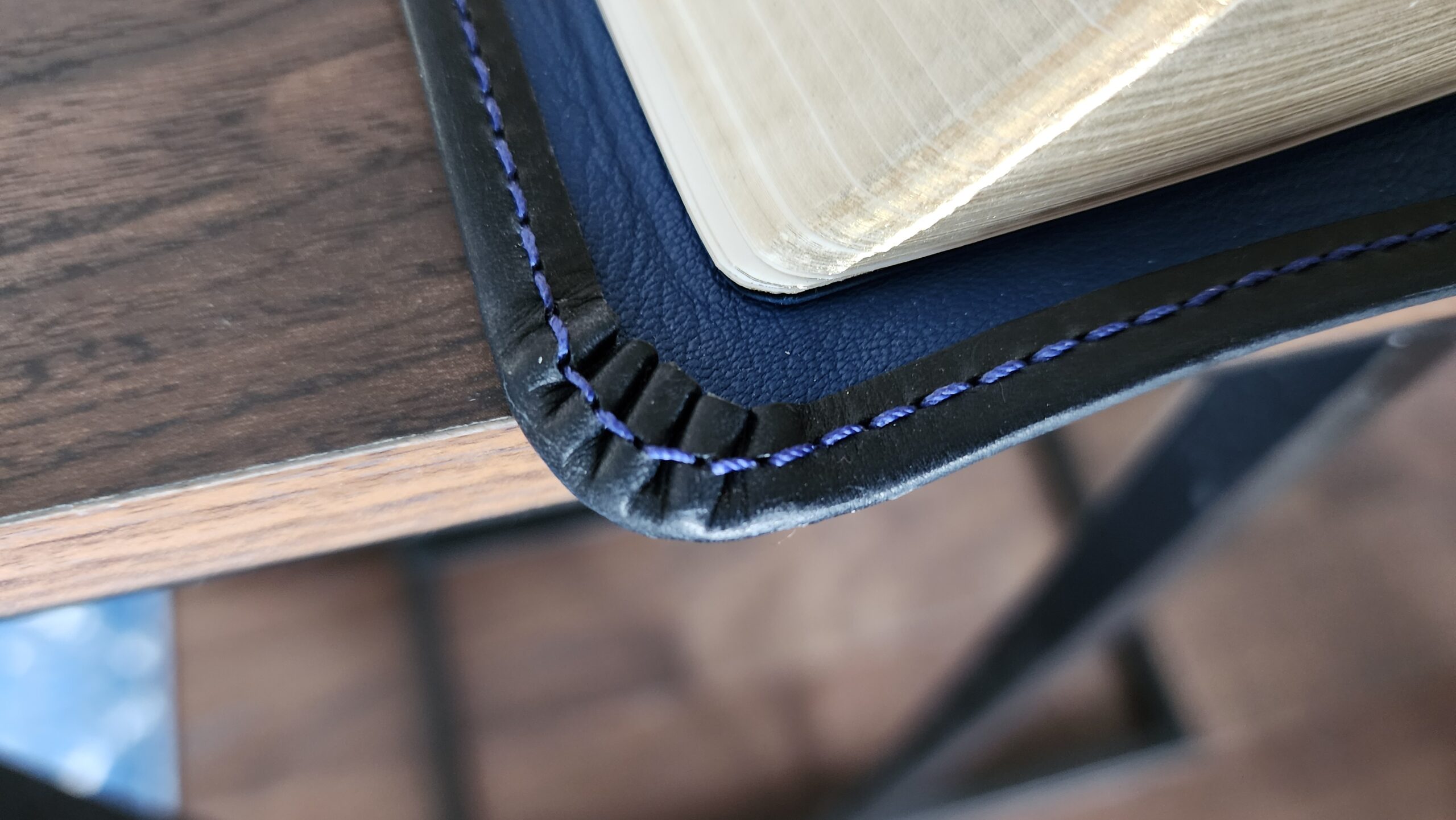
The Badalassi Carlo cowhide feels slightly thicker and a bit more substantial than the highland goatskin on the RL Allan NRSV, but it is still quite flexible. I expected it to be firmer and less flexible than it actually is. This is a good balance for me. I like a cover that is pliable but not so floppy and “buttery” that it doesn’t hold its shape.
With the raised cross and hubs, the spine feels solid and sturdy. The raised cross is slightly off center on the spine. At first, I was bothered by that, but I accepted it and haven’t paid much attention to it since the first few days.
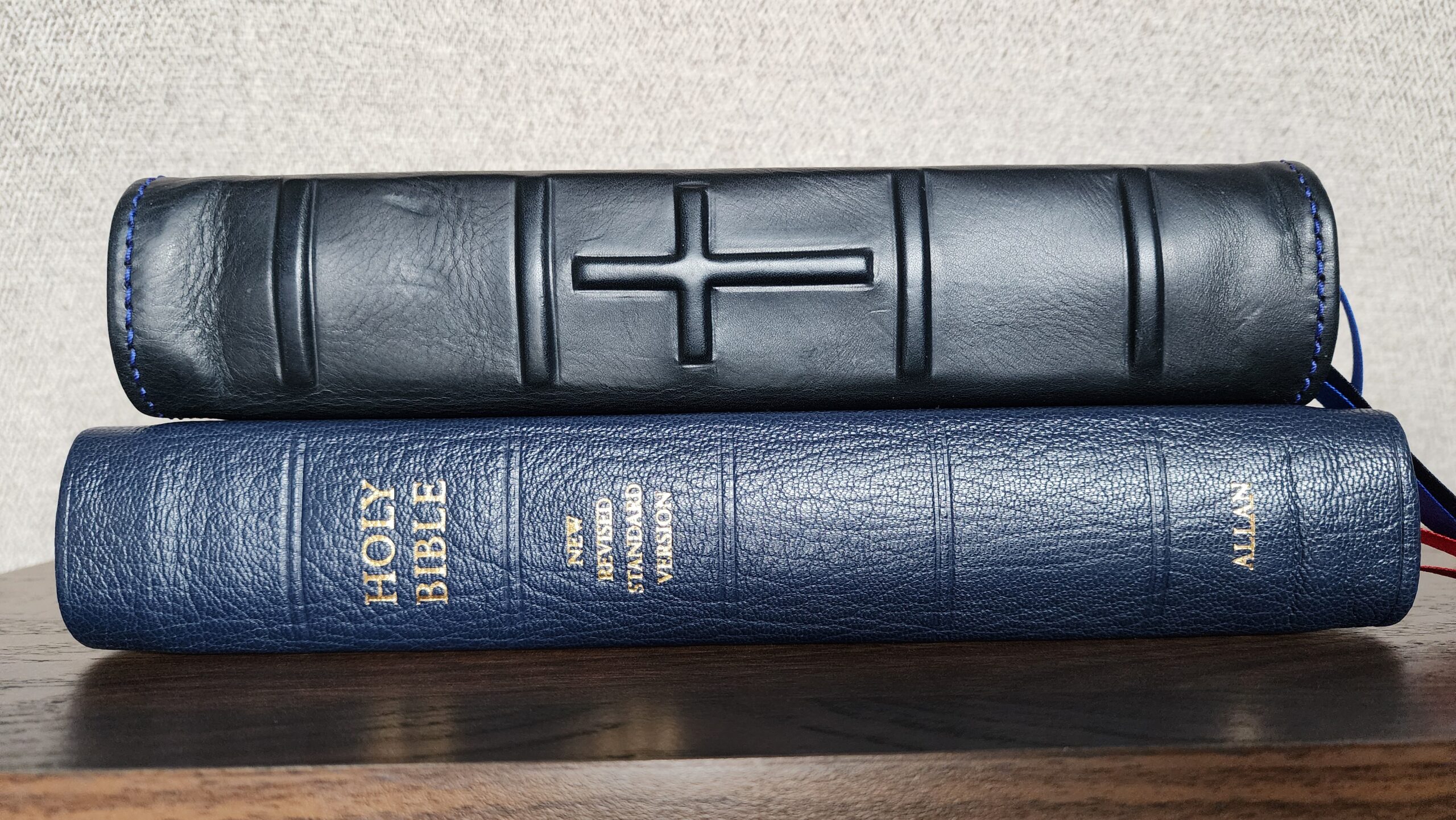
Another surprise which I wasn’t expecting is that the Bible doesn’t hinge open in the same way as before with its original leatherette cover. After the rebind, the spine stays mostly flat without bending when I open to the middle of the Bible. This is disappointing to me, because this Bible has relatively narrow margins. Now that the spine does not flex when I open it, the text curves down into the gutter more than it did before. This is not a deal-breaker (the text doesn’t run so far into the gutter that it’s difficult to read), but I didn’t expect the flexibility of the spine to change as a newbie to Bible rebinding. I asked Melissa about it, and she said that she included a hollow along the spine to encourage it to flex open. She also recommended “breaking it in” to encourage the spine to flex. Apparently, this is commonly recommended for rebound Bibles as noted in this YouTube video from Resurrection Rebinding.
Here is a before-and-after sequence showing the difference in spine flex between the old leatherette cover and the new rebound cover:
Before

After

I’ve completed the “break-in” procedure detailed in Resurrection Rebinding’s video a few times. It has helped the Bible to open and lie flat more easily, but it hasn’t made any noticeable difference in allowing the spine to hinge open. I suspect this has something to do with the way the edge-lined leather cover is attached, compared to the old leatherette cover. If any readers understand the mechanics of this process, please enlighten me in the comments!
Melissa also included new blue end sheets for the Bible to complement the cobalt blue lambskin liner:
Conclusion
Overall, I’m very happy with how this Bible turned out. It has successfully been transformed from a Bible I didn’t want to take anywhere to a Bible I’m comfortable bringing with me. It feels durable, premium, and yet approachable. Its small imperfections are a blessing, because it doesn’t feel like something I need to keep on a shelf in pristine condition. It feels like a book that is meant to be used.
The main drawback is the reduced flexibility of the spine after the rebind. I was originally planning to rebind my copy of the Oxford Catholic Study Bible after completing the St. Benedict Press NABRE. But I’m hesitating now. I’ve been writing notes in the margins of the Oxford this year (including the inner margin close to the gutter). I’m afraid that the Bible will no longer hinge open after the rebind, and I’ll be unable to write notes in the gutter anymore. It’s not a big problem with the St. Benedict Press NABRE, because the margins are too narrow for notes. But it could make a bigger difference for me with the Oxford. If anyone has experience rebinding the Oxford Catholic Study Bible, or if you have any suggestions for how to ensure that the spine will still hinge open after a rebind, please let me know in the comments!
Nice work mate that bible is absolutely beautiful.
Thank you for the review Marc. I too recently had my Saint Benedict Press NABRE rebound by Leonards. I found that I also lost some inner gutter after the rebind because they had to tighten the sewn binding some, at least that’s my understanding. I too have come to appreciate the NABRE a great deal more after being challenged by a Priest to give it another go recently. Im not too proud to admit that I was wrong about the NABRE and find it to be a wonderful translation overall.
Nice to see a good rebind story, Marc. I was really into rebinds a few years ago (getting three successfully done within a year or so span, though I’ve since sold two of those, retaining only one), but having a particular rebinder ghost me (and several others, as I later found out) on what would’ve been my fourth, taking the money (which had been paid upfront) but not delivering or responding to any follow-ups for what’s now been officially over two years soured me on the practice, even though I have two well-worn Bibles that really could use rebinding. I’m happy to see that your rebinding went well, and I hope one day I’ll regain the stomach to try again, especially since there are probably plenty of new, quality rebinders who’ve cropped up since I last tried.
On an unrelated topic, Dr Michael Barber – in an interview with Matt Fradd on YouTube at about 1 hour, 35 minutes in – makes a passing reference to the Augustine Institute’s ongoing project to translate the Bible. He stresses that it isn’t a revision of a previous translation but a fresh translation based on the latest critical editions.
I saw that. He also called it a “10-year project.” If that clock started with the publication of CSV Matthew in 2022, then somewhere around 2032 or so would be the target for completion, and earlier if we consider when the work itself began, not the publication of the first fascicle. He also confirmed what I assumed had been obvious: That the fascicles being released (Matthew and Mark thus far) are not the final CSV texts of those Gospels (sans errata), since work on the later books has given them reasons to go back and make further translation changes to the previous books. Altogether, it’s safe to assume the translation is still in flux, to some extent, until a complete NT or full Bible is published.
Marc,
This is a very nice review, thanks for taking the time to post good photographs !
I understand your investment in the NABRE. I had been waiting for the Catholic American Bible to be available. Then I saw a photograph of the CAB, it’s huge and comes in two very large three ring binders ! This alone is enough for me to stick with my NABRE.