This is the last installment in a three part series on the new children’s story Bible from Word on Fire called The Story of All Stories. In part one, I covered the purpose of the book, the range of ages it is designed for, and some of its basic features. Part two covered the Old Testament. In this final part, I will cover the New Testament.
Proclamation of the Messiah
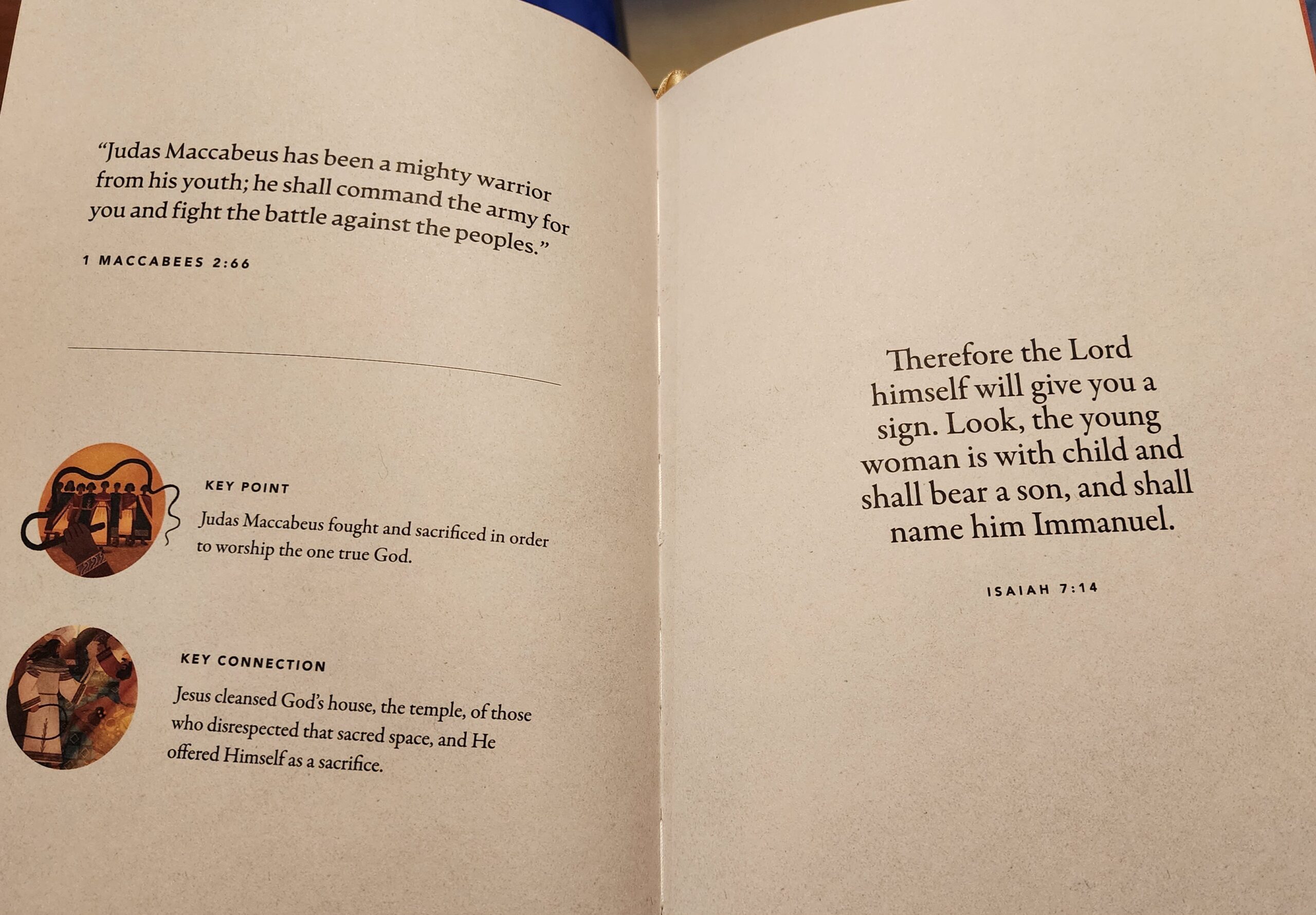
As the book transitions from the Old Testament to the New Testament, there is a full-page quote of Isaiah 7:14 from the NRSV (photo above). It’s worth noting that this Bible uses the NRSV for all direct quotes of biblical verses (which are relatively few). Nonetheless, I found it striking to see the NRSV’s translation of Isaiah 7:14 highlighted so prominently, since that verse is one of the most commonly criticized verses in both the NRSV and the RSV. Both versions use the term “young woman” as opposed to “virgin” which was used in the Septuagint and was quoted by St. Matthew’s gospel.
However, in the context of a children’s Bible, I think it really works. Given the age range this Bible is designed for (ages 7-13), the word “virgin” may be more of a distraction than a help for younger readers. Chapman does not use the word “virgin” in her storytelling either. She depicts the angel Gabriel telling Mary that her child will be God’s Son, and that his birth will be a miracle.
Inconsistency on Summary Pages
Oddly, in spite of the choice not to use the word “virgin” in the written story, the summary page at the end of the story of the annunciation features a quote from St. Irenaeus drawing a link between the virgin, Eve, who subjected the human race to death and the virgin, Mary, who remedied Eve’s disobedience by her obedience. This leads me to wonder if there were different people responsible for the summary pages who were not always checking to make sure that their selections matched Chapman’s written stories.
In part 2, I pointed out a couple of cases in the Old Testament where the summary page highlighted details of the biblical account which Chapman did not include in her story, and that pattern continues in the New Testament. It is not a pervasive issue (it happens in only a handful of cases), but I think it’s worth giving a heads-up to parents who will be reading this Bible aloud with their children. You might need to explain an extra detail or two when you get to the end of a story and read the summary. Here are the three other discrepancies I noted between the stories and the summary pages in the New Testament:
- When she tells the story of Jesus calling his first disciples, Chapman does not quote Jesus as saying “follow me.” But on the summary page, the “key point” (key takeaway or summary of the story) states: “Jesus revealed to His disciples that following Him is the heart of the Christian life.”
- In retelling the miracle of the wedding feast at Cana, Chapman does not include the word “woman” in Jesus’s response to his mother Mary (“What does this have to do with me? My hour has not yet come.”). But the “key point” on the summary page states, “Jesus called His mother ‘woman’ at this wedding feast, referring to her identity as the New Eve.”
- Chapman follows John’s gospel closely in her retelling of Mary of Bethany’s anointing of Jesus’s feet with costly oil. In John’s account (John 12:1-7), Mary does not weep and bathe Jesus’s feet with her tears. She only anoints his feet with aromatic oil. But on the summary page, the “key point” states, “Mary of Bethany washed Jesus’ feet with her tears, offering us an image of a loving heart that has turned to the Lord.”
While I’m on the subject of the summary pages, I also noticed that there is less editorial consistency in distinguishing the “key point” from the “key connection” in the New Testament compared to the Old Testament. According to the description on the product page, the “key point” summarizes each story and the “key connection” introduces typology “showing how Old Testament events foreshadow Christ, Mary, the Church, and the sacraments.” In the Old Testament, the editors followed that distinction consistently. But in the New Testament, they often blurred or abandoned the distinction between the two. In some cases, it looks like the two have switched roles. An example of this occurs in the context of the Law of Moses (p. 276 of the book). The “key point” reminds readers that God gave his Law through Moses. Then, the “key connection” says that Jesus fulfills and transcends the Law. In my view, these should be reversed for consistency, since the giving of the law is the typological connection, while Jesus’s fulfillment of the law is the lesson of the story.
The “key connection” is also sometimes homiletic in nature in the New Testament section of this book, making the message of a parable explicit or drawing implications of a story for Christian life, rather than remaining faithful to the stated purpose of drawing typological connections between the Old Testament, New Testament, and sacraments.
Overall, this is a nitpicky point. A person who wasn’t paying attention to the marketing material could easily read through the New Testament in this book and not notice any problem or shortcomings on the summary pages aside from the occasional mismatch between details recounted in the story and details emphasized in the summary.
Storytelling Successes and a Few Missed Opportunities
With the nitpicking out of the way, it’s important to re-emphasize that this book succeeds at its primary goal. It tells the story of salvation history and emphasizes how Jesus is the culmination of that story. It also does a masterful job of explaining how the story of salvation is ongoing in our lives and that we still await the promised fulfillment when Jesus comes in glory. I was especially impressed with the last chapter, where Chapman summarizes the book of Revelation. She describes how the apostle John saw a vision of heaven, where he was able to view “The Story of All Stories” (i.e. salvation history) from a heaven’s-eye-view. After seeing God’s ultimate plan for a new creation, John wanted it to come soon, exclaiming “come, Lord Jesus!” The book closes with another full-page Bible verse: “See, I am making all things new.” (Revelation 21:5 NRSV).
Here are a few other highlights that stood out to me as I was reading the New Testament portion of this book:
- Chapman succinctly points out the importance of Jesus calling his disciples: he wants us to cooperate in his saving work.
- The entire story of the wedding feast at Cana is beautifully retold. Chapman explains key points about weddings in 1st century Judea versus now, and she brings out the significance of what Mary was asking Jesus to do.
- The beatitudes are creatively and effectively reformulated into an explanation of how to live. This is a well-done summary of the practical implications of the beatitudes. It offers food for reflection even for an adult. It is truly well done.
- Chapman weaves together the appearance of the Risen Jesus to Mary Magdalene, his appearance to the disciples on the road to Emmaus, and his appearance to the apostles in the upper room quite smoothly and organically. This is excellent storytelling.
- The story recounting Peter’s vision of the unclean animals from the Acts of the Apostles explains clearly and succinctly why God gave the dietary laws to Israel and why those laws no longer served his purpose for the Church.
There are a few missed opportunities to draw out symbolism or typological connections, though. I will highlight two:
In the parable of the wedding feast for the king’s son (based on Matthew 22:1-14), Chapman recounts how the people who were originally invited refused to come to the feast, so the king invited anyone he could find. Once the feast began, Chapman writes, “Everyone was wearing the very best clothes they owned, even if their best wasn’t very good. But one guest wasn’t wearing his best clothes. One guest had accepted the invitation, but had not cared about the feast, the king, or the king’s son to change out of his ordinary clothes and put on something special. When the king saw this, he asked him about it, but the man wouldn’t even answer, so the king had the rude guest thrown out of the feast.” This interpretation misses the connection that the wedding garment represents baptism in which we “put on the Lord Jesus Christ” (Romans 13:14 NRSV).
Secondly, when Chapman recounts Jesus’s words in John 12:32 (“And I, when I am lifted up from the earth, will draw all people to myself.” – NRSV), she paraphrases it as “when I die and rise again, I will draw all people to myself.” This certainly helps to make the underlying point understandable to a young audience, but it papers over the connection with the story of the bronze serpent from Numbers 21:4-9. This is especially surprising, since Chapman’s retelling of the bronze serpent story emphasizes its typological connection to Christ (to the point of adding the extra detail that some people refused to look at the serpent and be healed, which is not in the biblical account).
Conclusion
My goal in this review has been to take an in-depth look at this story Bible, paying close attention to how it presents the Biblical stories and how well it accomplishes its stated goals. As the author points out in her introductory video on the Word on Fire product page, it’s important to be clear on what this Bible is and what it isn’t. Any story Bible of this nature cannot be comprehensive, and it must make choices about what to emphasize and what to omit. But when viewed as a whole, this book is an excellent resource for children. It introduces them to the story of salvation history and shows them how the Bible fits together as an integrated whole. It teaches them how to read the Old Testament in light of Christ, and it does a masterful job of making Jesus’s teaching accessible and highlighting its practical implications (particularly the beatitudes). Finally, it emphasizes that the story of salvation is ongoing in each of our lives, and that God has promised a new creation which is still to come. The production quality of this book is good, like all books published by Word on Fire, and it should be able to withstand years of use.
My criticisms are primarily editorial critiques. If Word on Fire sees fit to make corrections or revisions on a subsequent printing, I think they could easily improve and smooth out the inconsistencies or missed opportunities which exist. In the meantime, the advantages of this volume strongly speak in its favor, and I don’t think the drawbacks are significant enough to warrant hesitating if you have children (or grandchildren, godchildren, etc.) who would benefit from this Bible.