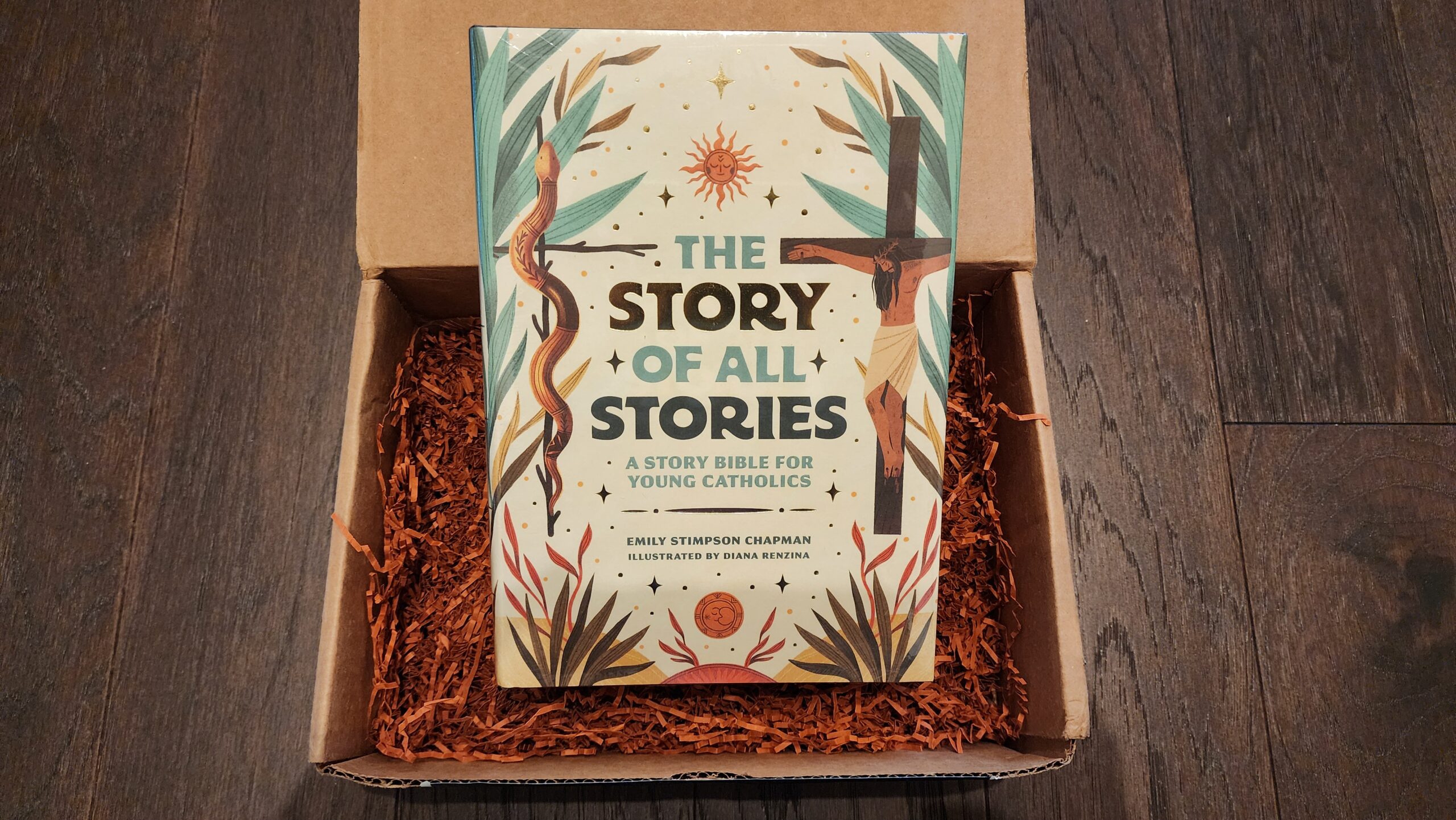
In mid-October, Word on Fire released a brand new children’s story Bible entitled The Story of All Stories. It is organized as a collection of biblical stories, each one a few pages in length, written by author Emily Stimpson Chapman. Artist Diana Renzina created the copious color illustrations throughout the book.
I’m grateful to Word on Fire for sending me a review copy of this story Bible, and I’m currently in the process of reading it in its entirety. In this post, I’ll cover basic details about the design and purpose of this Bible, and in parts 2 and 3 (coming over the next week or two), I’ll cover my impressions and analysis of the Old Testament and New Testament, respectively.
Goal and Purpose of this Bible
The overarching goal of this Bible is to introduce children to a coherent, integrated account of salvation history. Emily Stimpson Chapman’s storytelling throughout the Old Testament explicitly references and foreshadows the future fulfillment which God would bring about in the fulness of time through Jesus. In an introductory video on the Word on Fire product page, Chapman describes her goal as follows:
This book is what I’d share if you asked me to come to your house to tell your children the story of salvation in a way that is faithful, accessible, engaging, dramatic, and even funny. It helps children to understand what the Bible is about and what’s happening without having to consult biblical notes.
Emily Stimpson Chapman – Author of The Story of All Stories
The bite-sized stories often condense and retell longer biblical accounts in a practical length that parents could read with children in a single sitting (even children who can’t read on their own yet). At the conclusion of each story, there is a review page which includes a quote from a saint, church father, pope, or famous Catholic commentator (like G. K. Chesterton). These quotes are often written in more complex language than the stories themselves, so young children might have trouble grasping them without explanation. In the Old Testament, the quotes frequently point out typological connections between the story which just concluded and how it was fulfilled in Christ. Below the quote, there are two concise takeaways to remember. The first is called the “key point,” and it gives a brief summary of what just happened in the story. The second is the “key connection,” which points out a specific typological connection between the Old and New Testaments.
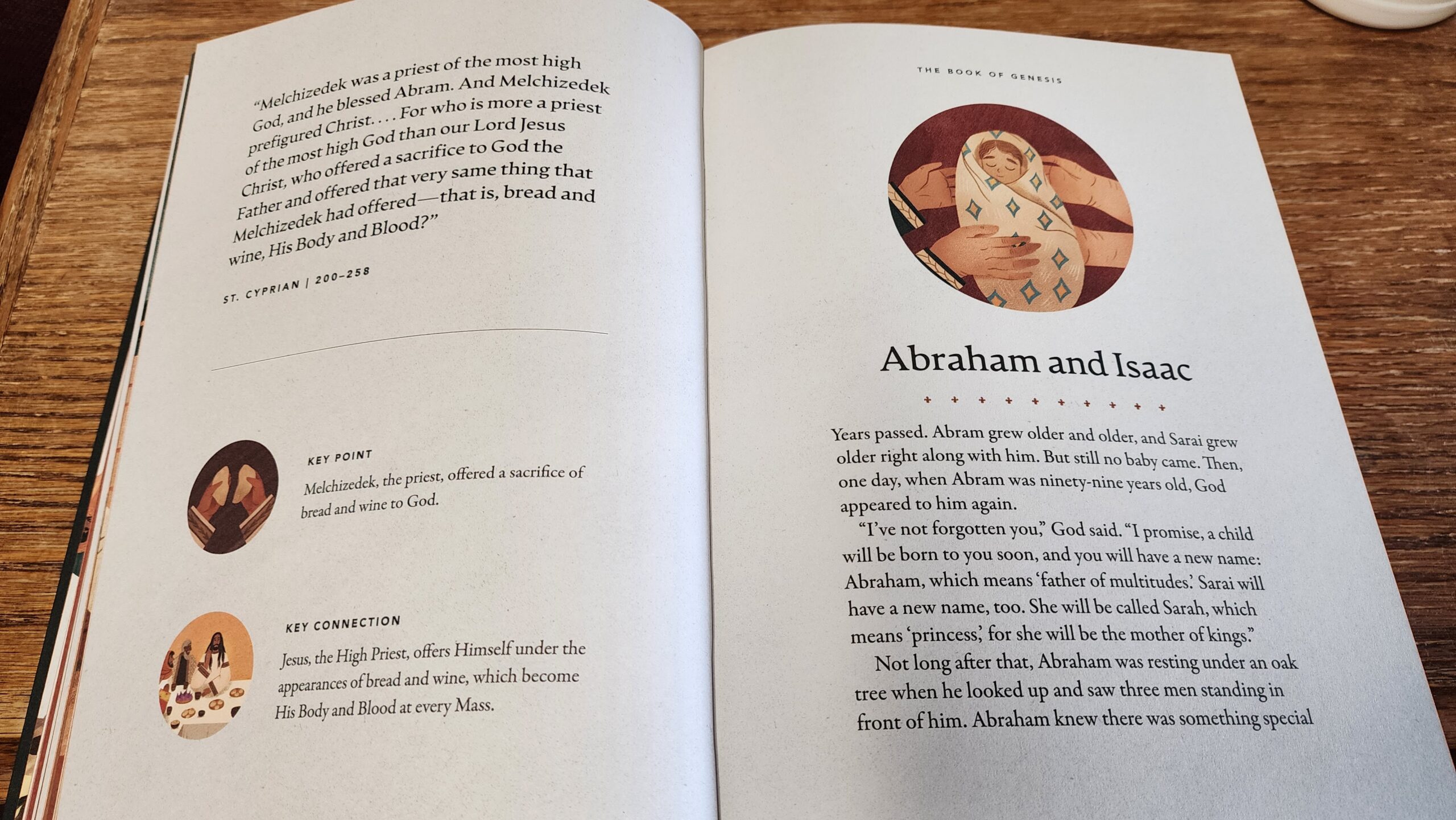
Word on Fire has published a PDF preview of the first 24 pages (including a full list of the included stories in the table of contents as well as the stories of the creation and fall). There is also an audiobook version, narrated by Jonathan Roumie, who plays Jesus in the TV series The Chosen.
What Age Range is this Bible Designed For?
This Bible is marketed for children ages 7-13. Not having any children of my own, I hesitate to second-guess that recommendation, but I can easily imagine reading some of the stories in this book to younger children, even those who are just learning how to read. The artwork is engaging, and I think it could hold a child’s attention while listening to the story. I was a bit surprised by the upper limit of age 13. By that age, I think a child could be reading from a full Bible translation, but I can see how a middle-schooler (ages 11-13) could still find this meaningful and discover new connections and typology which they glossed over when they were younger.
Physical Quality
Finally, it’s worth noting that the production value of this book is excellent, in line with all books published by Word on Fire. This is a durable hardcover with a sewn binding, thick paper, and excellent color printing. Unlike other cloth-wrapped hardcover books which Word on Fire publishes, this book is a more traditional hardcover with a paper dust jacket. When the dust jacket is removed, the hardcover is a plain, olive green with the title of the book (The Story of All Stories — A Story Bible for Young Catholics) printed in gold lettering on the front (no other artwork or illustrations). The pages have a matte texture, rather than the glossy or semi-glossy finish which is used in many color books (including the Word on Fire Bible).
Stay tuned for Part 2, where I’ll cover my impressions of the Old Testament stories.
Two additional details which I forgot to include when writing the main post:
1. There is no imprimatur listed on the copyright page or other preface pages.
2. All direct quotations from Scripture in this Bible are taken from the NRSV-CE
1. I thought they’d get a free pass given the relationship between Bishop Barron, WoF and the USCCB. How interesting they didn’t even bother with a general imprimatur.
2. So this book has a short shelf life then, given the 2027 sunset date. It might be reprinted with the NRSVue-CE.
Excuse me but, what’s the “Sunset date”?
When the 1989 edition of the NRSV goes out of print and disappears forever.
Ah, thank you. I thought it was something like that.
I can recommend this book and I concur that it has excellent quality. I bought this because I have seven year old and four year old boys. I found that a lot of kids material out there is too preschool oriented (too stupidy as my four year old says). I saw the ad on Instagram and thought this would be perfect. I’ve been reading it to them at bedtime only a few nights now and really enjoy it. The artwork is great. The text isn’t really the Bible it’s just the stories retold -that means they left some parts out – but also they made other parts of the story more poignant. For example it made explicit Cain holding back his best from God. Either way it’s effective, my boys lock in when I’m reading and I can tell they’re listening – which is actually very rare to see and I’ve tried a lot of different religious material.
What you mention is a common flaw in a lot of “kids’ material,” that they overwhelmingly baby them, thus making the material unproductive for long-term usage. It’s good to hear that Word on Fire decided to create something that actually respects children’s intelligence.
I am convinced that children are just as intelligent as adults; they just lack experience. Talk to them in a way that isn’t condescending; they usually understand.