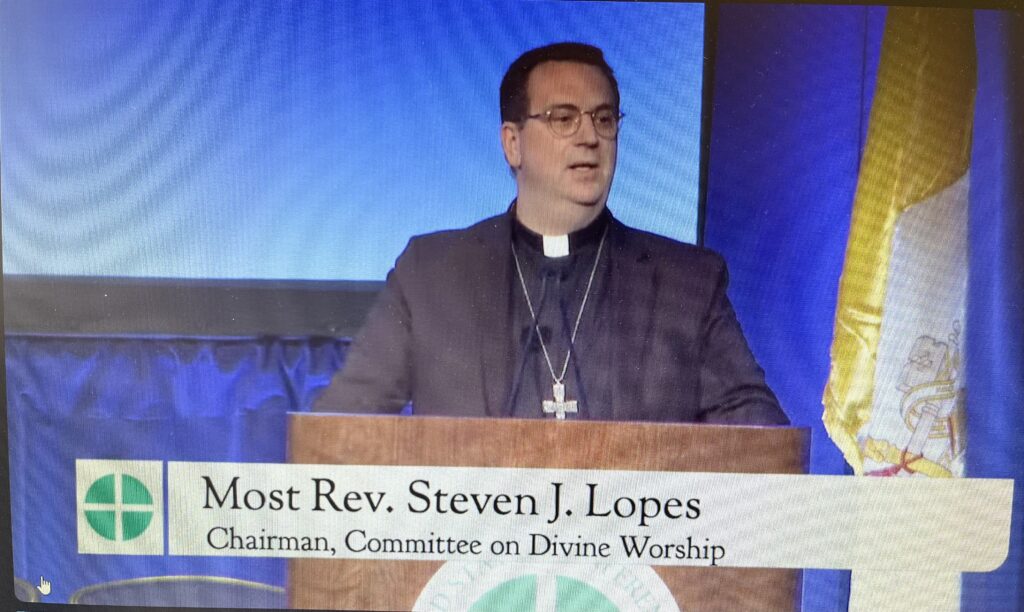
Most Rev. Steven Lopes, Chairman of the USCCB Committee of Divine Worship, announced a few moments ago, at the USCCB annual meeting in Baltimore, that the liturgical edition of the revised New American Bible will be renamed the Catholic American Bible. It will be published on February 10th, 2027 along with the even more recently Vatican-confirmed revised Liturgy of the Hours. February 10th, 2027 is Ash Wednesday.
Like the new name for the bible.solves the problem of the nabrere, lol. So thT also means the first volume of the LOTH should be available then. Time for a belated Christmas present!
As announced by Bishop Lopes, the first volume of the LOTH to be published will be volume 2, Lent-Easter, for use as of February 10, 2027.
WOW THAT WAS QUICK!
I’d be lying if I said I wasn’t disappointed in both the new name and the 15 month wait until it’s released. That said, I”m glad they didn’t create a monstrosity of an acronym by adding to NABRE
2027?
Think of the steps involved. First we had to prepare the files for publication. That couldn’t happen until we had the confirmation. Those files were completed last week. They have to be set for publication. Auxiliary materials need to be updated. Design work must be completed. Then the publisher has to do their internal review. We have to review proofs. (Do you know how long it takes to proofread a Bible????) We usually have to review a second version of proofs as well. Only then can they go to a printer. Even the simplest versions are likely to take at least 4 weeks on press. More complex formats can take 8 weeks or more. Since most printers are outside the US and Canada, the books then go on a ship to cross an ocean, wait to be unloaded, and then delivered to warehouses where they can be shipped to retailers and individuals. Less than 15 months is ambitious.
Thank you for taking the time to Respond, Ms. Sperry. I think many of us just are unaware of all the work/effort it takes to publish a Bible. I think many of us need to show more charity/ understanding to all of you involved in this massive project.
Do you know if there will be any previews of the CAB, before its published? 🙂
Any chance they would be open to reconsidering the name? If American or Catholic are desired, two names that I think fit are the Catholic Liturgical Bible (CLB) or the American Liturgical Bible (ALB). If they aren’t necessary, my favorite is the Standard Liturgical Bible (SLB). I also like American Standard Liturgical Bible (ASLB). Considering this will be the official Bible of the American Liturgy of the Word and Liturgy of the Hours, they would all be fitting names. I also just like the names and the acronyms better, though I am on the fence with ALB.
Ms. Sperry, I echo the sentiment from CatusDei. Thank you so much for providing information in the comments. It is much appreciated. I look forward to the new translation and the new LOTH!
Ascension has released a page on the translation:
https://ascensionpress.com/pages/the-catholic-american-bible
Ascension’s FAQs say there will be a Great Adventure Bible with the CAB translation. Left unanswered: Will Ascension continue to use the RSV2CE alongside the CAB in their Bibles, or will they drop the RSC2CE altogether?
Unless they rerecord Bible in a year, which people are still discovering, I don’t see them dropping the RSV2CE any time soon.
I don’t think they’re going to drop it, at least not completely, as it’s a quite popular and accurate translation. They will probably leave some rsv-2ce products in print.
(Hopefully).
I see they’re tripling down on the “American” branding, and now making its Catholic affiliation more overt. Well, good on them. Anyway, time to spend the next year writing as many “CAB” name jokes as possible!
First you must hail a cab. 😉
Me: Honey I’m going to sit by the fire and enjoy my CAB
Wife: I thought you said you were going to cut back on drinking
Me: I’m talking about the new update to the New American Bible Revised Edition, silly; not wine!
Or:
Husband: “Honey I’m going to sit by the fire and enjoy my CAB.”
Wife: “I’m just so thrilled that you’re so serious about the Bible!”
Husband: **coyly uncorks the Paso Robles**
I just received the email from Ascension Press as well. I’m so impatient about this. I was hoping for 2026.
Thereby cementing it forever as a translation all non-Catholics will avoid.
So much for “if these translations are produced in cooperation with the separated brethren as well, all Christians will be able to use them.” (DV 22)
https://www.vatican.va/archive/hist_councils/ii_vatican_council/documents/vat-ii_const_19651118_dei-verbum_en.html
Fortress Catholicus remains unbreached!
“Thereby cementing it forever as a translation all non-Catholics will avoid.”
Non-Catholics don’t buy Catholic Bibles anyway; most aren’t even aware that “Catholic Bible” is a thing that actually exists. This is why, despite being the most widely read Bible in the United States, the NAB has never appeared in even the top 100 best-selling Bibles in the “Evangelical Bible Sellers Association” list.
And any bookstore that carries Catholic Bibles will be segregated in a section labeled “Catholic Bibles”
At least one non-Catholic (me) buys them.
The word “Catholic” doesn’t bother me. I can take it to mean the world wide fellowship of Christians.
Protestants never touched the New American Bible anyway. I didn’t even know it existed until I looked into Catholicism.
At least we aren’t stacking adjectives too high yet. It should be several decades before a New Revised Catholic American Bible, Second Updated Edition (NRCAB-2ue) comes out.
Ehh… We have the whole Tyndale line as common texts among all Christians, and a Catholic liturgical translation isn’t directly for anyone else besides Mass-attending Catholics.
Something from the KJV line is what (IMO) most protestants use anyhow.
I don’t know how to define “most,” but for 40 years, the NIV has been the highest-selling Bible among evangelicals, although two of the biggest Protestant denomibations, the Lutheran Church Missori Synod and the Southern Baptist Convention abandoned it for the ESV and CSB respectively.
Thank you for the correction. Yeah, most protestants use NIV,ESV,CSB ect…
And I’d like to ask, what type of translation do you prefer?
(Dynamic vs formal)
Aw, but it’s 2027 :/
They had a nice, friendly acronym in NABRE. Shame to chuck it.
I do have some leftover Love Your NABRE buttons.
Too bad they didn’t revise the Old Testament. Ecclesiastes translation is rather meh
I strongly dislike labeling a Bible version / translation as being “American.” Something about it just seems off. It seems both “jingoistic” and “provincial.” I was hoping they would eliminate that from the new title. The Bible is too sacred to carry a name associated with a particular country.
Totally agree. Seems a little tone-deaf in this era of rising Christian Nationalism and Catholic Dominionism.
I would have gone with something like the Bible for Catholics in English (BCE).
There is no such thing as “Christian Nationalism”, Lutheran Satire did a hilarious video mocking the very concept, pointing out that no one even knows how to define it, except “expressing your religion in a public place”, it is a completely meaningless concept.
Yes, a more general title would have been better, in my opinion, such as simply calling it the Holy Catholic Bible (HCB).
I like the suggestion, but I think something like THE AMERICAN CATHOLIC LITURGICAL BIBLE (TACLB) would be nice but CATHOLIC AMERICAN BIBLE (CAB) is still sort of reminiscent of the NAB(RE).
Will the CAB have the same book introductions and footnotes as the NABRE? If so, I will not buy it. The NABRE book introductions are particularly troubling, as they present modern theories regarding late composition of and authorship as “fact.” The footnotes also are troubling, as they take an overly critical-historical approach that at this point is very “dated.”
Someone above posted a link to the announcement on Ascension’s site. The FAQ for what will be different between the CAB and NABRE says “The CAB features a modified version of the Old Testament from the NABRE, with the Book of Psalms replaced by the Abbey Psalms and Canticles alongside a new introduction and notes, a newly revised New Testament, and appendices to both the Old and New Testaments containing the Abbey Psalms and Canticles.”
I saw a talk months ago from Dr. Mary Healy, who was on the review board for the translation, and she said there would be new notes, though it was hard to gauge to what extent (all notes or just revising a few overly critical takes).
I agree with you. The NAB was my first Bible because it was the one we had to use in Catholic elementary school. The notes were extremely confusing as a kid, and if I have kids someday, I am going to be vigilant on which Bible I give them. That said I am pretty optimistic. I have too many handwritten notes in my RSV2CE to part with it as my main Bible, but still excited for the CAB.
Yeah I really hope not. I hope the Bishops are convinced that it’s very disliked.
I found the extensive notes to be the best part of the whole NABRE project.
Do you have the same problem with something like the Jerome Biblical Commentary?
I do have a problem with the theological suspicious note dealing with the baptism of Jesus in Matthew tho.
I think the real problem is that they didn’t very much also present the “opposing” side (traditional beliefs).
The name “Catholic American Bible” offers them a fresh start for future revisions: either the “New Catholic American Bible” or the “Revised Catholic American Bible.” And on and on.
Let’s not forget the Augustine Institute is still working on the Catholic Standard Version, so potentially we are looking are 2 “fresh”, authentically Catholic, translations that could
both come in a wide range of premium options from multiple publishers.
Exciting times!
Any news on the csv? Feels like it’s been years
There was a recent comment under one of the CSV posts saying that the Augustine Institute is holding a series of seminars for priests in Summer 2026, where they will be using a “pre-publication form” of the Four Gospels in the CSV translation, which indicates that Luke and John are likely done, just unreleased.
Just a couple of thoughts regarding the comments so far:
– Publishing a book of this size takes time. And while I know many have been waiting on this since 2015, Ash Wednesday 2027 isn’t an unreasonable date for a text that only recently got its full approval. And lets keep in mind that at least one of these publisher, Ascension, is also doing the Liturgy of the Hours. I would hate for there to be any publishing errors occur due to rushing these out. I am sure on their part the publishers need the time to complete these projects. This is a massive undertaking.
-I don’t mind the name at all. I think it both acknowledges the past while also looking forward towards a new era for this translation, which will now be largely identical in an actual printed edition as well as the lectionary and LoTH. This is an important moment for the Church in the US. Many have been waiting for this for decades, and we are only a little over a year away from this being a reality.
-In regards to “American” being in the title. Look, that is the reality of what it is. And it will largely be an American bible translation, used in the American Catholic liturgy. All the other Bishops conferences have moved on and made their decisions on what they are going with, whether that be the NRSV, ESV, or RNJB. That ship has sailed.
Ascension Press has announced that it will publish a premium edition of the CAB. I assume it will be the Great Adventure format.
Incredibly excited by this! Glad to see Ascension is already on the list as a publisher, I imagine WoF and CBP may also get involved…
Ideally we will see a wide range of formats like readers or study bibles, and also hopefully in multiple sizes and premium ranges.
I would love to have a “gift” sized CAB for travel and a larger edition for home study both in some form of a reader’s version that is premium.
Yes, I agree
Just for clarification in regards to what Ascension Press has announced. They have said that they will be both “publishing paperback, leatherlike, large print, premium, and digital editions of the Catholic American Bible” and in a separate FAQ “Yes, Ascension is planning to offer an edition of the popular Great Adventure Catholic Bible with the Catholic American Bible translation.”
So, there will hopefully be many quality editions of the CAB available beginning in 2027. Very good news indeed, particularly for those who have been pining for a premium edition of the NAB(RE).
Assuming Ascension sets their “standard” CAB and their CAB:GAB (heh) at the same time, and Word on Fire also gets involved with their own CAB editions (likely, given that they’re getting the LOTH), there could be a ton of very quality options right out of the gate in 2027. It’d be nice if Cambridge and Oxford got involved, too. Catholic media is also much larger than it was in 2011, so the CAB could have a very strong launch.
OSV will also be publishing the CAB:
https://www.osvnews.com/new-english-version-of-bible-to-be-called-the-catholic-american-bible/?fbclid=IwY2xjawOBwQFleHRuA2FlbQIxMQBzcnRjBmFwcF9pZBAyMjIwMzkxNzg4MjAwODkyAAEezHDTAalty0yNyiDlphtUAtwYK8QtRxfRsVn–q310yAxCtWd8Fx0awregi0_aem_Cye0_As-7NTsoDd-0ZV25w
That’s awesome.
Unfortunately the CAB in the Republic of Ireland is the Criminal Assets Bureau whose aim (according to Wikipedia) is ‘to identify the criminally acquired assets of persons and to take the appropriate action to deny such people these assets’.
We already have a Bible that shares an acronym with a respiratory virus (RSV), so it’ll be in good company.
It would be difficult to think of a title that couldn’t be abbreviated into something that already exists somewhere.
Sometime in Ireland,
Me, “I brought the CAB here.”
Somebody not listening, “What the Criminal Assets Bureau, here. I have to run.”
{He quickly leaves the room)
Me, “I’m in my Bible. :/”
It would be amazing if one of the publishers produced a yellow faux leather version. Only then will the CAB be at its best.
Honestly, this wouldn’t be such a bad idea, especially for a children’s bible. A yellow and black cover with “A CAB drive through the bible” or something like that.
Ascension, please hire him.
haha
Here come the “CAB” jokes.
Don’t these publishers know there are established rules of grammar about the order of adjectives? Origin (American) should come before purpose (Catholic). So it should be titled the American Catholic Bible, not the Catholic American Bible. To test this out, which sounds more correct, “Catholic American Church” or “American Catholic Church”? You never hear the former, because it’s incorrect.
I understand they’re trying to update the New American Bible, so they just replace New with Catholic, and voila. But age (new) properly comes before origin; it’s not just a matter of replacing a word.
Given this display of their tenuous grasp of our language, I really don’t hold out much hope for the translation of the text itself.
@Alan,
Prepare to be mercilessly (and idiotically) attacked here, but please know that I treasure your comment here. In fact, I love the insight you provided and you are absolutely correct. Dead on.
Anyway, I’ve no interest in this CAB translation. The NABRE translation of the OT is both wildly inaccurate (including omitting an entire verse, something I noticed the other day while comparing to the Hebrew text) and downright awful. This whole NAB to CAB effort is an embarrassment. The Church in the British Isles (UK & Ireland) are vindicated in adopting the ESV.
I’m very happy that we have a Lectionary that uses the ESV in Britain. Ireland – including Northern Ireland – is adopting the RNJB.
However, it is correct from the standard of “identity-nationality” such as Asian-American, African-American, Indian-American, Irish-American, etc… hence Catholic American. I personally I therefore fine with CAB ordering.
To boldly go…..to go boldly? Make it so!
I suppose you’re right. “Catholic American Bible” sounds OK to me, but only because I’m parsing it as a modification to “New American Bible”. But I still expect it to be a good update, since I prefer the NABRE to the NAB in almost all cases.
American Bible for Catholics (ABC) would indeed be a better branded title.
If the CAB matches the new lectionary then that will be great news! A 2027 publication date means that the NABRE will have been in print will have been in print about as long as the original NAB, and just a few years shy of the record set by the NAB with revised NT and Psalms.
With the one volume Ignatius Study Bible out late last year; the NRSVue-CE coming next year; and the CAB, CAB-Lectionary, and CAB-LOTH coming in 2027 the mid 2020s are shaping up to be a golden age for Catholic American readers of the Bible in English.
Again, congratulations are due. I hope the new LOTH and CAB will bring blessings and grace to all. Still, I wish “American” wasn’t in the title, though I understand why. Though it would have been nice to dedicate the Bible to an American Saint, perhaps a woman since much of the Synodal process was about highlighting the role of women? Could you have imagined the Kateri Tekakwitha Catholic Bible, or the Seton Bible, or the Cabrini Bible?
I’m just surprised that we got a new Bible translation that doesn’t have the words “New”, “Standard”, or “Revised” anywhere in the title.
Any word yet on when we can expect to begin hearing the new translation at mass?
Not as I know of. Probably as late as 2029.
I’m excited for this, and for the forthcoming options from Ascension – and I’m really happy that the quality of our ritual and liturgical translations (and the quality of the books they’re printed in) has been on such an upward trend over the last 15 years. God be praised!
At least until Lent 2027, I’m still very happy with my premium GACB, but it should be pretty well marked up by the time the CAB is released.
Im genuinely excited about this and i like the new name! It’s straight forward. It’s a American Catholic Bible. Also, at this point it’s not really “new”, so calling it the New American Bible 2re isn’t accurate. I really didn’t want something like the NRSV-UE CE or RSV 2CE. Hopefully there will be a single column layout available.
Also, according to an article published by Adoremus, Pope Francis, before his death, approved the publication of the two year supplement for the Office of Readings!
https://adoremus.org/2025/03/pope-francis-approves-publication-of-supplement-to-liturgy-of-the-hours/
I would give this two cheers rather than three. Rather like alternative readings in the Lectionary, for instance for Our Lady on Saturday, a multiplicity of options can be frustrating. Which one to choose? Hopefully a good translation of the psalm prayers will follow. The present translations are often weak and theologically poor.
Wow, that’s huge! It seems this was not much talked about on the Internet.
At this pace, the Ignatius Catholic Study Bible may very possibly be in print before the CAB
Sarcasm I assume?
🙂
Do we know if there will be any digital editions, previews, or teasers coming before 2027?
This is the most exciting news all year for the dozen of us who follow this sort of thing so closely….
Interesting choice. One of the reasons given by Catholic Book Publishing for commissioning their own NCB translation and dumping the NABRE was the presence of “American” in the name.
https://catholicbookpublishing.com/pages/ncb-faq
Regarding the motivations to produce this translation, a significant one is that people in other English-speaking countries told us that they have been reluctant to embrace a translation with the word “American” in its name because it appears to be exclusive to an American audience; therefore, we wished to be mindful of, and responsive to, that often-repeated observation.
It was called “American” because the bishops were proud of producing the first English Bible translated, from scratch, entirely by American scholars. The RSV was also by American scholars, but it was a revision, not a brand new translation. It was also called “American” in the hope that by downplaying the Catholic nature of the translation, it might be adopted by Protestants as well. This was not mere “wishful thinking”; the popularity of the RSV, still the only Bible to be authorized for use in Catholic, Protestant, and Orthodox Churches, led many to dream of a common English Bible. The Bishops were hoping that with a somewhat generic title, the New American Bible might become that common Bible.
This was also the reasoning behind the Novus Ordo, as it was thought that a simplified liturgy might be adapted by high church Protestant churches, which really did happen. Several modern Lutheran and Methodist prayer books have been highly influenced by the Novus Ordo.
Also, most Protestant denominations have adapted the post Vatican II 3-year Catholic Lectionary for use in the churches. The Revised Common Lectionary in use in most Protestant denominations is identical to the Catholic lectionary about 90% of the time.
But, now that the NAB is clearly permanently out of the running for the position of “Common Bible” the bishops have apparently decided to just give it the Catholic branding they could have given it 50 years ago, since it won’t make a difference anyway.
What’s also nice is the RSV-CE is mostly used for the English translation of the Bible for some of the Eastern Catholic Churches in their liturgical books, (I suppose for its moderate use of older English) and the Ordinariates also use the RSV-(2)CE for their Biblical readings. So, by Ordinary rite Latin Catholics using it, there may be a common translation used among (some) Catholics.
The fact is products with the name of America in it like the New “American” Standard Bible do not sell well outside the United States because they’re specifying tact their made for Americans. As of the people have pointed out here: the Catholic “American” Bible also smacks of “jingoism” and “provincialism”. 🙂
As a Catholic in America, I don’t even like the adjective “American” in the title of the Bible. The Word of God is infinitely above country, nationality, ethnicity, and so on. Apparently, the bishops have an interest in asserting that this Bible is American in nature. I hope it isn’t idiomatic as the name suggests. That was one of the main problems with the original 1970 version of the NAB. It contained an annoyingly banal American lingo.
Missed opportunity for the USCCB and Confraternity of Christian Doctrine to reach a wider audience due to CAB’s name, particularly because of the “American” naming. Seeing that it has all the notes and introduction are new material, hopefully the notes read like a catholic belief instead of secular scholarship, unlike its predecessor and safeguard the faithful from error. 🙂
Yeah, honestly those notes are just a hot mess and suspicious at times.
There is absolutely no possibility that any Catholic Bible will ever be purchased by a non-Catholic. And given that every other English-speaking country in the world has already adopted a lectionary based on the ESV or the RNJB, there is no possibility of the CAB being used anywhere outside the United States. Eliminating a market that does not even exist does not seem problematic to me. I
Nothing wrong with calling it the CAB as it’s only going to be used over here in the US for liturgical purposes (probably) and it’s an American translation, but I understand that “American” in the title does appear a bit weird to some.
I ran into this video last week, interesting enough. The author seems to be a protestant in the US. He likes the RSV-2CE:
https://youtu.be/saZvOr_lhB8?si=YPmkqpPAfDf4nU9Y
Here’s a review by Tim Nichels, a Pentecostal pastor:
https://youtu.be/xJu50Psacik?si=X60ByyQWhqkAglpx
Actually the Episcopal Church approved for worship only two Catholic translations i.e. NAB & RNJB. Furthermore, you find recommendations for the NABRE on r/AcademicBiblical form reddit and I have recommended it to people because of how academic footnotes are. Also, people have lost their faith because of how secular the notes are. So I generally recommend it to people looking for more academic (secular) reasons.
They may want to tone down or eliminate the secular nature of the notes for CAB because people lose their faith from the footnotes of the NABRE. I don’t want to see people go to hell for being apostate. Just because their Bible didn’t confirm their worldview. 🙂
It’s true tho that protestants use the RNJB and the NAB.
The lectionary used in Anglican churches contains readings from the Deuterocanon, yet I cannot see any except the absolute highest Church Anglo-Catholics ever using the NAB in the liturgy.
Looking back at publishing in the early 70’s, it appears that Catholic Book Publishing was at the right place at the right time. They had kept up to date with every iteration of the Confraternity Bible since the early 40’s, offering what was then considered a nice Bible, with “genuine” leather, page guilding, and “fine art” throughout. They kept up with the liturgical trends with their St. Joseph editions of the Missal, providing missals in English (before the Mass was even in English!) and the Confraternity Version of the Bible “Word-for-word as Read from the Pulpit.” The bishops probably saw these guys as the most cutting edge, up to date publishers, ready to pivot on a dime to produce all new Bibles and liturgical books.
Fast forward 50 years… the publishing scene has changed, CBPC not so much. The “fine art” in their gift Bibles was phased out in favor of cartoonish children’s Bible illustrations. Their LOTH books and other prayer books have the same Virginia Broderick dual tone clip art style illustrations, the exact same book blocks since the 1970’s. Although the book blocks themselves have held up well in my experience, the bonded leather and “leatherette” covers leave much to be desired.
We have seen some mock up images of the LOTH from the two publishers, which are certainly not final forms but do give some clues. The WOF editions look like they will feature Gustave Doré illustrations, which I like, but I am anticipating the typeface and format of the Ascension editions to be more pleasing to my eye. I think both editions will contain artwork, but the Ascension edition will be more colorful and vibrant. I’m not as critical of the place of origin as some have stated. Is supporting a local publisher the same as supporting the government? If we buy “made in the USA” are we supporting the murder of the most innocent and crimes against the sanctity of human life and marriage? I wonder if other countries think so.
When the CAB is released it will certainly be able to be published by any and every publisher who wants the license, just like the NAB(RE.) So we should get apologetics editions, study editions, teen editions, Didache editions… etc. That goatskin premium edition that will probably come from WOF and Ascension will certainly be tempting.
That’s fascinating! You wouldn’t know anything about the history of the Daughters of St. Paul Christian Prayer book, would you? And why it went out of print/ is it still approved for use in the U.S.?
Thanks!
I ordered the “Prayer of the Church” from Pauline Publications Africa back in 2013 and my review of it appeared in Daria Sockey’s blog “Coffee and Canticles.”
http://dariasockey.blogspot.com/2013/09/
I used the African edition for quite a while, until my choir director generously gifted me the four volume leather bound set by CBPC. To be honest, that set is the one I use most frequently as my favorite hour is Matins, the Office of Readings.
At this point it makes sense for those considering purchase to wait until Feb. 2027. I was a little put off from the African edition since the Grail was revised again and rebranded “Abbey Psalms;” part of the appeal of the African edition was that I thought it was a sneak peek at the upcoming American edition. It was, in a way, but 18 years later when we get the new American edition it will look quite different: Bible, Psalter, Hymns, are all different, along with translations of prayers and antiphons. I suggest the African edition is not worth seeking out since the new edition is so close. I have considered getting the Abbey Psalms and Canticles book and/or the Divine Office Hymnal but I think I will spend the next year giving a final farewell to the first edition. I am wondering how much I will miss the familiar hymns!
Non-Americans find it off-putting in the name of the Catholic “American” Bible, a little too provincial and jingoistic. Predict that it will have poor sales outside the United States, similar to the New American Standard Bible and don’t get me started about the faith-destroying notes of the NAB Revised Edition.